
Does an older home need every outlet replaced, or does the requirement depend on the location and the work being done? Tamper resistant outlet requirements generally cover specified dwelling receptacles under the NEC model, but Northern Utah projects must follow the adopted code and the local inspector's interpretation.
What Tamper Resistant Outlet Requirements Mean
The short answer is that covered dwelling receptacles generally must be listed tamper-resistant devices. Under NEC Article 406.12, that includes 15- and 20-ampere, 125- and 250-volt nonlocking receptacles in dwelling units and specified related locations, as summarized in the manufacturer's technical guidance on tamper-resistant receptacles.
That's a model-code answer, not confirmation of a particular Utah project's obligations. The authority having jurisdiction, typically the local building department or electrical inspector, controls project-specific interpretation under the applicable adopted edition and amendments.
Direct answer checklist
| Question | What to check | Why it matters |
|---|---|---|
| What work is proposed? | New construction, addition, remodel, repair, or replacement | The work scope affects which requirements need review |
| Where is the receptacle? | Dwelling room, garage, accessory building, or common area | Coverage depends on location and occupancy |
| What device is installed? | Rating, listing, and tamper-resistant identification | Appearance alone doesn't establish compliance |
| Does an exception apply? | Height, appliance access, or listed assembly | Some locations require closer analysis |
| Who makes the final determination? | The project's local building department | National guidance doesn't replace local interpretation |
For a homeowner in Weber, Davis, or Salt Lake County, the useful starting point is the planned work, not the home's age. A permit discussion should identify the rooms, receptacles, and circuits involved before devices are purchased.
Black Rhino Electric's code compliance guide provides related background for that conversation. As a separate regional planning resource, Trademaster Construction's Southwest Michigan building code tips can serve as a comparison resource, but Michigan guidance mustn't be treated as Utah code authority.
How Tamper Resistant Receptacles Work
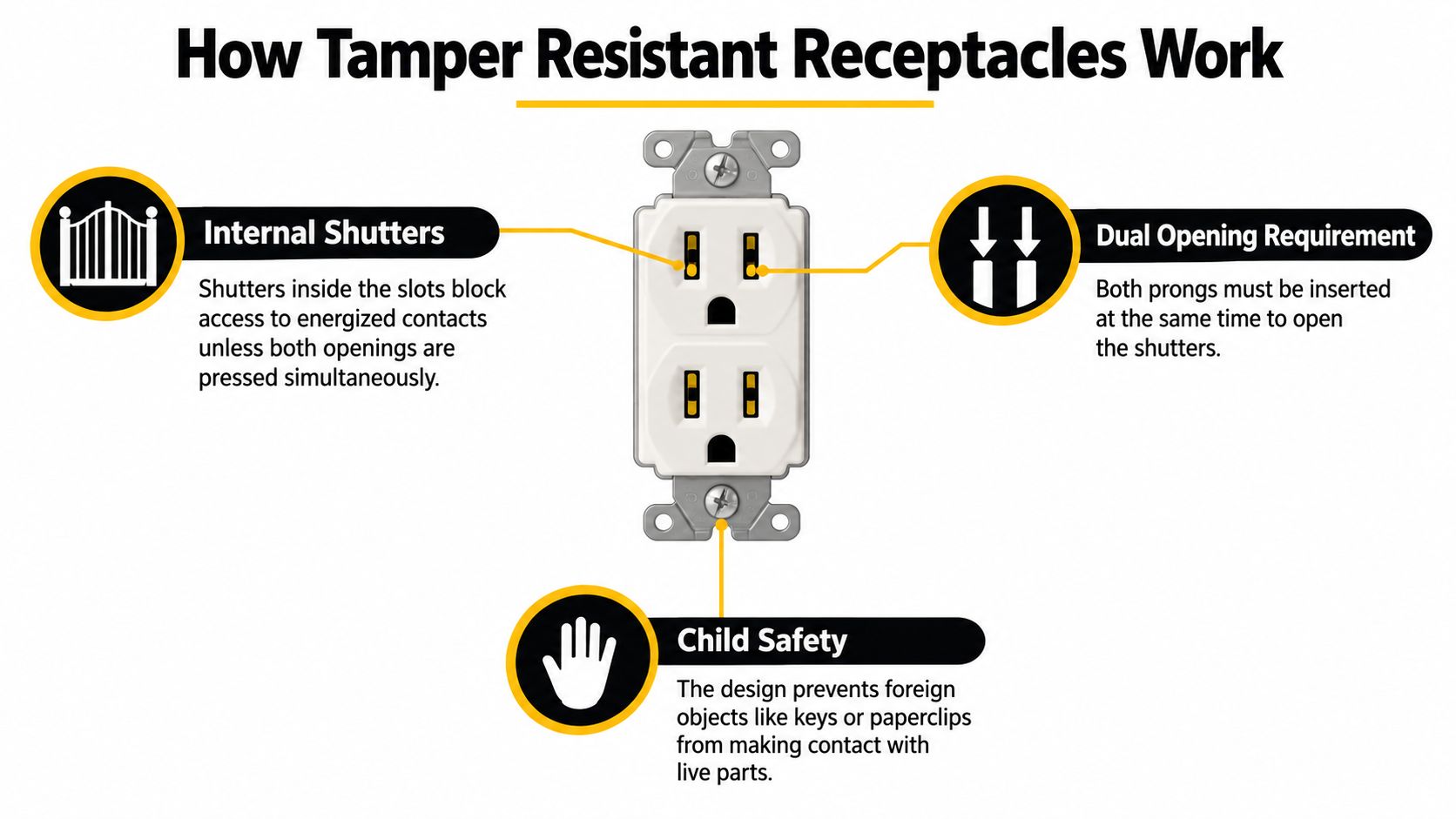
A tamper-resistant receptacle contains internal shutters behind the plug openings. The shutters limit access to energized contacts unless matching plug blades engage both openings together, rather like a safety gate that needs the correct key.
The design addresses a documented injury problem. Analysis of federal consumer-safety data identified more than 24,000 emergency-room-treated receptacle injuries among children age 10 or younger from 1991 through 2001, as described in this municipal explanation of tamper-resistant receptacle safety. The same document explains the residential requirement introduced in the 2008 NEC, which moved protection into the receptacle rather than relying on removable outlet caps.
Built-in protection still needs a sound device
Listing matters because the shutter must continue working after repeated use and physical stress. Published technical coverage of UL 498 testing describes 5,000 plug insertion-and-withdrawal cycles, followed by checks that the receptacle still accepts a plug and prevents probe access to energized contacts.
- Identification matters: Installers look for the manufacturer's TR or Tamper Resistant marking, not just something visible behind the slots.
- Condition matters: A cracked face or unreliable mechanism shouldn't be accepted merely because the device was originally listed.
- Normal use matters: A plug that won't seat normally needs evaluation, not extra force.
Practical rule: Tamper-resistant means restricted access to the contacts. It doesn't mean shockproof.
Grounding, correct wiring, a suitable cover plate, and other required protection remain separate parts of a safe installation. The shutters are a protective feature, not permission to ignore the rest of the electrical system.
Where TR Receptacles Apply in Dwellings
The room name helps organize an inspection, but it doesn't settle every outlet's status. A bedroom wall receptacle and a receptacle behind fixed equipment can need different analysis even though both belong to the same dwelling.
The government electrical inspection checklist addressing the 2023 NEC describes broad dwelling coverage, including garages, accessory buildings, and common areas, while recognizing specific exceptions. It's useful model-code guidance, not evidence that a Northern Utah jurisdiction has adopted that exact edition.
Room and scenario applicability
| Area or scenario | Typical TR relevance | Key exception or check | Who confirms |
|---|---|---|---|
| Bedrooms, family rooms, dining rooms, dens, and recreation rooms | Ordinary dwelling receptacles generally fall within coverage | Device configuration and any applicable exception | Electrician, with inspector interpretation |
| Kitchens | General-use dwelling receptacles are relevant | An appliance location isn't automatically exempt | Electrician and inspector |
| Attached or detached garages | Included in broad dwelling-related coverage | Equipment use alone doesn't establish an exception | Electrician and inspector |
| Exterior dwelling spaces | Outdoor placement shouldn't be treated as an automatic exclusion | Applicable dwelling coverage and separate outdoor requirements | Electrician and inspector |
| Accessory buildings and common areas | Can fall within covered locations | Building use and occupancy classification | Local authority |
| High-mounted receptacles | A height exception may apply | More than 5½ feet above the floor, under the cited checklist | Electrician and inspector |
| Dedicated appliance locations | Certain installations may qualify for an exception | Whether the appliance is not readily movable and the exception's conditions are satisfied | Electrician and inspector |
| Receptacles integral to luminaires | May qualify for an exception | Whether the receptacle is actually part of the luminaire | Electrician and inspector |
A receptacle behind a refrigerator, for example, shouldn't be labeled exempt solely because an appliance sits in front of it. The electrician needs to evaluate the actual installation against the exception's wording.
A room-by-room inventory is useful. A room label alone isn't a compliance decision.
For landlords and remodelers, reviewing electrical inspection failure causes can help keep the conversation broader than the outlet face. The device, its location, and the surrounding installation all deserve attention.
TR GFCI and AFCI Devices Compared
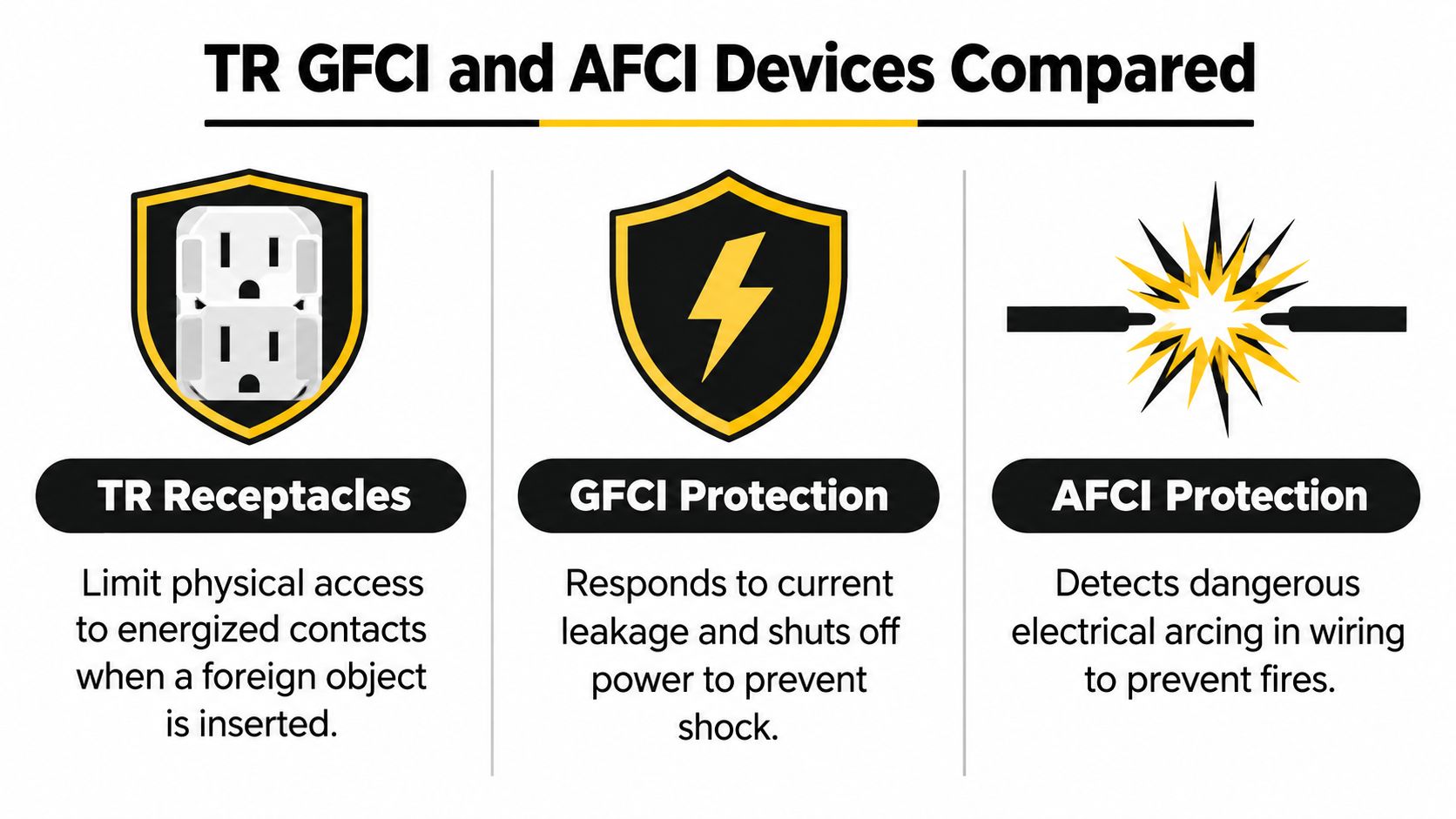
TR, GFCI, and AFCI describe different protective functions. Selecting a device by its appearance or familiar initials can leave the wrong hazard addressed.
Tamper resistance concerns physical access to energized contacts. Ground-fault circuit-interrupter protection responds to current leakage associated with shock hazards, while arc-fault circuit-interrupter protection addresses dangerous arcing conditions associated with electrical fires.
Protection function matrix
| Device or feature | Primary hazard addressed | What it does not replace | Reader decision |
|---|---|---|---|
| TR receptacle | Foreign-object access to energized contacts | Ground-fault or arc-fault protection, grounding, or correct wiring | Confirm whether the location requires a listed TR device |
| GFCI protection | Shock hazards associated with current leakage | Tamper resistance or arc-fault protection | Have the applicable shock-protection requirement evaluated separately |
| AFCI protection | Dangerous electrical arcing associated with fire risk | Tamper resistance or ground-fault protection | Have the circuit's arc-protection needs checked |
The distinction between tamper resistance and ground-fault protection is also addressed in the dwelling inspection guidance cited earlier. Neither feature should be treated as a substitute for the other.
A kitchen replacement illustrates the decision without establishing a blanket location rule. If the adopted requirements call for both TR and GFCI protection, choosing only a TR receptacle doesn't complete the job. Likewise, a test button doesn't establish that a device has tamper-resistant shutters.
The related explanation of what's the difference between GFCI and AFCI provides further background for discussing circuit protection. For coordination with a broader interior project, electrical planning insights from Interiors by DeX can be treated as a planning resource, not a substitute for electrical code interpretation.
The practical purchasing decision should follow the electrician's assessment. A familiar-looking replacement isn't necessarily the correct replacement.
How Remodels and Replacements Change the Analysis
An older property shouldn't be evaluated through either extreme: replace every outlet immediately, or leave every existing outlet untouched. The important question is what the proposed work triggers.
A new addition, an altered circuit, and replacement of a damaged receptacle aren't identical scopes. Receptacle replacement can invoke current requirements, so describing work as “like-for-like” doesn't settle the code question.
Separate the existing installation from the proposed change
For a basement remodel, the electrician should identify the new receptacle locations and the circuits being altered. For an isolated damaged-device replacement, the review may be narrower, but the replacement still needs to meet the applicable rules. Neither situation justifies assuming that every untouched receptacle elsewhere must automatically change.
Partial commercial and multifamily renovations deserve particular care. The government summary of significant 2023 NEC changes identifies expanded or clarified coverage involving fitness centers, residential-care settings, rehabilitation facilities, group homes, and publicly accessible agricultural-building areas. A public-facing space shouldn't be evaluated using residential-only advice.
- New work: Establish the intended occupancy and installation requirements before rough-in.
- Replacement work: Confirm the required device rather than copying the removed device's features.
- Changed use: Flag a converted common room, public waiting area, or other occupancy change during planning.
- Permit scope: Ask which existing conditions the alteration requires the inspector to review.
Keep a useful replacement record
A practical maintenance record should identify the location, device type, voltage and amperage rating, listing identification, circuit protection, and reason for replacement. The electrician can supply details that aren't safely observable from the room.
The Cabinet Coach's pre-contractor preparation advice is a separate planning resource for organizing a renovation before hiring decisions. Electrical scope should likewise be written down early, including added outlets, dedicated circuits, and common-area changes, rather than left until finish work is underway.
Plan the Outlet Upgrade Before Work Begins
Consider a homeowner planning new kitchen finishes and a landlord arranging a garage receptacle replacement. Both projects involve outlets, but neither should begin with a shopping list based only on matching colors and faceplates.
A useful estimate starts with the location, the proposed change, and the existing installation. The local-adoption discussion in the trade association's history of tamper-resistant requirements reinforces why the applicable code edition and exceptions need confirmation rather than assumption.
Questions for the planning conversation
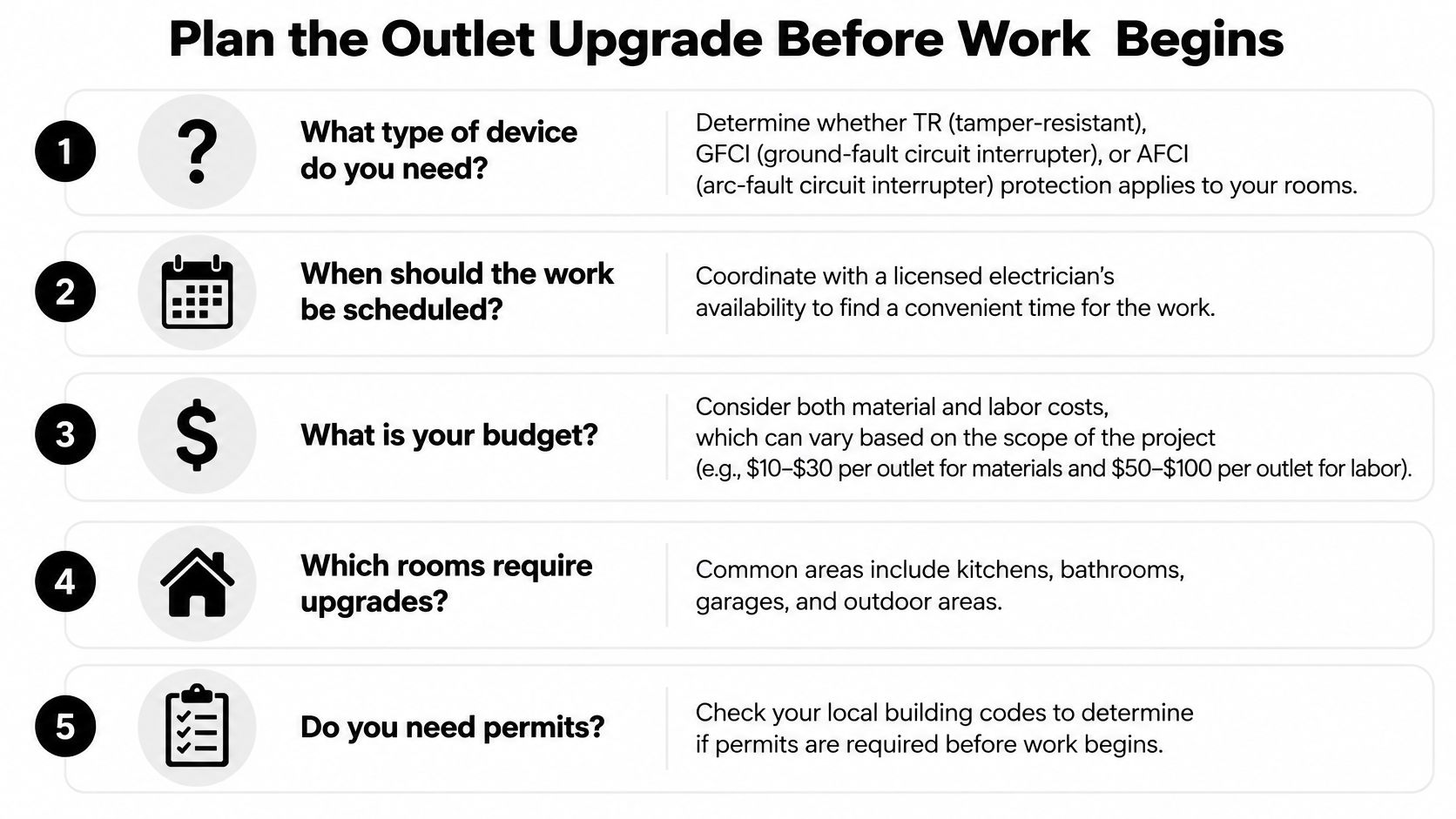
- Applicable rules: Which Utah code edition and amendments govern, and is a permit required?
- Location and occupancy: Is the receptacle in a dwelling, garage, common area, educational facility, healthcare setting, or public-facing space?
- Existing device: Is its listing identifiable, and is its condition acceptable?
- Work scope: Will the project change the circuit, device rating, box fill, or number of receptacles?
- Protection: Which functions need evaluation for the proposed installation?
Cost depends on scope, not just the receptacle. Device type, quantity, accessibility, box condition, wiring changes, and permit or inspection coordination are useful items to separate in an estimate.
Planning insight: A clearly defined outlet scope makes estimates easier to compare than a request to replace “some plugs.”
Black Rhino Electric pricing for outlets provides related estimating context. A project-specific assessment is still needed before assigning a price or deciding whether circuit corrections belong in the same scope.
What an Electrician Checks During the Service Visit
A professional visit should establish what is installed, whether it's sound, and what the proposed work requires. The inspection may extend beyond the receptacle face to the box, wiring, grounding, and circuit protection, with electrical access and testing left to the electrician.
The electrical safety foundation's guidance on TR receptacles explains the importance of appropriate identification and intact protection. It also supports taking a problematic device out of service rather than forcing a plug or testing the shutters with an object.

Safe observations and professional checks
Homeowners can observe the receptacle from outside without dismantling it. A visible TR mark, cracks, discoloration, or an obviously loose face can be reported during scheduling; nobody should deliberately touch a suspect device to check its temperature.
- Electrician's review: Device identification, condition, shutter operation, normal plug fit, and applicable location requirements.
- Installation review: Box condition, conductor connections, grounding, and required circuit protection.
- Homeowner boundary: No cover removal, box opening, slot probing, or contact with energized conductors.
Stop-and-call conditions
An outlet that is warm, damaged, buzzing, discolored, arcing, or causing shocks shouldn't remain in use. A plug that won't insert normally is also a reason to stop, not apply more pressure. A qualified electrician should inspect the circuit before the affected outlet returns to service.
For unclear symptoms, professional electrical troubleshooting is a more appropriate next step than buying a replacement and assuming the device alone caused the problem.
Black Rhino Electric provides outlet work, electrical troubleshooting, and remodel electrical services across Northern Utah, including Weber, Davis, and Salt Lake counties. Homeowners, landlords, and remodelers can call 385-396-7048 or request a quote to discuss receptacle locations, replacement scope, and the protection their project needs.