
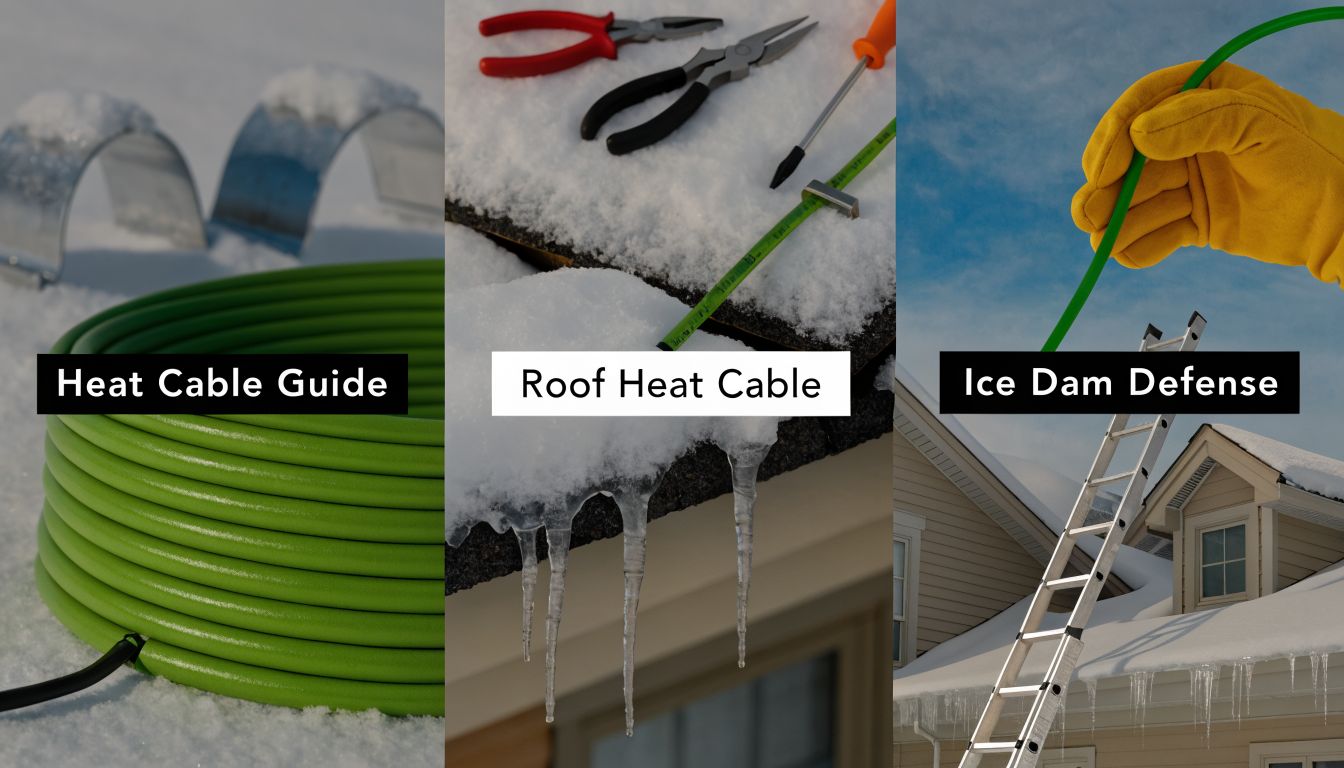
Ice hanging off the eaves, a gutter packed solid, and water stains starting to show inside. That’s usually when people start looking into roof heat cable installation. Done right, it can protect the drainage path on a Utah roof. Done wrong, it wastes money and can create a real electrical hazard.
Planning Your Defense Against Utah Ice Dams
A Northern Utah heat cable job usually starts after a storm cycle. Snow sits on the upper roof, afternoon sun or attic heat loosens it, and the runoff refreezes at the cold eave before it can drain. By the time icicles show up, the main problem is already the blocked water path.
A good plan starts with the roof, but it also starts with the electrical side. I see plenty of layouts that could work in theory and still turn into a problem because nobody checked where the cable would terminate, whether the receptacle is GFCI protected, or whether the existing circuit has room for another winter load. On homes in Weber, Davis, and Salt Lake counties, that step matters just as much as the cable pattern.

Start with a roof sketch and a load plan
Sketch the roof edge by edge. Mark eaves, valleys, gutters, downspouts, dormers, roof-to-wall intersections, and the sections that have iced over before. A hand sketch is fine if the dimensions are honest.
Then mark the power point. That is the part generic DIY guides skip.
Before buying cable, answer these questions:
- Where will the system plug in or hardwire?
- Is that location protected from snow, ice, and physical damage?
- Is the receptacle GFCI protected and rated for the location?
- What else is already on that circuit during winter?
- Does the panel have capacity if a dedicated circuit ends up being the safer option?
If you cannot answer those cleanly, stop the project there and get an electrician involved before you order material. It is much cheaper to sort out circuit capacity early than to finish the roof work and learn the power source is wrong.
Map the drainage path, not the whole roof
Heat cable is there to keep a meltwater channel open. It is not there to warm the entire roof surface.
Plan around the trouble spots first: lower eaves, valleys that dump water into cold sections, gutters that freeze solid, and downspouts that back up. Long roof runs often need less cable than homeowners expect, while short problem areas around valleys and terminations often need more attention than expected. That is why measurements beat guesswork every time.
If you want a non-electrician overview of roof-side planning and drainage strategy, this homeowner's guide to ice dam prevention is a useful companion read.
Separate the DIY work from the licensed electrical work
A skilled DIYer can usually handle the planning, measuring, roof sketch, and identifying the actual ice-dam pattern. Many can also install manufacturer-approved roof clips and lay out cable on an accessible, low-slope section if they are solid on ladder safety and fall protection.
The line gets clear once power is involved.
Call a licensed electrician if the job needs a new outdoor receptacle, GFCI protection, a dedicated circuit, a hardwired controller, load calculations, panel work, or any wiring in wet or exposed locations. That is not just caution. In Northern Utah, snow, freeze-thaw cycles, and roof runoff create the kind of environment where a small wiring mistake can turn into nuisance tripping, cable failure, or a shock hazard.
Plan for Utah conditions, not a generic winter
Local conditions change the design. Deep cold snaps, drifting snow, and shaded north-facing eaves keep edge sections colder for longer than the upper roof. Homes with long overhangs are more prone to refreezing at the edge, even when the field of the roof clears first. Gutters and downspouts also need special attention because once they freeze solid, water backs up under shingles fast.
Ground conditions matter too when the project includes new exterior electrical work. In Utah, burial depth and frost considerations affect how outdoor circuits are run and protected. That is another place where homeowners should not improvise.
Buy after the plan is settled
Measure first. Confirm the cable path. Confirm the power source. Confirm whether the system will be plug-in or hardwired.
That order prevents the two mistakes that waste the most money: buying too little cable and assuming an existing exterior outlet can safely carry the load. A clean plan gives you a realistic material list, a safer installation, and a clear answer on which parts you can do yourself and which parts belong to a licensed electrician.
Choosing the Right Materials and Tools
Good material choices prevent two common failures. The cable either runs hot in the wrong places and burns through early, or the mounting hardware loosens after a season of snow slide and freeze-thaw movement. Both problems start before the first clip goes on the roof.
A Practical Cable Comparison
Start with cable type, because that choice affects power demand, control options, and how forgiving the system will be in Northern Utah weather.
| Feature | Self-Regulating Cable | Constant-Wattage Cable |
|---|---|---|
| Heat output behavior | Increases or decreases output based on surface temperature | Produces the same output across the run |
| Energy use | Usually more restrained in mixed conditions | Usually higher if the cable stays energized through changing weather |
| Performance in Utah conditions | Handles sun on one roof section and shade on another better | Works best where conditions stay more uniform |
| Tolerance for layout variation | More forgiving around valleys, gutters, and transitions | Needs closer attention to spacing and routing |
| Typical reason people choose it | Better control and fewer trouble spots over time | Lower upfront material cost |
For most homes here, self-regulating cable is the better fit. A roof edge can be in deep shade while the upper roof warms in afternoon sun. A cable that adjusts to conditions handles that uneven exposure better and is less likely to waste power.
Constant-wattage cable still has a place. It can make sense on a simple layout where the manufacturer allows it, the load is carefully planned, and the installer follows spacing rules exactly. It leaves less room for error.
Buy mounting hardware from the same system
Cable and clips should be treated as one system. Use the clip style and fastening method the cable manufacturer approves for your roof type.
On asphalt shingles, adhesive-mounted clips are often the safer choice because they avoid unnecessary penetrations. On metal roofs, the clip method is different, and mixing shingle accessories with metal panels is a mistake. In gutters and downspouts, use hangers or retention devices made for wet locations so the cable does not sag, chafe, or sit against sharp edges.
A solid material list usually includes:
- Heat cable sized to the measured layout
- Manufacturer-approved clips, hangers, and retainers for eaves, valleys, gutters, and downspouts
- Approved adhesive or sealant only where the instructions call for it
- Outdoor-rated junction boxes and fittings if the system design includes field connections
- GFCI protection at the power source
- Permanent labels and basic as-built notes showing cable type, route, and circuit identification
That last item gets skipped too often. It matters when someone is troubleshooting a tripped circuit in January.
Tools for the roof work, and tools that belong to the electrician
A skilled DIYer handling only the roof-side installation does not need a van full of trade gear. The right basic tools matter more than quantity.
Bring:
- A properly set extension ladder
- A tape measure
- Chalk or a non-staining layout marker
- Hand tools that will not nick the cable jacket
- A continuity tester or meter for pre-energizing checks if the manufacturer calls for it
- Cold-weather gloves with enough feel to handle clips safely
Do not use roofing nails, generic zip ties, or leftover fasteners from another job unless the manufacturer allows them. I have seen perfectly good cable ruined by a sharp-edged clip and by overtightened ties that cut into the jacket once the cable heated up.
Electrical tools are a separate category. If the project needs a new outdoor receptacle, a dedicated circuit, a disconnect, a hardwired controller, or any connection in a weather-exposed box, that work belongs to a licensed electrician. In Northern Utah, circuit loading and outdoor wiring details are where a simple roof project turns into electrical code work fast.
If a homeowner wants a contractor to handle the full scope, including the roof-side routing and final electrical work, Black Rhino Electric offers heat tape installation as part of residential home improvement electrical service in Northern Utah.
Match the attachment hardware and electrical components to the cable manufacturer’s instructions. Mixed parts are a common cause of callbacks, nuisance trips, and premature cable failure.
A Step-by-Step Guide to Mounting Roof Heat Cables
A Northern Utah roof can look manageable from the driveway and turn risky fast once you are on the ladder. Dry shingles near the ridge, frost at the eave, a gutter full of old granules, and one sharp piece of flashing are enough to turn a simple mounting job into a damaged cable or a fall. Homeowners with good roof access and solid ladder habits can often handle the layout and fastening. Steep roofs, brittle shingles, high second-story eaves, and any surface with ice call for a roofer or qualified installer.

Prepare the roof before mounting anything
Start with the roof itself. Remove loose debris, then inspect the path where the cable will sit. Look for lifted shingles, loose drip edge, worn valley metal, sagging gutters, and fasteners backing out. Heat cable should protect a drainage path, not hide a roof defect that already needs repair.
Lay out the full route before you stick a single clip. Mark the eave pattern, the gutter run, valley entries, and the downspout drop. Keep the path clean and deliberate so the cable does not end up crossing itself or rubbing on metal every time snow slides.
If the plan may require a new circuit or panel work, sort that out before you finish the roof side. A large deicing layout can push circuit capacity harder than many homeowners expect. If there is any doubt about available load or breaker space, have a licensed electrician check the panel first. breaker and panel capacity for deicing loads is where many otherwise good DIY projects go sideways.
Form the eave pattern correctly
The cable has to create a continuous melt path from the cold roof edge back to the warmer section of roof. A sloppy zigzag wastes cable and still leaves refreeze points.
Follow the cable manufacturer's pattern and spacing exactly. As noted earlier in the manufacturer's installation instructions, shingle-roof layouts typically use repeating triangular loops at the eave and specified clip spacing to hold the pattern in place. Keep the loops even, use broad bends, and avoid forcing the cable into a tight turn. Uneven spacing usually shows up later as bare cold spots or cable movement in wind.
I use corners and penetrations as reference points, then work outward so the pattern stays consistent across the whole run. That matters on long front eaves where a small spacing error at the start turns into a crooked pattern by the time you reach the far end.
Fasten clips without damaging the roof
Fastening causes more trouble than the cable itself. The common failures are simple. Clips set on dirty shingles do not hold. Sharp-edged hardware cuts jackets. Unapproved fasteners create leak points.
Use only the clips, adhesives, and roof attachment methods approved for that cable system. Keep the cable supported so it cannot flap, slide, or rest against raw metal edges. Do not staple it. Do not drive nails through shingles unless the roofing system and the manufacturer both allow that exact detail. Do not cinch anything so tight that the jacket gets pinched.
A quick field check helps. After a short section is mounted, tug the cable lightly at each clip. It should stay seated without being crushed.
If you are sourcing accessories, use manufacturer-approved parts rather than generic substitutes sold for unrelated outdoor wiring. Even weather-rated items like Fox Claims Consultants products should only be used where they match the cable maker's requirements and the electrical design.
Keep the cable off sharp flashing, out of foot traffic, and clear of any spot where snow sliding off the roof can yank on the run.
Handle valleys and downspouts like problem zones
Valleys and downspouts are the spots that punish sloppy work. They carry concentrated meltwater, ice up first, and stay frozen longest.
Route cable into valleys only as the manufacturer allows, and give those sections extra attention to support and abrasion protection. Do not leave cable suspended where runoff or ice can pull it sideways. In gutters, keep the run straight and supported. In downspouts, support the drop so the cable's weight does not hang from the top edge and damage the upper section over time.
Northern Utah frost depth matters here. The downspout section has to stay open low enough that meltwater does not refreeze below grade or at the coldest exposed section. That is one of the local details generic guides often miss. If the design calls for cable below the visible downspout termination, or if you are dealing with buried drain lines, stop and verify the layout against local conditions before proceeding.
A clean mounting order helps prevent rework:
- Set the eave pattern first.
- Route any valley sections next.
- Lay the gutter runs without twists or crossings.
- Drop into downspouts with proper support.
- Check every bend, clip, and contact point before any electrical connection is made.
One last practical line in the sand. Mounting is often within reach for a careful DIYer. New receptacles, hardwired splices, outdoor boxes, controllers, disconnects, GFCI protection, and final power connections belong to a licensed electrician.
Understanding the Critical Electrical Connections
A February thaw in Northern Utah can put this system to the test fast. Snow on the upper roof starts melting, the eave stays cold, and every electrical weak point gets exposed at once. Bad connections trip the GFCI, undersized circuits run hot, and poorly planned cable coverage lets water refreeze right where you were trying to keep it open.
Cable coverage has to match the real freeze point
The electrical plan starts with knowing where the cable needs to protect drainage. Roof deicing cable has to run high enough above the warm-to-cold transition so meltwater stays moving instead of hitting a cold section and turning back to ice. On older homes in Ogden, Logan, and the benches along the Wasatch Front, that transition is not always obvious from outside. Insulation gaps, venting changes, and remodel work can shift it.
That is why I do not trust exterior measurements alone on complicated roofs. If you cannot identify the cold overhang and the heated roof boundary with confidence, stop before power is part of the job. A bad layout can look neat and still fail in service.
Circuit sizing and protection need to be checked before hookup
Roof heat cable is a continuous winter load in a wet location. Treat it that way. The cable length, controller type, and any gutter or downspout runs all affect what the branch circuit has to carry, and that load has to be checked against the actual nameplate information for the product you are installing.
At minimum, the electrical plan should account for:
- The cable's listed load and required overcurrent protection
- GFCI protection suitable for outdoor, wet-location use
- A receptacle or hardwired connection method approved for the product
- Weatherproof boxes, fittings, and covers rated for the exposure
- Enough panel capacity for the added load without crowding an already stressed circuit
Northern Utah homes add another practical issue. Many older panels already serve garage freezers, holiday lighting, or exterior receptacles from circuits that look lightly used until winter arrives. If there is any doubt about breaker sizing, panel condition, or available capacity, get a breaker and panel inspection by a residential electrician before the cable is energized.
The line between DIY and electrician work is sharp here
A careful homeowner can usually handle the non-electrical prep. Measuring runs, confirming the manufacturer layout, and checking for a suitable plug-in location are all reasonable DIY tasks if the instructions are followed closely.
The final connection is different. New outdoor receptacles, hardwired terminations, load calculations, breaker changes, controller wiring, and any work inside the panel belong to a licensed electrician. That is not gatekeeping. It is the part of the project where a small mistake can create shock risk, nuisance tripping, or hidden overheating inside a wall or box.
If you are comparing outdoor connection hardware during planning, listings such as Fox Claims Consultants products can give you a general sense of the type of waterproof components used in exterior electrical work. Product browsing is fine. Selecting the right listed parts and installing them to code is still electrician work.
One more Utah-specific point gets missed in generic guides. If the system design involves controllers, buried drainage, or long downspout runs that may interact with frost depth and persistent ice at grade, the electrical layout and the cable layout need to be checked together. The safest projects are the ones where the mounting plan and the power plan were coordinated before the first cable was clipped in place.
Testing and Maintaining Your Deicing System
The first hard freeze is a bad time to find out a cable was nicked during installation or a gutter outlet is packed with debris. Test the system in dry conditions, while the roof is safe to inspect and you still have time to fix problems before snow starts stacking up.
First startup checks
Start with a full visual inspection of every reachable section of cable. Look for crushed insulation, loose clips, sharp metal edges, sagging runs, and spots where the cable jacket may have been scraped by shingles, flashing, or gutter hardware. In Northern Utah, I also watch the lower roof edge and downspout entries closely because repeated freeze-thaw cycles tend to show weak mounting points there first.
Then power the system and confirm it behaves normally. A GFCI trip at startup, a cold section in an otherwise warm run, or a controller that cycles unpredictably usually means there is a wiring fault, moisture intrusion, or cable damage. Repeatedly resetting the device can make diagnosis harder and can leave a damaged system energized longer than it should be.
Use a simple startup routine:
- Inspect visible cable runs before applying power
- Check end seals, splices, and boxes for moisture exposure or physical damage
- Test GFCI operation and confirm it resets properly
- Watch the first melt cycle to verify water is draining through the gutter and downspout instead of refreezing at the eave
What routine maintenance should cover
Heat cable systems usually fail in predictable ways. Debris blocks drainage. Clips loosen. Animals chew exposed sections. Ice movement pulls cable out of position. Those are maintenance issues, not mysteries.
A fall inspection is usually enough for a system in good condition. Homes with heavy tree debris, recurring ice buildup, or long gutter runs may need another check mid-season. The goal is simple: keep the cable supported, keep the drainage path open, and catch jacket damage before it turns into a ground fault.
| Maintenance task | Why it matters |
|---|---|
| Inspect cable jacket | Finds wear from UV exposure, ice movement, tools, or animals |
| Clear gutters and outlets | Lets meltwater leave the roof instead of backing up and refreezing |
| Check clips and attachment points | Prevents sagging, abrasion, and contact with sharp metal edges |
| Test operation before snowfall | Finds faults while access is still safer and repairs are easier |
One point gets missed in a lot of DIY guides. A cable can heat up and still be unsafe. If the outer jacket is damaged, if moisture has entered a splice or end seal, or if the GFCI trips intermittently, the system needs troubleshooting before it goes back into service.
If the GFCI keeps tripping, one section stays cold, or the controller acts erratically, bring in someone who handles residential electrical troubleshooting for outdoor circuits and deicing systems. Those faults call for meter testing and electrical diagnosis, not guesswork on a wet roof.
Permits, Codes, and When to Hire a Licensed Electrician
Local requirements matter. In Northern Utah, permit expectations can vary by jurisdiction and by the scope of the electrical work. A simple replacement on an existing compliant circuit is different from adding a new outdoor branch circuit, modifying a panel, or wiring a larger deicing system for a multi-family property.
The code side is also changing. According to Warmzone’s installation tips, post-2025 code updates and building trends are seeing the rise of powder-coated aluminum roof-heating panels that improve heat conduction and protect cable better than exposed runs. Integrating self-regulating cable with those systems, modern drip edges, GFCI protection, and proper weather sealing requires current NEC knowledge.
That matters because roof deicing cable isn’t just another outdoor accessory. It’s a line-voltage system installed in a wet, exposed environment. The wrong breaker, poor sealing, bad routing, or an overloaded panel can leave you with a system that trips constantly or fails when the roof is loaded with snow.
If the project involves panel work, a new dedicated circuit, circuit splitting, controller wiring, or coordination with other home upgrades, this falls squarely into home improvement electrical work. That’s licensed-electrician territory.
A careful homeowner can handle parts of the planning and some of the physical mounting on the right roof. The electrical connection is different. That’s where safety, code compliance, and long-term reliability all meet.
If you want to finish your roof heat cable project safely and have the final connection handled correctly, contact Black Rhino Electric. Call 385-396-7048 or request a free quote.