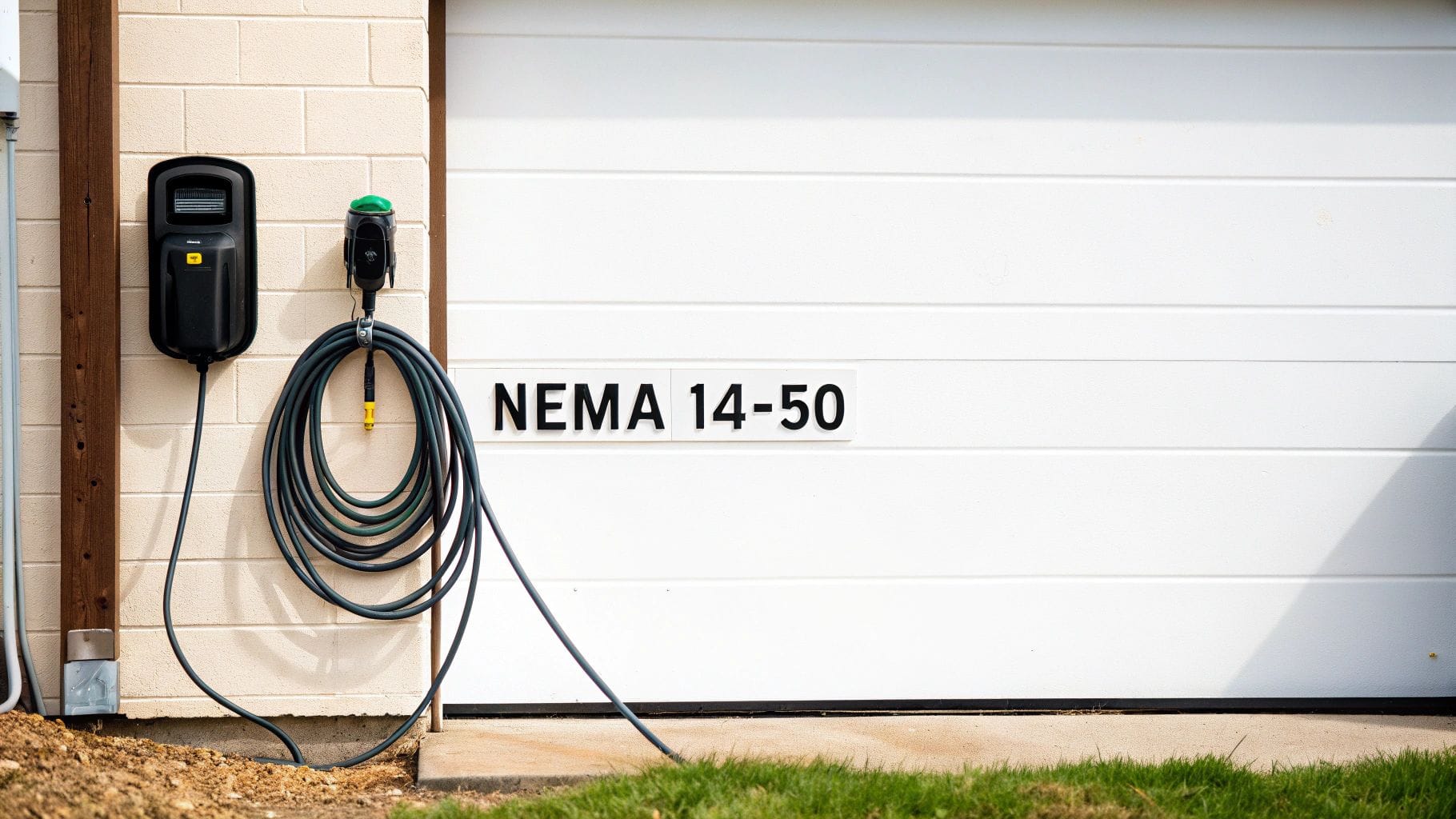
Stepping into the world of electric vehicles is exciting, but are you prepared for charging at home? For a truly seamless experience, the NEMA 14-50 outlet for ev charging is a game-changer. This simple upgrade transforms your garage into a personal, high-speed charging station, ensuring your car is ready to go whenever you are.
The Smarter Way to Charge Your EV at Home
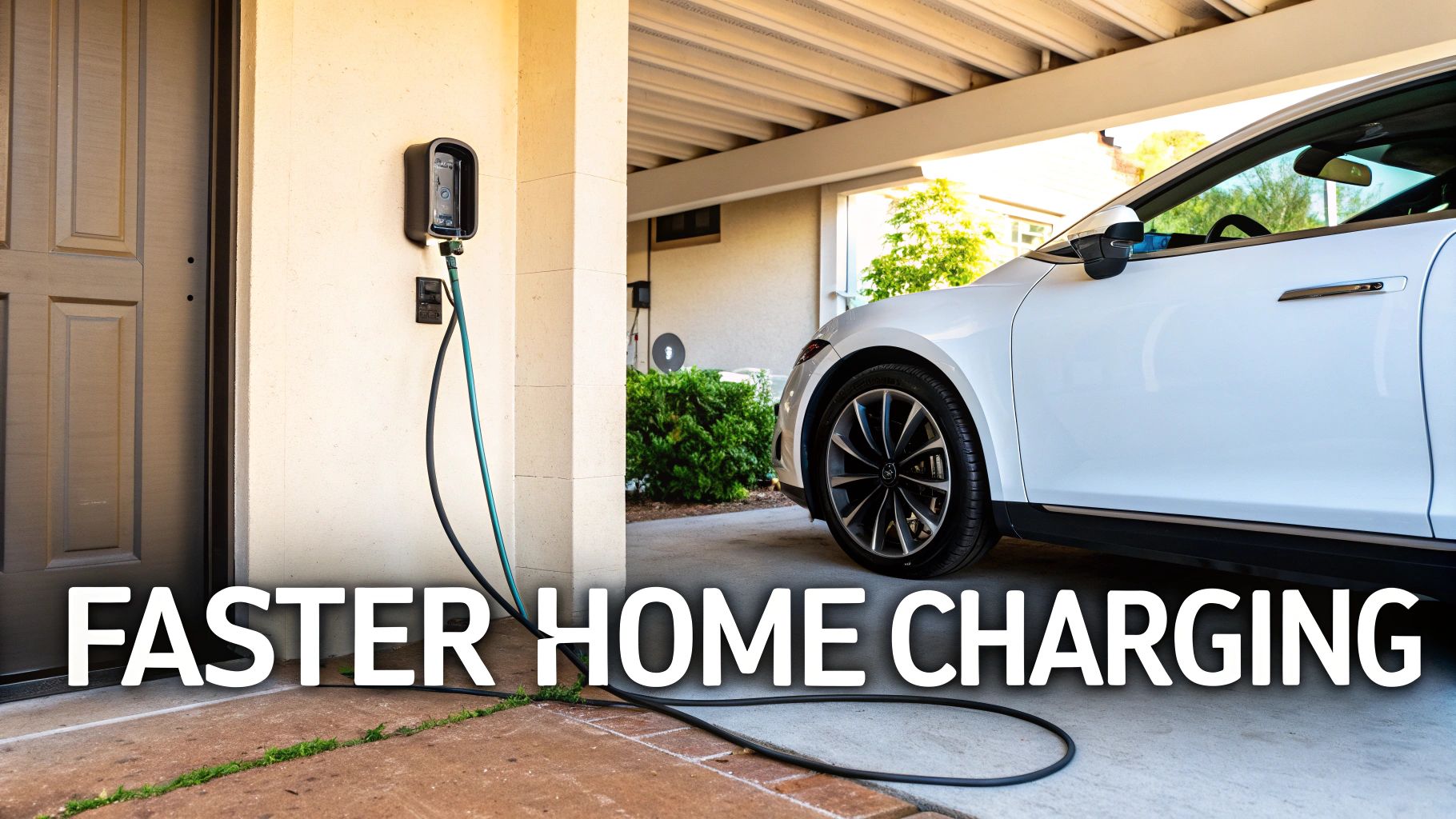
Here’s the thing: a NEMA 14-50 outlet dramatically slashes your charging time, making sure your electric vehicle is actually ready for the road when you need it. Think of it as upgrading from a slow garden hose trickle of power to a steady, efficient flow from a fire hose. This installation, handled by our experienced electricians at Black Rhino Electric, completely transforms how you manage your daily driving, turning "charge anxiety" into a thing of the past.
Breaking Down the NEMA 14-50 Outlet
So, what’s the big deal with the NEMA 14-50 outlet for EV charging? Think of it as the supercharged cousin to the standard outlet you use for your phone. It was originally designed for heavy-duty appliances like electric ranges and RVs, and that high-power DNA is exactly what makes it perfect for the long, steady energy draw an EV needs.
This isn’t your average receptacle. As seasoned professionals, we know it’s a robust power delivery system built for serious work. Let me explain the secret behind its electrical specs.
The Technical Specs in Plain English
A NEMA 14-50 outlet is a 240-volt receptacle. That’s double the voltage of a standard household outlet, and it’s the key difference. Higher voltage lets it push significantly more power into your car's battery in the same amount of time.
It’s installed on a 50-amp circuit, but for safety, the National Electrical Code (NEC) limits continuous loads like EV charging to 80% of the circuit's max rating. In simple terms, this means your EV charger will safely pull up to 40 amps.
This combo of 240 volts and 40 amps delivers up to 9.6 kilowatts (kW) of power. That’s the magic number that unlocks true Level 2 charging speeds at home, turning a painfully slow process into a simple overnight routine.
The NEMA 14-50 has become the go-to for Level 2 EV charging in homes all over North America. This setup is ideal for overnight charging, adding about 30 miles of range per hour to most EVs—a total game-changer for daily commuters. It's no surprise that projections show the U.S. will need 28 million charging ports by 2030, and a massive 92% of those are expected to be private Level 1 and 2 chargers at home.
Why It's the Standard for Flexible Charging
Okay, so why this specific outlet over other 240-volt options? The answer is its four-prong design: two "hot" wires, a ground, and a neutral wire. This four-wire setup makes it more versatile than older three-prong outlets (like the NEMA 6-50) that skip the neutral wire.
You know what? That versatility is a huge benefit. It means the 14-50 is not only perfect for a huge range of portable EV chargers but also for RVs, making it a common sight at campsites and a flexible, future-ready choice for your garage. This widespread use has cemented its status as the default plug for powerful, non-permanent EV charging.
The table below really drives home just how massive the speed difference is.
NEMA 14-50 vs. Standard Outlet Charging Speed
When you plug in your EV, the outlet you choose makes all the difference between waking up to a full battery or just a handful of extra miles. Here’s a side-by-side look.
| Feature | NEMA 14-50 Outlet (Level 2) | Standard Household Outlet (Level 1) |
|---|---|---|
| Voltage | 240 Volts | 120 Volts |
| Max Power Delivery | Up to 9.6 kW | Approximately 1.4 kW |
| Charging Speed | ~30 miles of range per hour | ~3-5 miles of range per hour |
| Typical Full Charge Time | 4-8 hours (depending on EV model) | 24+ hours |
| Best For | Convenient overnight charging & daily use | Emergency or occasional top-ups |
As you can see, the NEMA 14-50 is in a completely different league. It transforms your garage into a personal fueling station, ensuring your car is ready to go every morning.
Critical Factors for a Safe Installation
Honestly, installing a NEMA 14-50 outlet for EV charging involves much more than just picking a spot on your garage wall. Several critical electrical requirements must be met to ensure a safe, reliable, and code-compliant setup. Think of this as the essential pre-flight checklist for your home's power system—a process our team at Black Rhino Electric has mastered.
Before we even talk about outlets, we have to look at your home's main electrical panel. The big question is: can it handle the new load? Let me explain what that means.
Assessing Your Electrical Panel Capacity
Your home's electrical panel is like the heart of its power system, with a finite capacity to pump electricity throughout your house. Adding a 50-amp circuit for an EV charger is a significant new demand—it's like adding a whole new appliance. A licensed electrician will perform what’s called a "load calculation" to determine if your existing service—typically 100, 150, or 200 amps—has enough spare capacity.
If your panel is already close to maxed out from your HVAC, water heater, and other appliances, adding another 50-amp circuit could push it over the edge. This can lead to frequently tripped breakers or, in a worst-case scenario, a dangerous overload of your main service. For more details, you can learn about the importance of properly sized breakers and panels to see why this step is non-negotiable. It's not uncommon for an older panel to need an upgrade to safely accommodate an EV charger.
Choosing the Right Wire Gauge and Breaker
Once we've confirmed the panel can handle it, the next step is selecting the correct hardware for the circuit itself. This isn't a place to cut corners, as using undersized components is a major fire hazard.
- Wire Gauge: For a 50-amp circuit powering a NEMA 14-50 outlet, the standard is 6-gauge copper wire. Using a smaller wire (like 8-gauge) would be like trying to send a river's worth of water through a garden hose. The wire will overheat, melt its protective insulation, and create a serious risk of fire.
- Circuit Breaker: This circuit must be protected by a 50-amp double-pole circuit breaker. This type of breaker connects to both "hot" wires in your panel to deliver 240 volts. Its job is to trip and cut power instantly if it detects an overload or short circuit, protecting the entire line.
GFCI Protection and Outlet Location
Modern electrical codes have evolved to enhance safety, especially for EV charging. The National Electrical Code (NEC) now requires GFCI (Ground Fault Circuit Interrupter) protection for NEMA 14-50 outlets installed in locations like garages.
A GFCI breaker is designed to protect you from electric shock. It instantly shuts off power if it detects an imbalance in the current, which could mean electricity is dangerously flowing through a person instead of its intended path. This is a life-saving feature.
Finally, the outlet's physical location matters a great deal. It needs to be:
- Convenient: Placed where you normally park your EV so the charging cable reaches easily without being strained or creating a tripping hazard.
- Protected: Positioned to avoid getting bumped by your car, hit by garage doors, or exposed to excessive moisture.
- At the Right Height: Installed high enough to keep the plug and connector off the ground.
This flowchart gives you a simple visual of how the power gets from your home's wiring through the NEMA 14-50 to your vehicle.
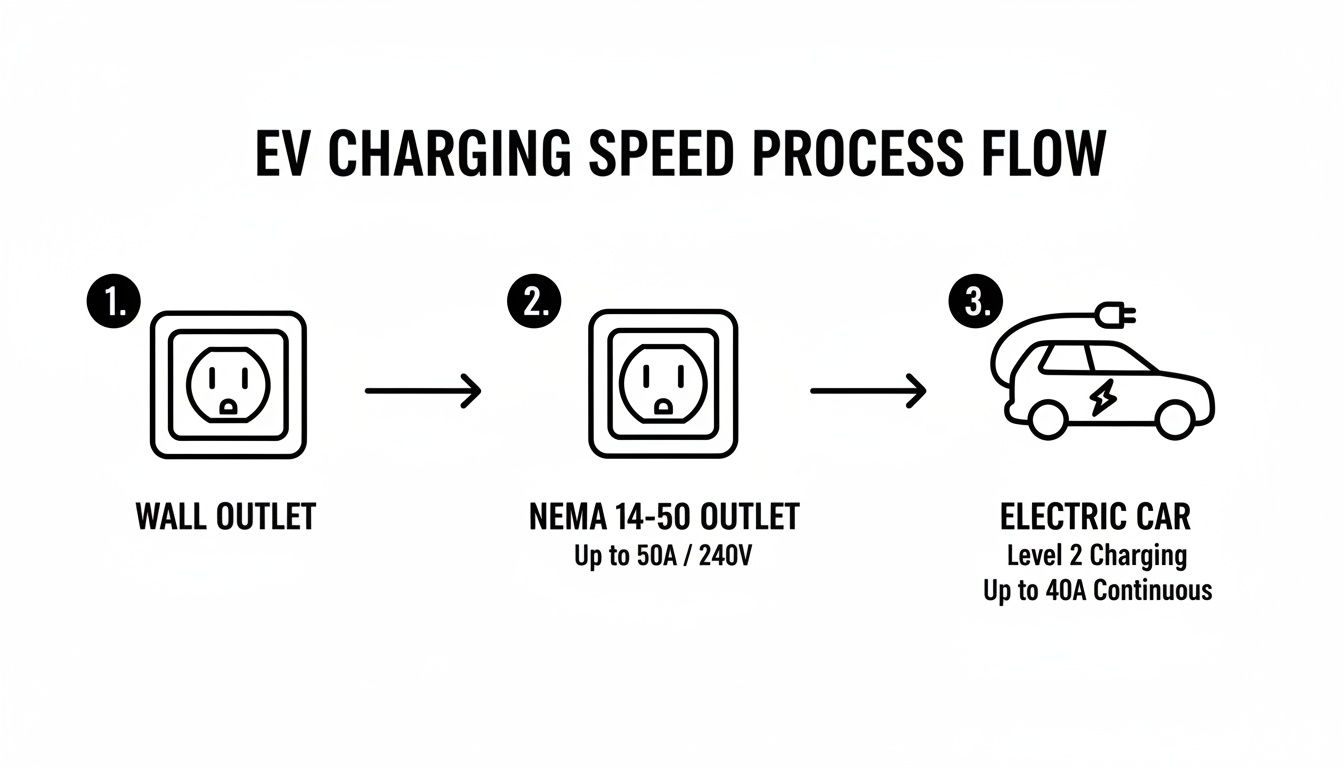
As you can see, each step—from the wall circuit to the outlet itself—is a critical link in the chain, all working together to deliver high-power current safely and efficiently to your EV.
Let's be blunt: when you're dealing with high-power electrical work, safety is the only thing that matters. Installing a NEMA 14-50 outlet for your EV isn't like hanging a picture frame. A small mistake here can have huge consequences for your home, your car, and your family.
When an installation is rushed or done by someone without the right experience, the risks pile up fast. Using the wrong materials, making a loose connection—every shortcut creates a weak link. The continuous, high-amperage pull from an EV charger is relentless; it will find any weakness in the system and turn a tiny oversight into a major hazard.
Cheap Outlets Are a Fire Hazard
Ever wonder why you can find one NEMA 14-50 outlet for $10-15 at the hardware store, while another one right next to it costs $50 or more? That extra money buys you heavy-duty, industrial-grade internal components built to handle heat and sustained electrical loads. It's not a luxury; it's a necessity.
A cheap outlet is often made with lower-quality plastics and thinner metal contacts. When your EV is pulling up to 40 amps for hours on end, those inferior materials start to protest. The plastic can warp and melt, the connections inside can loosen up, and all that heat buildup can easily spark an electrical fire right in your garage.
Think about it this way: the steady, hours-long pull of an EV charger is completely different from the on-and-off use of an electric stove or dryer. That’s why splurging on a commercial-grade outlet isn't an upgrade—it's the single most important safety decision you can make to prevent a fire.
The Critical Role of Proper Torque
One of the most common—and most dangerous—mistakes we see is when wire connections aren't torqued correctly. Every screw terminal on an outlet and circuit breaker is engineered to be tightened to a specific pressure, measured in inch-pounds.
It's just like tightening the lug nuts on your car's wheel. Too loose, and the wheel wobbles and could fall off. Too tight, and you strip the threads. In an EV circuit, a loose wire connection creates electrical resistance, which generates intense heat. This is a classic recipe for arcing, melted wires, and total failure. A professional electrician always uses a calibrated torque wrench to make sure every single connection is perfect, eliminating this hidden danger.
Adhering to Electrical Codes Isn't Optional
The National Electrical Code (NEC) and the local rules here in Weber, Davis, and Salt Lake counties exist for one reason: to keep you safe. These codes spell out every detail, from the right wire gauge and breaker type to the specific GFCI protection you need. Being able to spot a problem is a lot like the professional process of identifying potential hazards in any regulated field—it requires knowing the rules.
Cutting corners on the code can lead to some serious headaches:
- Failed Inspections: If the work doesn't pass a required electrical inspection, you'll be on the hook to pay for a pro to fix it and get it re-inspected.
- Voided Homeowner's Insurance: If a fire ever occurs, your insurance company can—and likely will—deny your claim if they find out it was caused by unpermitted, non-compliant electrical work.
- Legal Liability: You could be held personally responsible for any damage or injury caused by an installation that wasn't up to code.
Recent safety concerns have put a spotlight on EV charging setups. Standard dryer outlets just weren't built for the continuous high-power draw of an EV, which can lead to overheating and fires. Heavy-duty models are built to take the stress, and recent code updates now mandate GFCI breakers on these outlets to protect against shock. It's all part of making sure your home charging is as safe as it is convenient.
Choosing Between an Outlet and a Hardwired Charger
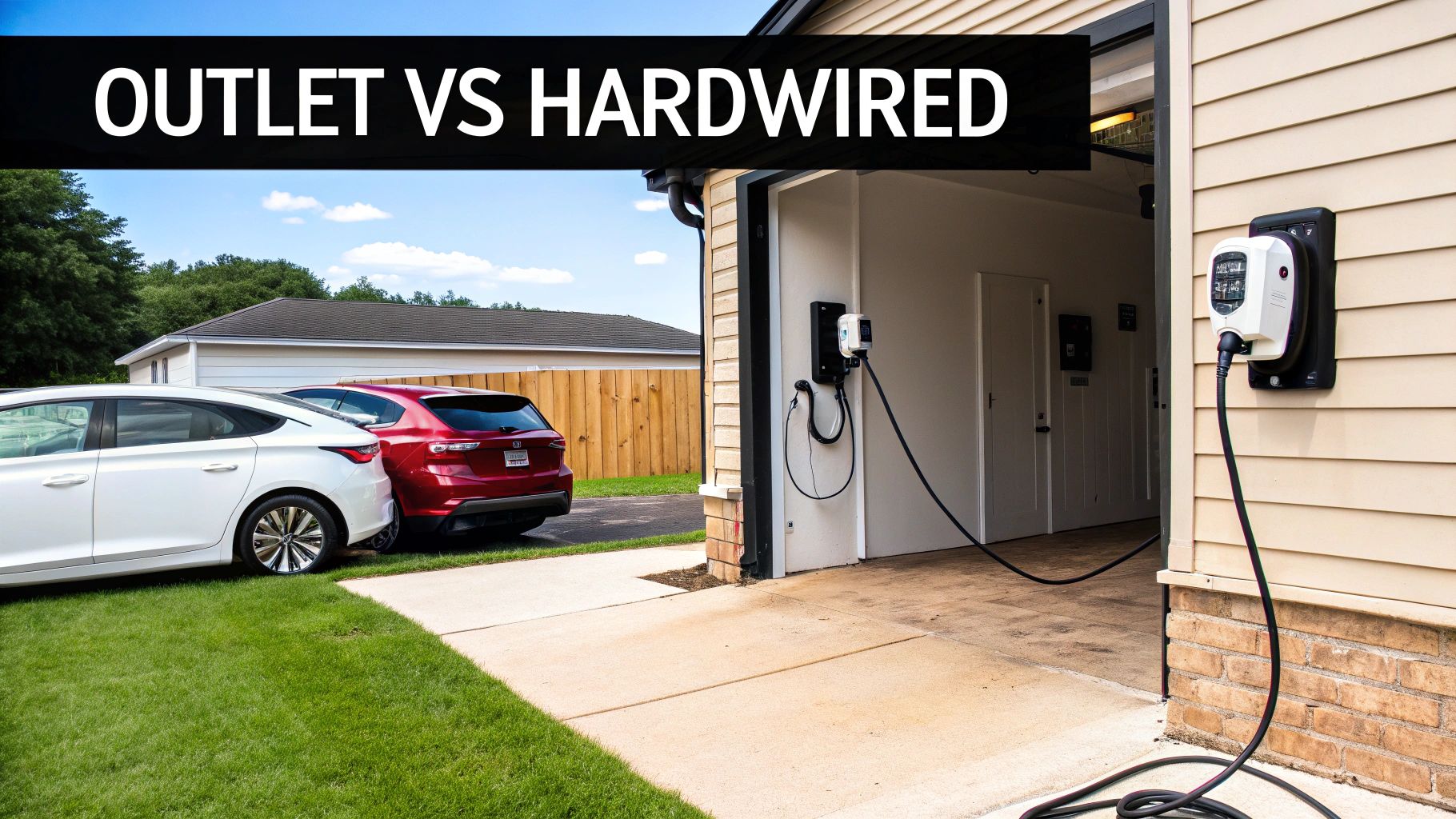
This is one of the first big decisions every new EV owner faces: should you install a flexible NEMA 14-50 outlet for a plug-in charger, or is a permanent, hardwired station the better investment? There’s no single right answer. It all comes down to your budget, your property, and how you plan to use your car.
Let's break down the two main paths so you can make a choice that fits your life perfectly. Each approach has real-world advantages that appeal to different drivers.
The Case for the NEMA 14-50 Outlet
Flexibility is the name of the game here. For many homeowners, installing a NEMA 14-50 outlet is the most practical and budget-friendly way to get solid Level 2 charging speeds without bolting a permanent fixture to the wall.
Here’s why it’s so popular:
- Lower Initial Cost: The installation is generally simpler and less expensive than a hardwired unit. Since you’re just putting in a high-power outlet, the labor and material costs are often lower.
- Portability: This is a huge perk. If you move, you can just unplug your portable EV charger and take it with you. It's a fantastic option for renters who can’t install permanent fixtures.
- Versatility: A NEMA 14-50 outlet isn't just for EVs. You can also use it to power an RV or other heavy-duty shop equipment, making it a genuinely useful addition to any garage.
The demand for home charging is exploding. Portable Level 2 chargers—many of which use the NEMA 14-50 standard—are projected to grow from a USD 1.65 billion market in 2025 to USD 5.73 billion by 2033. That growth says a lot about how much people value flexible, powerful home charging.
The Argument for a Hardwired Charger
On the other side of the coin, a hardwired EV charging station is a more robust, integrated, and often more powerful solution. If you’re a long-term homeowner looking for maximum performance and durability, this is the route for you.
These are the key benefits of going hardwired:
- Higher Power Potential: While a NEMA 14-50 is capped at a 50-amp circuit (delivering 40 amps of continuous power), many hardwired chargers can be installed on 60-amp circuits or higher. This lets them deliver more power and charge your EV even faster.
- Enhanced Durability and Safety: With a direct connection to your electrical panel, there are no plugs or outlets to wear out from constant plugging and unplugging. This permanent connection is generally considered safer and more reliable over the long haul.
- Better for Outdoor Installations: If your charger needs to be installed outside, a hardwired unit is the superior choice. They are built to be weatherproof and can handle exposure to rain, snow, and temperature swings much better than an outlet.
A hardwired charger provides a clean, permanent installation that can even add value to your home. It signals to future buyers that your property is already equipped for the electric vehicle era.
Making the Right Choice for You
So, which path should you take? To make the decision a little easier, let's put them head-to-head. If you have a Tesla, you might also want to check out our guide on professional Tesla EV charger installation for more specific insights.
This comparison table should help clarify which option aligns best with what you need.
NEMA 14-50 Outlet vs. Hardwired Charger Comparison
| Feature | NEMA 14-50 Outlet | Hardwired Charger |
|---|---|---|
| Installation Cost | Generally lower | Generally higher |
| Charging Speed | Up to 9.6 kW (40A) | Often higher (up to 11.5 kW+ on a 60A circuit) |
| Portability | Excellent; unplug and take it with you | None; it's a permanent fixture |
| Durability | Good, but outlet can wear out over time | Excellent; no moving parts to wear out |
| Weather Resistance | Not ideal for direct outdoor exposure | Designed for outdoor use (with proper models) |
| Best For | Renters, budget-conscious owners, those needing flexibility | Homeowners, performance-focused drivers, outdoor setups |
At the end of the day, both a NEMA 14-50 outlet for EV charging and a hardwired station are fantastic upgrades from a standard wall outlet. Your decision will come down to balancing upfront cost, desired charging speed, and your plans for the future.
Why You Should Always Hire a Professional Electrician
Let's be honest, the idea of a DIY project to save a few bucks is always tempting. But installing a NEMA 14-50 outlet for EV charging is one of those jobs where cutting corners can cost you way more than you save. This isn’t just about getting the outlet on the wall; it’s about the safety of your home, your expensive new car, and your family.
Handling a 50-amp circuit is serious business. It’s not like swapping out a light switch. One small mistake—using the wrong size wire, not tightening a connection enough, or skipping a GFCI breaker where it’s needed—can create a massive fire hazard. A licensed electrician doesn’t just do the work; they understand the risks and build in the safety to give you a reliable power source for years.
The Black Rhino Electric Difference
At Black Rhino Electric, we look at the whole picture. Our entire process is built on making sure your home’s electrical system can handle the new, heavy, and sustained load of an EV charger without breaking a sweat. This E-E-A-T (Experience, Expertise, Authoritativeness, and Trustworthiness) approach is at the core of everything we do.
This is what our comprehensive approach looks like:
- A Full Panel Assessment: We run a detailed load calculation on your main electrical panel. This tells us if it has enough capacity for a new 50-amp circuit without tripping the main breaker every time the AC kicks on.
- High-Quality Component Selection: We don’t use cheap, residential-grade parts. We install industrial-grade NEMA 14-50 receptacles and top-tier breakers and wiring specifically designed to handle the constant power draw of charging an EV, day in and day out.
- Code-Compliant Installation: Our team lives and breathes the National Electrical Code (NEC). We’re also deeply familiar with all the local rules in Weber, Davis, and Salt Lake counties, which means your installation will sail through inspection without a hitch.
- Permitting and Inspection: We handle all the paperwork. From pulling the right permits with your city to scheduling the final inspection, we manage the entire process so you don't have to deal with the red tape.
Peace of Mind Is Part of the Service
Honestly, the biggest reason to hire a pro is the peace of mind you get knowing the job was done right. A certified installation protects your vehicle and charger warranties, keeps your homeowner's insurance happy, and completely removes the "did I do that right?" anxiety that comes with a complex DIY attempt.
You get a safe, reliable charging solution you can plug into every single day without ever second-guessing it. It’s a straightforward investment in your property's safety and value.
Common Questions About NEMA 14-50 Installations
We get it—planning a home EV charging setup brings up a lot of questions. From costs and codes to whether your panel can even handle it, you want to be sure you're making the right call for your home and your new car.
To cut through the noise, we’ve put together some straightforward answers to the questions we hear most often about installing a NEMA 14-50 outlet for EV charging. This should help clear things up and give you a solid idea of what to expect.
What Does a Typical Installation Cost?
The cost can vary quite a bit, and it usually boils down to a couple of key things. The biggest factor is the distance from your main electrical panel to where you want the outlet. A longer run means more materials—like that pricey 6-gauge copper wire—and more labor to get it there.
The other big variable is your panel's current capacity. A simple, clean installation in a home with plenty of extra space on the panel might only run a few hundred dollars. But if the job is more complex or your panel is already maxed out and needs an upgrade, the cost will naturally be higher. If you're trying to get a rough idea, this external EV Charging Station Installation Cost Calculator can give you a useful ballpark figure.
At Black Rhino Electric, we believe in total transparency. We provide clear, upfront quotes before any work begins, so you know exactly what to expect. No surprises.
Do I Need a Permit to Install a NEMA 14-50 Outlet?
Yes. In just about every jurisdiction across Utah—including Weber, Davis, and Salt Lake counties—installing a new 240-volt, 50-amp circuit requires an electrical permit. This isn't just bureaucratic red tape; it's a critical safety measure.
The permitting process makes sure the work is documented and, more importantly, inspected by a city or county official to confirm it meets all current electrical codes. A licensed electrician like Black Rhino Electric handles the entire permitting and inspection process for you, ensuring everything is fully compliant and safe from start to finish.
Can I Use My Existing Dryer Outlet for EV Charging?
Generally, this isn't a good idea. Most dryer outlets might look similar, but they're often a different type, like a NEMA 10-30 or 14-30. Those are 30-amp circuits, not the beefier 50-amp circuit a NEMA 14-50 needs to deliver full power to your EV.
Even if you have an unused 14-50 outlet for an electric range, it’s always safer and more reliable to install a new, dedicated circuit specifically for your vehicle. EV charging is a unique, continuous load that can run for hours. Sharing circuits can lead to overloaded breakers and potential safety issues you just don't want to mess with.
How Do I Know if My Panel Can Handle It?
This is a question that really needs a professional to answer with certainty. A qualified electrician from our team will perform what’s called a "load calculation" on your home’s main electrical panel. It’s a detailed analysis that adds up all the existing electrical demands in your home, from your AC unit to your kitchen appliances.
This calculation determines if there is enough available capacity to safely add the 50-amp circuit for your charger. If your panel is at or near its limit, we'll talk through the best options for an upgrade to make sure your entire system remains safe and reliable.
We get a ton of questions about this stuff. You can find more answers in our frequently asked questions section.
Powering your electric vehicle should be simple and worry-free. When you're ready to do it the right way, trust the local experts who put your safety first. For a professional and safe installation of your NEMA 14-50 outlet for EV charging, contact Black Rhino Electric today by calling us at 385-396-7048 or request a free quote online to get started.