

Choosing the right commercial electrical contractors utah is one of the most critical decisions for any construction project or business renovation. It's not just about connecting wires; it's about safeguarding your investment, ensuring compliance, and laying a dependable power foundation for your operations. A skilled, licensed contractor ensures your building’s electrical system is robust, reliable, and ready for future demands.
Why Your Choice of Electrical Partner in Utah Matters
Ever thought about your building’s electrical system as its central nervous system? When it works flawlessly, you don't even notice it's there. But a single fault can bring your entire operation to a screeching halt, costing you time and money.
You know what? Rolling the dice on a subpar electrical partner can lead to some seriously painful consequences. These risks aren't just hypotheticals; they manifest as real-world safety hazards, expensive rework, and project delays that can cripple a business. In Utah's booming construction scene—from Salt Lake City to growing hubs in Weber and Davis counties—selecting a dependable electrical partner isn’t just a good idea; it’s essential for demonstrating the kind of experience and trustworthiness that protects your investment.

Protecting Your Investment and Operations
Let me explain. A true expert does a lot more than just follow blueprints. They bring critical, experience-based insights to the table during the planning phase, helping you design a system that not only meets today’s needs but is also ready to scale with tomorrow's growth.
This kind of forward-thinking saves you from costly, disruptive upgrades later on. A reliable partner ensures your facility runs smoothly from day one, protecting both your bottom line and your reputation through proven expertise.
The electrical contracting industry here has seen incredible growth, mirroring the state's vibrant economy. Utah's electrical contracting market is projected to hit $5.6 billion in 2026, making it the 20th highest revenue industry in the state. This boom is fueled by a construction sector that added roughly 5,000 jobs over the past year.
The Foundation of Safety and Compliance
Honestly, the single most important job of a commercial electrician is to guarantee safety and strict code compliance. A non-compliant electrical system is a massive liability. It can lead to:
- Safety Hazards: A much higher risk of electrical fires, shocks, and equipment failure.
- Failed Inspections: Project delays that cost you time and money to fix violations.
- Insurance Issues: Headaches trying to get or keep your property insurance coverage.
- Legal Liability: The potential for fines and legal trouble if an accident happens on your property.
A professional contractor meticulously follows the National Electrical Code (NEC) and all local Utah amendments. This authoritativeness ensures your project is safe, legal, and built to last. For a closer look at what that involves, you can learn more about our commercial electrical services and our commitment to getting it right the first time.
Understanding Core Commercial Electrical Services
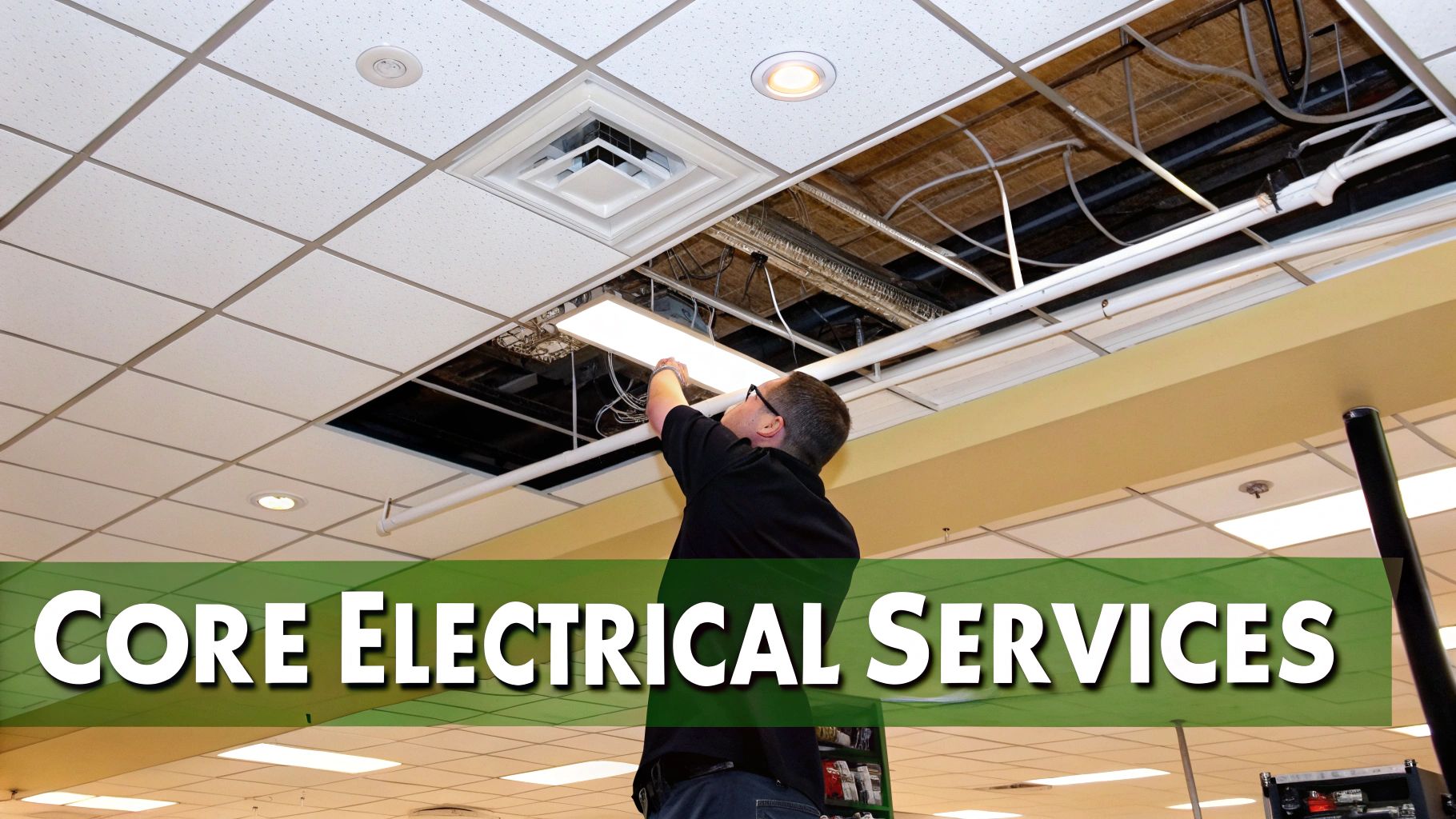
Most business owners don’t realize how different commercial electrical work is from what you’d find in a house—it's a completely different world. Commercial systems must handle much heavier electrical loads, comply with far stricter safety codes, and support the kind of equipment that keeps a business running.
Here’s the thing: a professional contractor provides start-to-finish solutions, from designing the electrical grid for a new warehouse to the detailed work needed when a new tenant moves into a retail space. Every service is a critical piece of the puzzle, and our extensive experience ensures each piece fits perfectly.
New Construction and Tenant Improvements
Putting up a new building from scratch demands tight collaboration between the electrical contractor, the general contractor, and the architects. The electrician’s job is to map out and install the entire electrical nervous system of the building, making sure it’s powerful and reliable enough for whatever you throw at it. This is where expertise is non-negotiable.
On the flip side, tenant improvements (or TIs) are all about customizing an existing space for a new business. We see this constantly in Utah’s booming commercial real estate market:
- Retail Spaces: A new boutique might need specific track lighting to make products pop and extra power for its point-of-sale systems.
- Restaurants: These are power hogs, requiring dedicated circuits for industrial kitchen equipment, specialized mood lighting in the dining room, and code-required emergency lighting.
- Office Buildings: A growing tech company might need a total overhaul of floor outlets, data cabling for workstations, and advanced A/V wiring in conference rooms.
In every case, the electrical work is tailored to the business's unique needs, demonstrating our authoritative understanding of diverse commercial demands.
Power Distribution and Panel Upgrades
Think of your electrical panel as the heart of your building. An overloaded or ancient panel isn’t just an inconvenience; it’s a serious risk that can cause constant disruptions and create a genuine fire hazard. A seasoned electrician will assess your power demands—both now and in the future—to determine if an upgrade is in order.
A professional panel upgrade is more than just adding breakers. It's about strategically balancing electrical loads, ensuring everything is up to the current code, and building a system that can grow right alongside your business.
Lighting and Low-Voltage Systems
Good lighting does more than just brighten a room; it sets the mood, boosts productivity, and can seriously slash your energy bills. Beyond lighting, today’s businesses are built on data. Low-voltage wiring is the invisible backbone for all your communication and security infrastructure, a specialty where our expertise shines.
| System Type | Purpose and Examples | Why Professional Installation Matters |
|---|---|---|
| Data & Communication | Ethernet cables for computers, VoIP phone systems, and Wi-Fi access points. | Guarantees reliable network speeds and prevents frustrating downtime. |
| Security & Access | Wiring for security cameras, alarm systems, and key card readers. | Proper installation is crucial for system reliability and keeping your property secure. |
| Audio/Visual | Systems for conference rooms, background music, or building-wide PA systems. | Clean, hidden wiring delivers a professional look and flawless performance. |
These systems require a completely different skill set than heavy-duty power wiring, highlighting the broad expertise a top-tier commercial contractor must possess.
Navigating Utah's electrical codes and licensing isn't just about paperwork—it's the entire foundation of a safe, legal, and successful project. These rules exist to protect your property, your team, and your customers from the very real dangers of bad wiring. Hiring a contractor who demonstrates authoritativeness in this area isn't just a good idea; it's the only way to ensure your project's integrity.
The NEC and Local Utah Amendments
At the core of electrical safety is the National Electrical Code (NEC). It’s a complex document updated every three years to keep pace with technology. Here’s the twist: Utah and its local jurisdictions—across Weber, Davis, and Salt Lake counties—can add their own amendments. A qualified, trustworthy contractor must be a master of both the national code and every local variation that applies to your job site.
Understanding Utah Electrician Licensing Tiers
Not all electricians are created equal. The Utah Division of Professional Licensing (DOPL) runs a tiered system to ensure electricians have proven their knowledge and experience. For a commercial project, understanding these tiers is crucial for a safe outcome.
Utah Electrician License Tiers and Responsibilities
| License Level | Required Experience & Training | Permitted Scope of Work | Why It Matters for Your Project |
|---|---|---|---|
| Apprentice Electrician | Must be enrolled in an approved training program and work under direct supervision. | Can perform electrical work but must be supervised by a licensed Journeyman or Master Electrician. | Apprentices are learning the trade. They are a normal part of a crew but cannot legally lead work. |
| Journeyman Electrician | Requires 8,000 hours (about 4 years) of on-the-job training and passing a state exam. | Can install, maintain, and repair electrical systems independently and supervise apprentices. | A Journeyman is a fully qualified professional who can handle the vast majority of hands-on installation tasks. |
| Master Electrician | Requires 4,000 hours of experience as a Journeyman and passing an advanced state exam. | Can do everything a Journeyman can, plus design systems, pull permits, and oversee entire projects. | This is crucial. A Master Electrician’s oversight is legally required to pull permits and ensure the entire project meets code. |
For any real commercial work, you absolutely need a Master Electrician involved to demonstrate the highest level of expertise and accountability.
The Importance of Permits and Inspections
Let me be blunt: skipping the permit process is one of the riskiest mistakes a business can make. A permit kicks off the most important part of the process: inspections. An independent inspector will visit your site at key stages to verify that every component meets the current code.
A professional electrical contractor manages the entire permitting and inspection process seamlessly. This demonstrates trustworthiness and protects you from liability, ensuring your project is approved without a hitch.
Navigating this web of regulations is a core part of what an expert contractor does. If you're worried about existing work, our team is skilled in handling code violation repairs to bring your systems up to modern standards.
The Future of Electrical Work: EV Chargers and Smart Buildings
Modern commercial properties need to be smart, efficient, and ready for what’s next. Choosing the right commercial electrical contractors utah means finding a partner who understands today's power needs and tomorrow's technology. Two areas are leading the charge: electric vehicle (EV) infrastructure and integrated smart building systems.
The Rise of Commercial EV Charging Stations
The demand for EV charging is exploding in Utah. For commercial electrical contractors, installing EV charging stations has become one of the fastest-growing parts of the job. Our first-hand experience shows that tech campuses, new office buildings, and retail centers all need this infrastructure.
Putting in commercial EV chargers is a whole different beast than a simple home unit. For a deeper look at the nuts and bolts, you can check out our guide on EV charger installation.
Adding EV charging isn't just a perk anymore; it's a strategic move. For office parks, it’s a key factor in retaining employees. For retail centers, it’s a powerful amenity that attracts high-value customers.
Understanding EV Charger Levels
To make the right call, you need to know the different types of chargers. Each level serves a specific purpose, and the best solution for your property might be a mix.
| Charger Level | Typical Use Case | Charging Speed | Best For |
|---|---|---|---|
| Level 2 | Workplace, Retail, Multifamily Housing | Adds 10-20 miles of range per hour | Employees parked all day or shoppers staying for a few hours. |
| DC Fast Charging (Level 3) | Public Charging Hubs, Highway Rest Stops | Adds 60-100+ miles of range in just 20-30 minutes | Quick top-ups for drivers on the go or fleet vehicles needing a rapid turnaround. |
A real pro will perform a load calculation to make sure your building's main panel can handle the new demand, ensuring a safe, reliable charging network.
Integrating Smart Building Technologies
Beyond EVs, the future is smart. Smart building tech connects your core systems—lighting, HVAC, security, and energy management—into one automated network. The benefits are huge:
- Energy Efficiency: Automated lighting and climate control can cut energy use by up to 30%.
- Operational Intelligence: Smart systems give you real data on how your building is being used.
- Enhanced Security: Integrated access control and surveillance create a much safer environment.
As businesses look to pair smart tech with solar panels, figuring out the solar return on investment is a key first step. Our expertise includes designing the low-voltage wiring backbone for these systems, ensuring your property is not just powered, but truly intelligent.
A Practical Checklist for Hiring Your Electrical Contractor
Choosing an electrical contractor is one of the most critical decisions you'll make. The right partner ensures your project is safe and on-schedule. So, how do you find that trustworthy expert?
This visual decision tree can help you clarify your project’s electrical needs before you even start making calls.
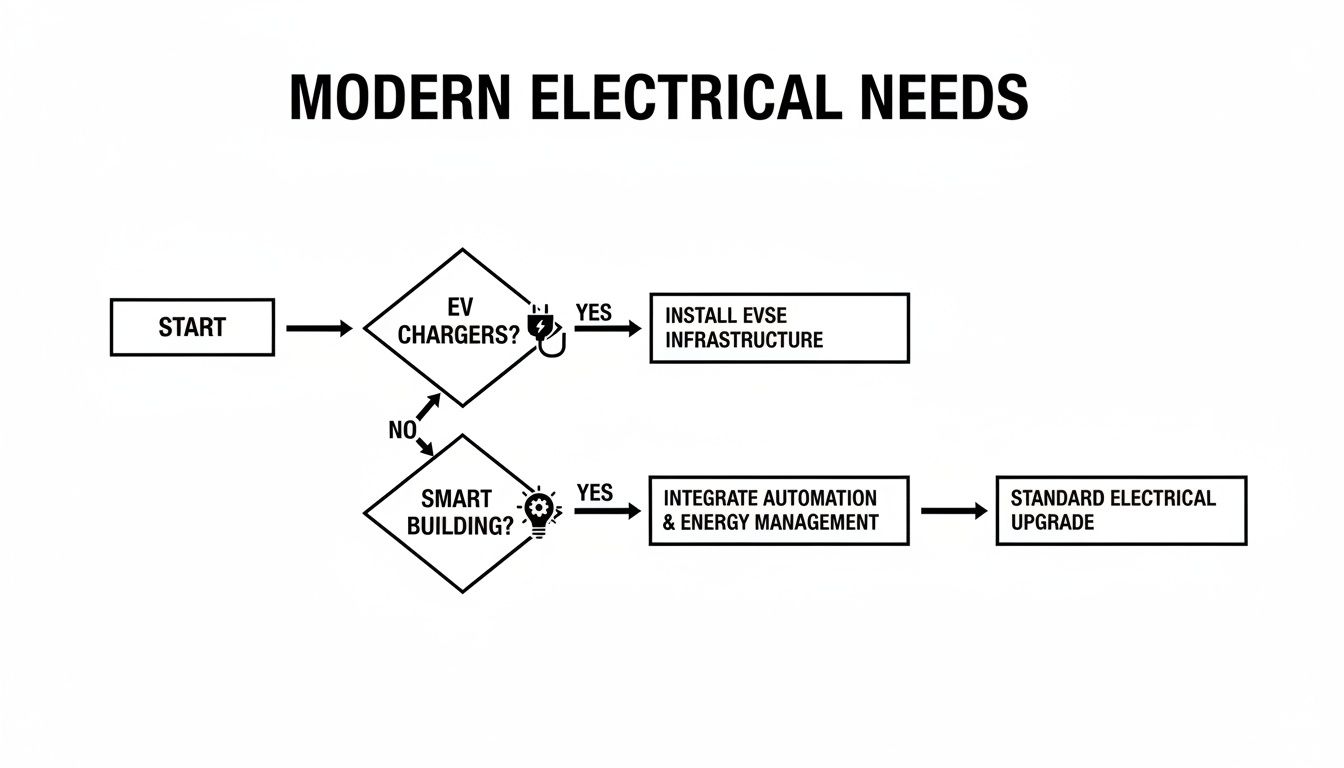
By following this flow, you can quickly pinpoint if your main focus is future-proofing with EV chargers, boosting efficiency with smart building tech, or handling foundational system upgrades.
Licensing and Insurance Verification
This first step is completely non-negotiable. Always verify the contractor holds a current license from the Utah Division of Professional Licensing (DOPL), specifically confirming they have a Master Electrician on staff. Just as important is their insurance—ask to see their certificate.
- General Liability Insurance: Protects your property from damage.
- Workers' Compensation: Covers their crew if they get injured on your job site.
A legitimate, trustworthy contractor will have this documentation ready without hesitation.
Experience and Project Portfolio
You need a contractor with a proven track record of successfully finishing projects similar to yours. Ask to see a portfolio and request references from previous clients. A confident contractor, backed by years of experience, will be proud to connect you with satisfied customers.
Key Questions to Ask Every Potential Contractor
Once you’ve narrowed down your list, it's time to dig deeper. The answers to these questions will reveal their professionalism and expertise.
| Category | Key Question | What the Answer Reveals |
|---|---|---|
| Project Management | Who will be my main point of contact and the on-site project manager? | Establishes a clear line of communication and accountability. |
| Change Orders | How do you handle unforeseen issues or changes to the project scope? | A professional process for change orders prevents surprise costs. |
| Timeline & Scheduling | Can you provide a detailed project timeline and how you'll coordinate with other trades? | Shows they understand the bigger picture and can work effectively within a larger schedule. |
| Safety Protocols | What specific safety protocols and training programs do your electricians follow? | Demonstrates their commitment to a safe job site. |
| Technology Use | What kind of technology do you use for project management and bidding? | Look for contractors who use modern tools like electrical estimating software for precise bids. |
These aren't just questions; they’re tools to gauge a contractor’s experience and trustworthiness.
Remember, a detailed and transparent contract is your ultimate protection. Vague pricing or handshake deals are recipes for disaster.
Think of Your Electrician as a Partner, Not Just a Vendor
The best relationship with your commercial electrical contractors utah doesn't end when the final invoice is paid; it evolves into a partnership built on trust and reliability. A truly great contractor is invested in your business's ongoing success, becoming a proactive electrical partner who helps protect your investment for years through demonstrated E-E-A-T (Experience, Expertise, Authoritativeness, and Trustworthiness).
The Real Value of Preventative Maintenance
Most major electrical problems don't just happen overnight. They start as small, undetectable issues that grow over time. Preventative maintenance is about catching those problems early, preventing expensive downtime and extending the life of your critical electrical systems based on our extensive field experience.
Think of it this way: paying for a small, scheduled inspection is always cheaper than shutting down your entire operation for emergency repairs.
What a Good Maintenance Plan Actually Covers
A quality maintenance plan is a systematic inspection of your entire electrical system. Based on our expertise, a comprehensive plan should include:
- Thermal Imaging Scans: We use an infrared camera to detect "hot spots" in your electrical panels, which are invisible to the naked eye and a sure sign of a potential failure.
- Panel and Circuit Breaker Inspections: A technician will check for loose connections, signs of corrosion, and overloaded circuits.
- Equipment Testing: This includes checking safety devices like GFCI outlets and emergency lighting systems.
- System Cleaning: Dust and debris can build up inside electrical components, leading to overheating.
Peace of Mind When Emergencies Strike
Ultimately, the single greatest benefit of a long-term partnership is knowing exactly who to call in an emergency. You need a responsive, trustworthy team that already knows your building's systems inside and out. Having that established relationship means faster response times and more effective solutions.
Frequently Asked Questions
When you're searching for a commercial electrical contractor in Utah, you end up with a lot of the same questions. Getting straight answers from an authoritative source is the first step to making a smart decision. Here are a few of the most common ones we hear from our years of experience.
What Is the Typical Cost for Commercial Electrical Work in Utah?
Honestly, costs swing wildly depending on the project's size, scope, and the materials needed. A quick repair might be a few hundred dollars, but a full tenant improvement can run into the tens of thousands. Key factors include square footage, the age of your existing system, and any special equipment you need. The best way to get an accurate number is with a detailed, itemized quote that demonstrates transparency and trustworthiness.
How Long Does a Typical Commercial Electrical Project Take?
This depends entirely on the project. A simple service call might be wrapped up in a few hours. A small office lighting retrofit could take a few days. Major projects, like a new construction build-out, happen in phases over several weeks or months. Any professional contractor with deep experience will provide a project schedule with clear milestones so you’re never left guessing.
Do I Need a Permit for My Commercial Electrical Work in Northern Utah?
Yes, almost certainly. For any commercial electrical work in Weber, Davis, or Salt Lake counties that goes beyond a simple repair, a permit is non-negotiable. This includes new installations, major wiring changes, adding circuits, or upgrading an electrical panel.
A qualified, licensed contractor is responsible for handling the entire permitting process. This authoritative management includes submitting plans, scheduling inspections, and ensuring the final work is fully code-compliant, safe, and properly documented.
For a partner who provides clear answers and reliable solutions for your commercial electrical needs, trust Black Rhino Electric. Call us at 385-396-7048 or request a free quote to discuss your project today.