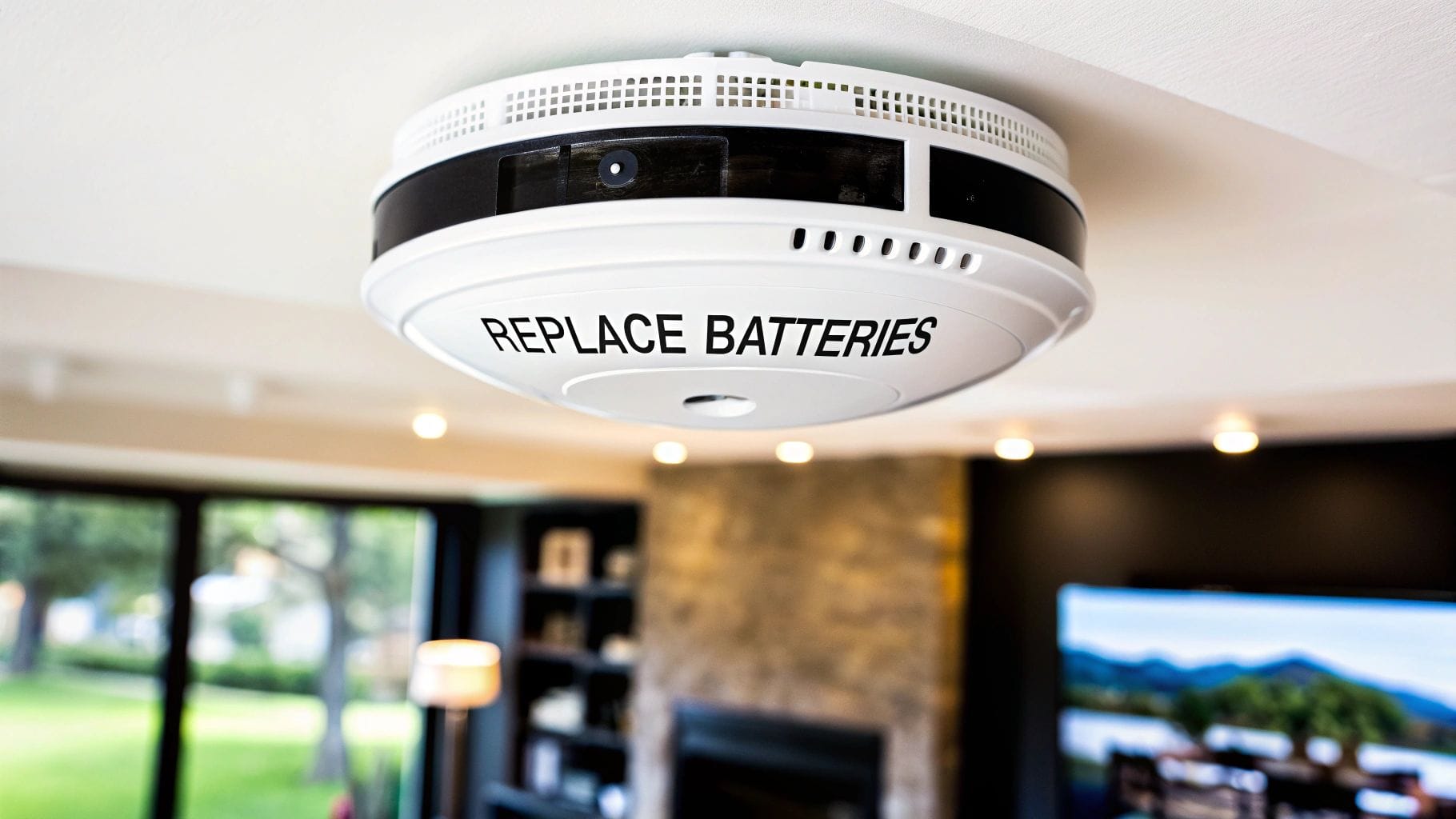
Knowing how often to replace smoke detector batteries is a crucial part of home safety, but the answer isn't always simple. For standard detectors, the rule of thumb is to change the batteries every 6 to 12 months, but this schedule can vary. The best routine truly depends on the specific type of smoke alarm installed in your home.
The Quick Answer on Replacing Smoke Detector Batteries
Let me explain. Not all smoke alarms are the same. Think of it like car maintenance—a high-performance vehicle needs a different service schedule than your daily commuter, and the same logic applies to these life-saving devices. Some need frequent checks, while others are built for the long haul.
You know what? The single biggest reason smoke alarms fail in an emergency is a dead or missing battery. That’s why a consistent routine is non-negotiable for your family's safety. The National Fire Protection Association (NFPA) hammers this home, recommending you change standard batteries at least every 6 months. A lot of people tie this chore to Daylight Saving Time—when you change your clocks, you change your batteries. It's a simple trick that can cut fire-related risks by half.
This image breaks down the two most common battery lifespans you'll encounter.
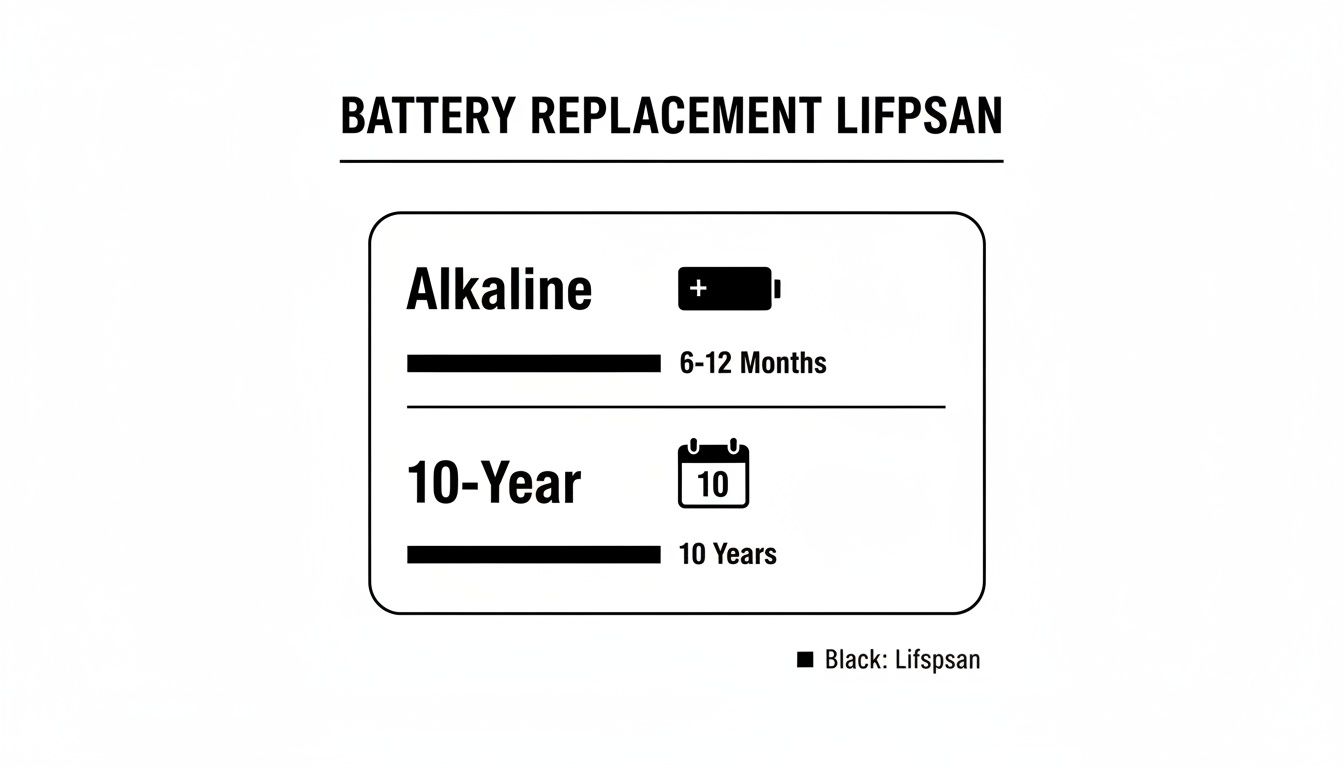
The difference is pretty stark. Standard batteries need your attention twice a year, while the sealed 10-year units are designed to give you a solid decade of peace of mind.
Smoke Detector Battery Replacement Schedule at a Glance
To give you an immediate, no-fuss answer, we put together a simple table breaking down the replacement schedule by device type. Use this as your quick reference guide.
| Detector Type | Battery Type | Recommended Replacement Frequency | Testing Frequency |
|---|---|---|---|
| Standard Battery-Powered | 9-Volt or AA/AAA Alkaline | Every 6-12 Months | Monthly |
| Hardwired with Battery Backup | 9-Volt or AA Alkaline | Annually (Once a Year) | Monthly |
| Sealed Unit | 10-Year Lithium (Sealed) | Replace Entire Unit Every 10 Years | Monthly |
This table lays out the core timelines you need to know. The key takeaway here is that even hardwired units—the ones running on your home’s electricity—have backup batteries. Those backups are critical during a power outage, and they demand regular replacement just like any other battery. We'll dig deeper into these different types in the next sections.
Why That Annoying Chirp Is Your Best Friend
Honestly, we’ve all been there. It’s 3 AM, and a faint, high-pitched chirp starts echoing through the house, pulling you from a deep sleep. Your first instinct is probably frustration, but that annoying sound is actually a critical safety feature—a lifesaver in disguise. Knowing how often to replace smoke detector batteries is key, but understanding why turns a simple chore into a proactive step to protect your family.
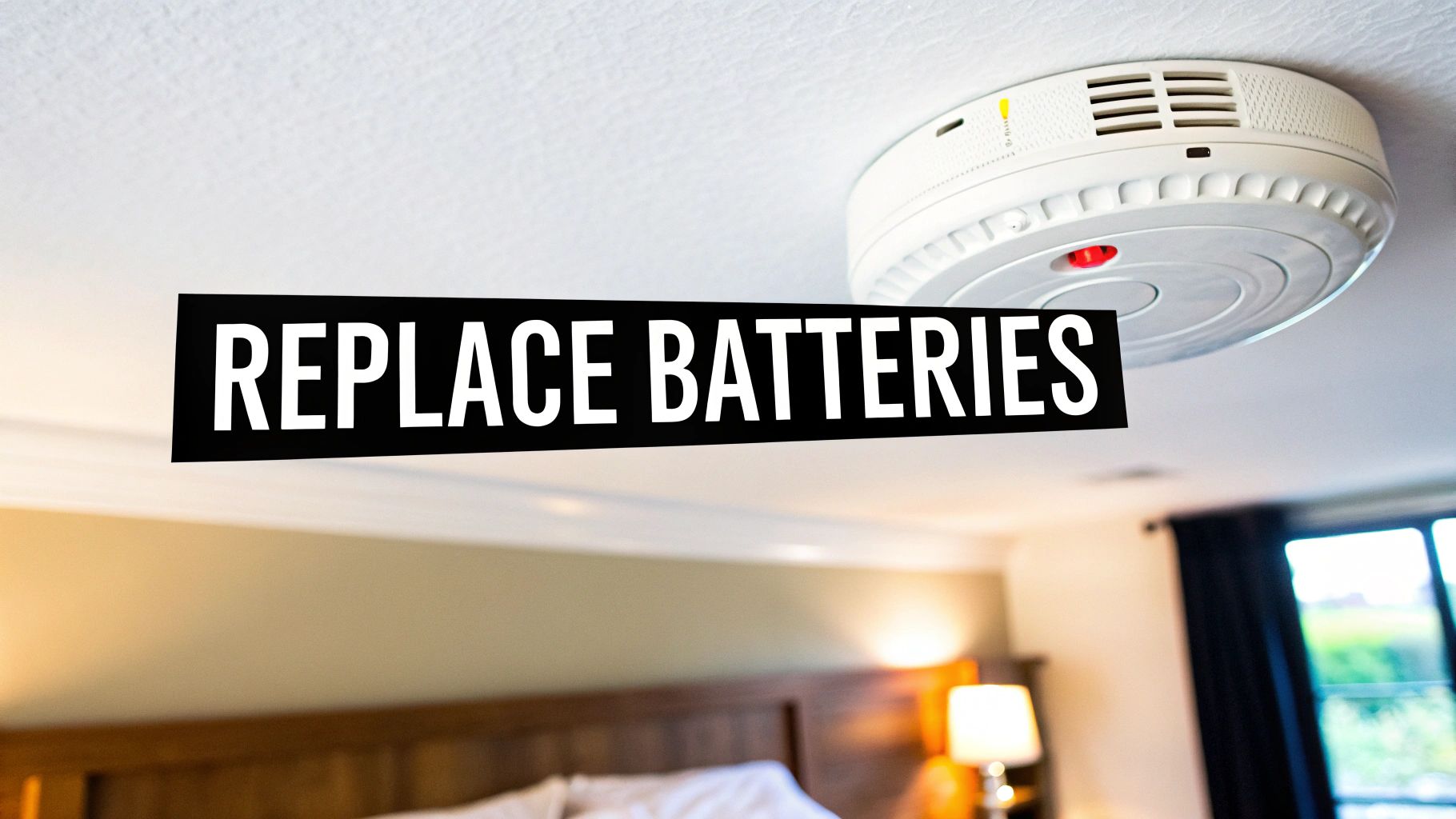
Here’s the thing: a chirping smoke detector isn't just an alert that its battery is getting low. It's a warning that your first line of defense against a fire is compromised. A battery doesn't just die suddenly; it gradually loses power, and this weakened energy can impact the detector's ability to sense smoke long before it ever starts making noise.
Think of it like a security guard slowly falling asleep on the job. They might still be at their post, but they aren't alert enough to spot danger. A smoke detector with a dying battery is exactly the same—present, but not fully functional.
Key Warning Signs Your Detector Needs Attention
That intermittent chirp is the most obvious signal, but it’s not the only one. Your smoke detector has a few ways of telling you something is wrong with either its power source or the unit itself. Being able to spot these signs is crucial.
Keep an eye—and an ear—out for these three distinct warnings:
- The Infamous Chirp: A single, high-pitched chirp every 30 to 60 seconds is the classic low-battery warning. It's designed to be annoying enough that you can't ignore it. To figure out exactly what that sound means, it helps to understand why your home fire alarm keeps beeping.
- A Flashing Red Light: Most detectors have a small LED light. A steady flash every minute or so is normal, but if that light starts flashing erratically or changes its pattern without the alarm sounding, it often points to a fault or a low battery.
- Sudden False Alarms: Has your alarm ever gone off for no reason, even right after you've cleaned it? A failing battery can send inconsistent power to the sensor, causing it to trigger a false alarm when there's no smoke at all.
A chirping smoke detector is a clear message from your device: "I'm losing power and won't be able to protect you soon." Ignoring it is like ignoring a check engine light—it doesn't solve the underlying problem and puts you at greater risk.
Understanding these signals is about more than just stopping a nuisance noise. It's about recognizing a direct threat to your home's safety system and taking immediate action. This simple awareness ensures your detectors are always ready to do their life-saving job.
Understanding Different Smoke Detector Types
Not all smoke detectors are created equal, and knowing what’s on your ceiling is the first step toward keeping it working right. The power source is the biggest difference, and it directly shapes your maintenance routine. It’s easy to assume they all work the same way, but their internal mechanics tell a different story.
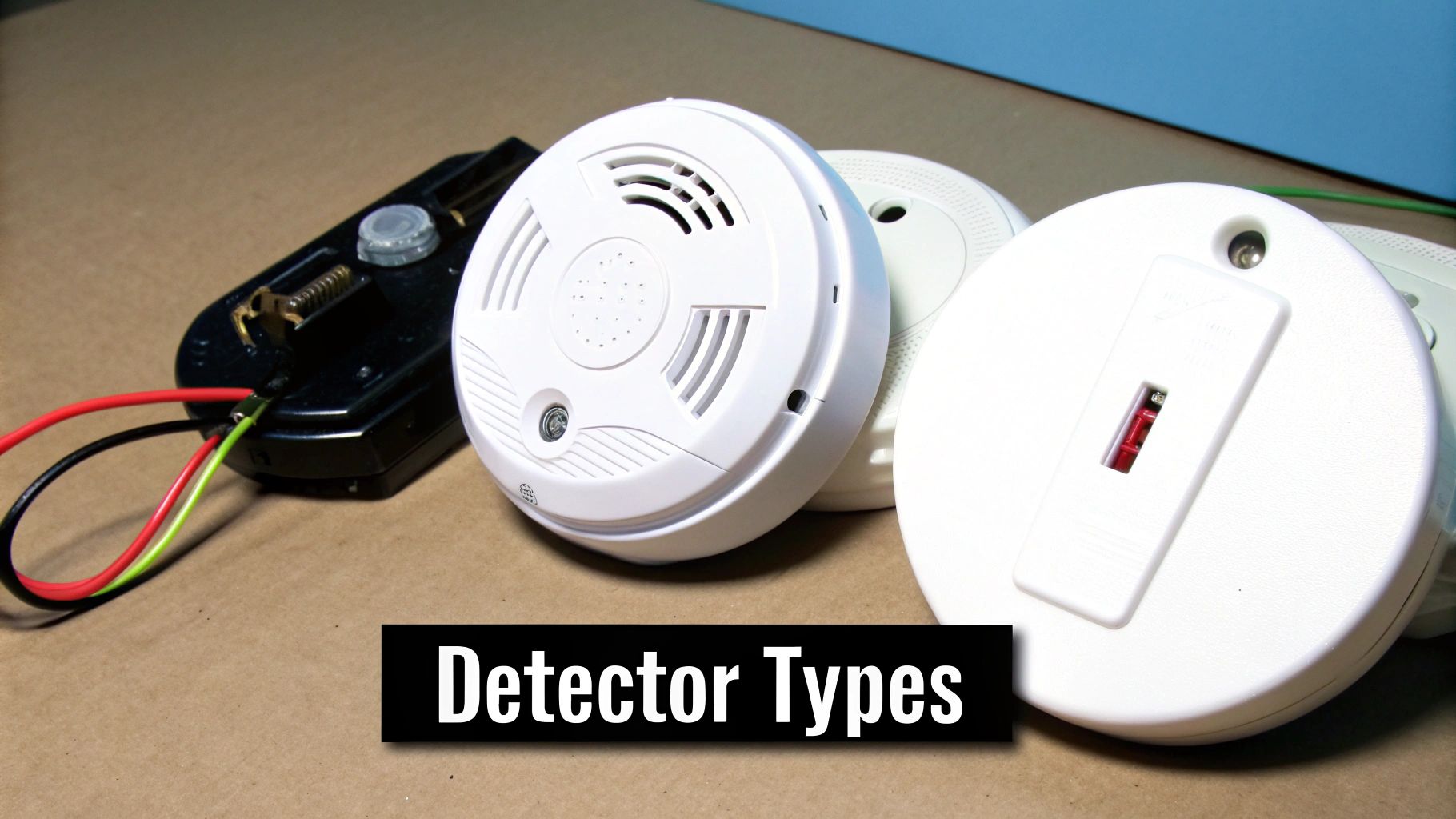
Let me explain. The three most common types you'll find in homes are the old-school battery-only units, hardwired detectors with a battery backup, and the newer 10-year sealed alarms. Each one has its own set of rules.
Traditional 9-Volt Battery Detectors
These are the classic, standalone units you probably grew up with, powered entirely by a single 9-volt or a couple of AA batteries. They’re simple to install—often just a couple of screws—making them a common choice for older homes where running new electrical wiring is a major hassle.
But here’s their biggest weakness: they are completely reliant on that one battery. When it dies, the detector is just a piece of plastic on the ceiling. This is why they demand the most attention, needing fresh batteries every 6 to 12 months.
Hardwired Smoke Detectors with Battery Backup
This is a big step up in reliability. Hardwired detectors connect directly to your home’s electrical system, giving them a constant, primary power source. But what happens during a power outage? That’s where the battery backup kicks in.
Here's a critical point many homeowners miss: even though it's hardwired, the backup battery still needs to be replaced every year. This backup is your only line of defense if a fire starts when the power is out.
Some of these systems are even smarter. Advanced setups like wireless interconnected smoke co detectors link all your alarms together, so when one goes off, they all do. For larger properties or commercial buildings, a professional installation is key; you can learn more about those smoke and CO2 detector services here.
10-Year Sealed Lithium Battery Detectors
Think of this as the "set it and forget it" champion of smoke alarms. These modern detectors come with a built-in lithium-ion battery that’s sealed inside the unit, designed to last for the detector's entire 10-year lifespan.
With these, you don’t replace the battery at all. You just install it and let it do its job for a decade. Once it reaches its expiration date, you replace the whole unit. It’s a hassle-free approach that’s becoming the new standard for a good reason.
Comparing Smoke Detector Power Sources
To make it easier to see the differences at a glance, here’s a quick breakdown comparing the three main types. Each has its place, but their maintenance needs are worlds apart.
| Detector Type | Primary Power Source | Maintenance Required | Pros | Cons |
|---|---|---|---|---|
| Traditional Battery-Powered | 9-Volt or AA/AAA Alkaline | Replace battery every 6-12 months | Easy to install anywhere; affordable initial cost. | Least reliable; entirely dependent on battery life. |
| Hardwired with Backup | Home’s Electrical System | Replace backup battery annually | Highly reliable; works during power outages. | Requires professional installation; still needs yearly maintenance. |
| 10-Year Sealed Unit | Sealed Lithium Battery | Replace entire unit after 10 years | Maintenance-free for a decade; no low-battery chirps. | Higher upfront cost; entire unit is disposable. |
As you can see, the trade-off is usually between upfront cost and long-term convenience and reliability. Choosing the right one for your home comes down to your budget and how much maintenance you’re willing to do.
Your Step-by-Step Smoke Detector Maintenance Routine
Knowing how often to replace smoke detector batteries is a great start, but true home safety comes from a consistent maintenance routine. It’s about more than just swapping out a 9-volt once a year; it’s about making sure the entire device is clean, functional, and ready to protect you.
This simple, step-by-step checklist turns upkeep from a chore into a quick, easy habit.
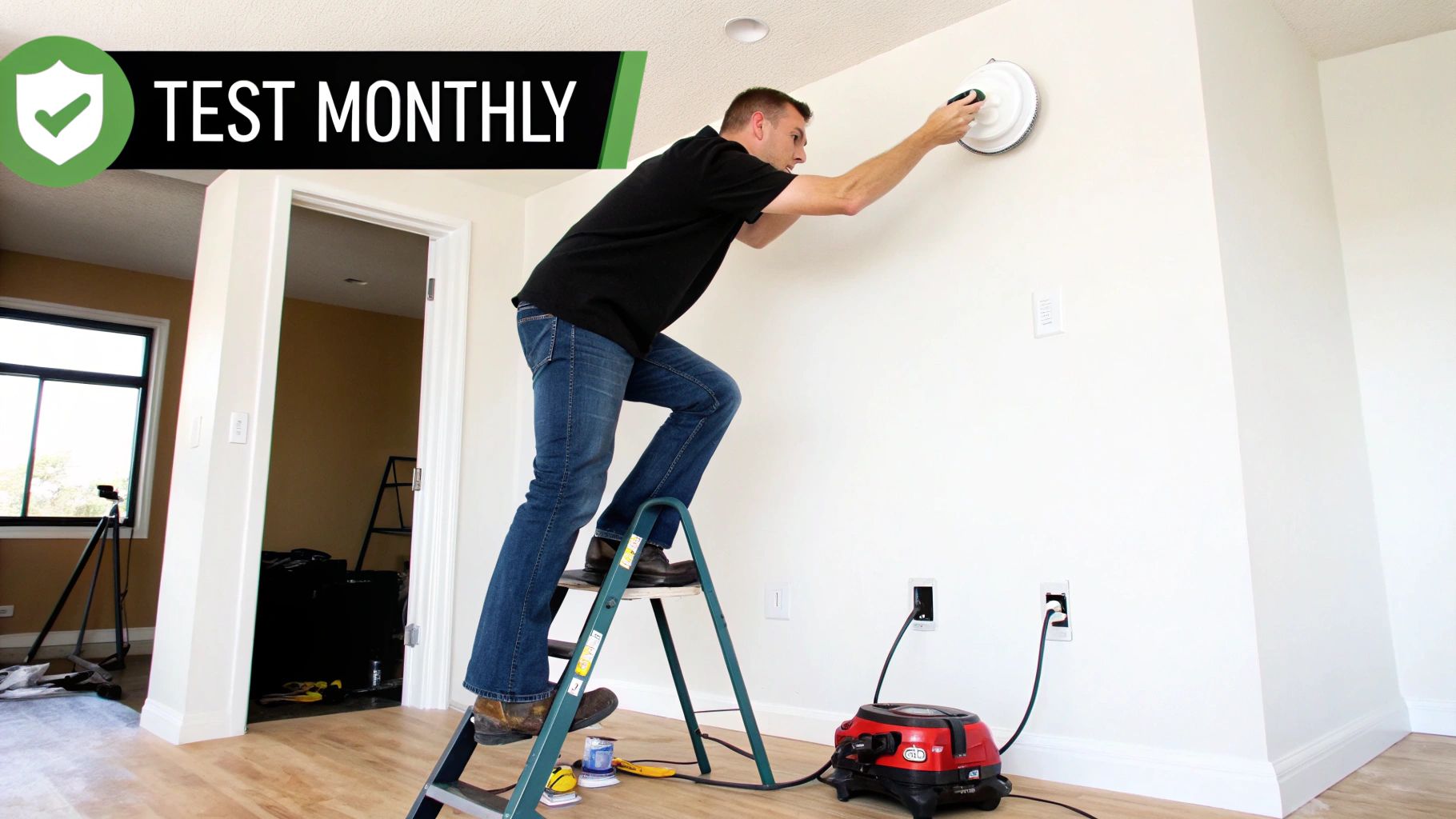
Think of it as a quick health checkup for your home's first line of defense against fire. Here’s a straightforward process you can follow to keep your detectors in peak condition.
1. Test the Alarm Monthly
This is the easiest and most important step. Once a month, just press and hold the "Test" button on each of your smoke detectors. You should hear a loud, piercing alarm.
If the alarm is weak or doesn't sound at all, that's a clear sign the batteries need to be replaced immediately, even if it's not on your regular schedule. If fresh batteries don't fix it, the unit itself might be faulty. For stubborn issues, our team offers expert electrical troubleshooting services to find the root cause.
2. Replace the Batteries on Schedule
Like we talked about, your replacement schedule depends on your detector type. Here’s a quick recap:
- For 9-Volt or AA/AAA Units: Replace these batteries every 6 to 12 months. A great way to remember is to do it when you change your clocks for Daylight Saving Time.
- For Hardwired Units: The backup battery needs to be replaced once a year. Power outages can happen anytime, and this backup is your only protection when the lights go out.
- For 10-Year Sealed Units: No battery changes are needed. Your only job is to replace the entire detector once it hits its 10-year expiration date.
Here’s the thing: never "borrow" a battery from a smoke detector for another device, like a TV remote. According to the NFPA, a disabled smoke alarm is a leading factor in home fire fatalities. An annoying chirp is a sign to buy new batteries, not to remove the old one.
3. Clean the Detector Vents
Did you know dust and cobwebs can clog your smoke detector's vents and interfere with its sensors? It’s a common problem. That buildup can either delay the alarm during a real fire or cause those frustrating false alarms.
At least once a year—ideally every time you change the batteries—gently vacuum the outside of your smoke detector using a soft brush attachment. You can also wipe it down with a dry or lightly damp cloth. Never use cleaning sprays or solvents, as they can easily damage the internal parts.
4. Check the Manufacturing Date
Finally, take a look at the back of your smoke detector for a manufacturing or replacement date. The National Fire Protection Association (NFPA) is crystal clear on this: all smoke alarms should be replaced every 10 years, regardless of the type.
Over time, the sensors inside the unit degrade and become less sensitive. A 15-year-old detector with a fresh battery is simply not as reliable as a new one. If you can't find a date, or if you know the unit is over a decade old, it's time for a replacement. This simple check is non-negotiable for safety.
When to Upgrade Your Smoke Detector System
Sometimes, just knowing how often to replace smoke detector batteries isn’t the whole story. Fresh batteries can’t fix a fundamentally outdated or failing smoke detector system, and sticking with old tech is a huge liability. So, how do you know when it's time for a complete overhaul?
If you're dealing with frequent false alarms even after putting in new batteries, that’s a classic sign the internal sensor is failing. Another massive red flag is the age of the unit itself. All smoke detectors have an expiration date—they must be replaced every 10 years, no exceptions. Their sensors degrade over time, making them less reliable when you need them most.
The Power of an Interconnected System
If your home still has individual, battery-only alarms scattered around, an upgrade isn't just a good idea—it's a critical safety improvement. Here's the problem with standalone detectors: they work in isolation. A fire starting in the basement might not be heard in an upstairs bedroom until it's far too late.
A hardwired, interconnected system completely solves this. It links every single detector in your home into one unified network.
- When one sounds, they all sound. A fire detected in the garage instantly triggers the alarm in your bedroom, giving your family the earliest possible warning.
- They run on your home's electricity. This gives them a constant, reliable power source, and a battery backup keeps them working even if the power goes out.
- They offer true peace of mind. This is especially vital in multi-level homes or properties with detached garages where a fire could otherwise go unnoticed for precious minutes.
Upgrading to an interconnected system is like giving your home a central nervous system for fire safety. Instead of a few isolated guards shouting into the void, you get a coordinated team where every member communicates danger instantly, ensuring the message is heard everywhere at once.
Smart Detectors: The Modern Safety Solution
Today’s technology takes protection a step further. Smart smoke detectors connect to your home’s Wi-Fi and send alerts straight to your smartphone the second an alarm goes off. That means you’ll know about a potential fire even when you're not home, letting you call for help immediately.
These modern systems are the peak of home fire safety, combining rock-solid reliability with immediate, remote awareness. At Black Rhino Electric, we specialize in designing and installing these modern solutions, making sure they’re placed correctly and work flawlessly. An upgrade isn't just an expense; it's a powerful investment in your family’s well-being.
Got Questions About Smoke Detector Batteries? We’ve Got Answers.
When it comes to your home's safety, there’s no such thing as a dumb question. We get calls all the time from homeowners trying to do the right thing, and a few topics come up again and again.
Let's clear the air on some of the most common questions about smoke detector batteries so you can feel confident your alarms are ready to go.
Can I Use Rechargeable Batteries in My Smoke Detector?
This is a great question, but the answer is a firm no. It’s tempting to think you’re being resourceful, but for a life-saving device like a smoke alarm, it's a risky shortcut.
Here's the thing: rechargeable batteries are designed for devices that get used and recharged frequently, like a camera or a remote control. They tend to lose their charge much faster when just sitting idle. A smoke detector, on the other hand, needs a battery that can reliably hold a charge for months on end. Standard alkaline or lithium batteries are built for that exact kind of slow, steady power draw. Stick with what the manufacturer recommends—it's the safest bet.
Do Hardwired Smoke Detectors Work If the Power Goes Out?
Yes, they absolutely do, and this is one of their biggest advantages. Every hardwired smoke detector is required to have a battery backup, usually a 9-volt or a pair of AAs.
Think of it as a built-in safety net. The detector runs on your home’s main electrical system day-to-day, but the moment the power cuts out—which often happens during a fire—that backup battery instantly takes over. There’s no gap in protection. That’s precisely why you still need to replace that backup battery annually. The hardwiring is for convenience; the battery is for emergencies.
What Does a Series of Three or Four Beeps Mean?
Your smoke detector has its own language, and it’s critical to know what it’s trying to tell you. A single, spaced-out chirp is a low-battery reminder—an annoying but non-urgent request for maintenance. A continuous series of loud beeps, however, is an entirely different story.
A pattern of three loud, repeating beeps is the universal alarm for a fire or smoke emergency. If you have a combination unit, a pattern of four loud, repeating beeps typically signals the presence of carbon monoxide.
Never, ever ignore those repeating patterns. A single chirp is a heads-up to change a battery soon. A series of three or four beeps is a demand for immediate action. Knowing the difference is one of the simplest and most important things you can do to keep your family safe.
Protect Your Home with Professional Electrical Safety
Knowing how often to replace smoke detector batteries is a great first step, but it’s just one piece of the puzzle. Your family’s safety isn't a place for guesswork, and true peace of mind comes from knowing your entire electrical safety system is installed correctly and working as it should.
This is where a DIY approach can fall short. Diagnosing a faulty unit, upgrading to a modern interconnected system, or integrating smart detectors takes real expertise. Professional installation guarantees that every wire is connected properly, the system meets local codes, and it provides the reliable protection your family deserves. It’s the difference between just having alarms and having a true safety system.
Your Local Experts in Home Safety
If your detectors are over 10 years old, if you’re tired of playing detective with mystery chirps, or if you simply want the ultimate protection of a modern, hardwired system, our licensed electricians are here to help. We provide Northern Utah homeowners with professional safety inspections and honest, transparent advice.
Let our team handle the complexities so you can rest easy knowing your home is secure. For homeowners looking to upgrade or install new systems, you can easily request a quote from our team.
At Black Rhino Electric, we believe safety should never be compromised. For a professional inspection and expert advice, call us today at 385-396-7048 or request a free quote online.