Electrical work isn't just another home improvement project; it's a matter of safety for you and your family. So, how to find a good electrician you can trust is one of the most important questions a homeowner can ask. Getting it right means peace of mind, while getting it wrong can lead to serious risks and costly repairs.
Your First Line of Defense: Licenses and Insurance
Skipping the credential check is one of the biggest gambles a homeowner can take. An unlicensed person might quote you a lower price, sure, but is that "deal" really worth it when you're facing failed inspections, faulty wiring, or worse, a house fire? Honestly, this one check is your best defense against shoddy work, financial headaches, and serious safety risks.

Here’s the thing: an electrician's license is proof they’ve passed the state's training and testing requirements. Here in Utah, that means they’re registered with the Division of Occupational and Professional Licensing (DOPL) and know the specific electrical codes for our area, whether you're in Weber, Davis, or Salt Lake County. It confirms they have the skills to handle your project safely, from a simple outlet swap to a full panel upgrade.
The Critical Role of Proper Credentials
So, what are you really checking for? These credentials are more than just paperwork; they speak volumes about a company’s professionalism and commitment to doing things the right way.
- Liability Insurance: This is what protects your property. If an accident happens—say, a power surge from the work fries your expensive appliances—their insurance covers it, not your homeowner's policy.
- Workers' Compensation: This protects you. If an electrician gets hurt while working at your home, their company's workers' comp handles their medical bills. Without it, you could be facing a lawsuit.
- Code Compliance: Licensed electricians are accountable for making sure their work meets local and national electrical codes. Unlicensed work that fails inspection often has to be ripped out and redone, and that bill lands right back in your lap.
The process of vetting a contractor is pretty similar across different trades. For another angle on doing your homework, check out this guide on how to choose a roofing contractor.
The Real-World Risks of Unlicensed Work
The numbers don't lie. Unlicensed electrical work is a major contributor to residential fires. In fact, some statistics show it's a factor in over 40% of electrical fires reported in the U.S. each year. By hiring only licensed and insured professionals, you slash your liability and ensure the job is done right the first time.
Any reputable company will be happy to provide their license number and proof of insurance. If someone hesitates or gets defensive, what does that tell you? It's a huge red flag. Your home's safety is not worth the risk.
Gauging Reputation with Reviews and Local Referrals
Finding a licensed and insured pro is a fantastic start, but now it’s time to dig into their track record. A company’s website shows you the highlight reel. For the real, unfiltered story, you need to turn to past customers.
Online reviews and good old-fashioned word-of-mouth are your best tools. They reveal the details that matter most: punctuality, communication, cleanliness, and the actual quality of the work.

Decoding Online Reviews
Don't just glance at the star rating. A perfect 5.0 with a handful of generic "great job!" comments is often less telling than a 4.7-star rating filled with detailed, specific feedback. The details are where the truth lives.
When you're sifting through reviews on platforms like Google or Yelp, look for patterns. Are multiple people praising the electrician's clear communication? Or are there several complaints about showing up late? That’s the valuable intel.
Look for reviews that tell a story. Comments like, "They explained the entire panel upgrade process and cleaned up perfectly afterward," give you a much clearer picture of their professionalism than a simple star rating.
This level of insight is crucial. Recent industry reports highlight that top-rated electricians resolve issues up to 40% faster than their lower-rated counterparts—a testament to their efficiency. Given how much weight consumers place on reviews, spending time here is invaluable. You can explore more electrical industry statistics to see just how important this has become. Reading reviews isn't just about spotting red flags; it's about finding the right fit for your project.
How to Analyze Online Electrician Reviews
| What to Look For | Why It Matters | Example Comment |
|---|---|---|
| Problem-Solving Details | Shows they can handle unexpected issues, not just routine tasks. | "We had a tricky wiring issue in our old house, and they took the time to trace it down instead of just giving up. Impressed." |
| Communication Mentions | Good communication prevents surprises with scheduling, scope, and cost. | "I always knew when they were coming, and they called ahead. The final bill was exactly what the quote said." |
| Cleanliness and Respect | Indicates professionalism and respect for your property—a huge plus. | "They wore shoe covers without me asking and left the work area cleaner than they found it. Five stars for that alone." |
| Response to Negative Reviews | A professional, constructive response shows accountability. No response or a defensive one is a red flag. | Owner Response: "We're sorry we missed the mark on scheduling. We've since updated our dispatch system to prevent this." |
| Consistency Over Time | A long history of positive reviews is more reliable than a recent burst of perfect scores. | "I've used them three times over the last five years. Consistently great service." |
The Power of Local Referrals
While online reviews are powerful, never underestimate a good old-fashioned local referral. Asking people in your community provides a layer of trust you just can't get online.
Consider these sources for solid recommendations:
- Neighbors and Friends: Especially those who have recently completed a remodel or had major electrical work done. They'll give you the unvarnished truth.
- Local Hardware Store Staff: They know which electricians are buying quality materials week after week and who has a solid reputation around town.
- Real Estate Agents: In areas like Weber and Davis counties, real estate pros rely on a network of trustworthy tradespeople to get homes ready for sale.
- Other Trusted Tradespeople: If you have a plumber or HVAC tech you trust, ask them who they recommend. Good pros tend to know other good pros.
A local referral comes with context. Your neighbor can tell you not just that the work was good, but that the electrician was respectful of their home, showed up on time every day, and stayed on budget—the exact details you need to make a confident decision.
Asking Questions That Reveal True Expertise
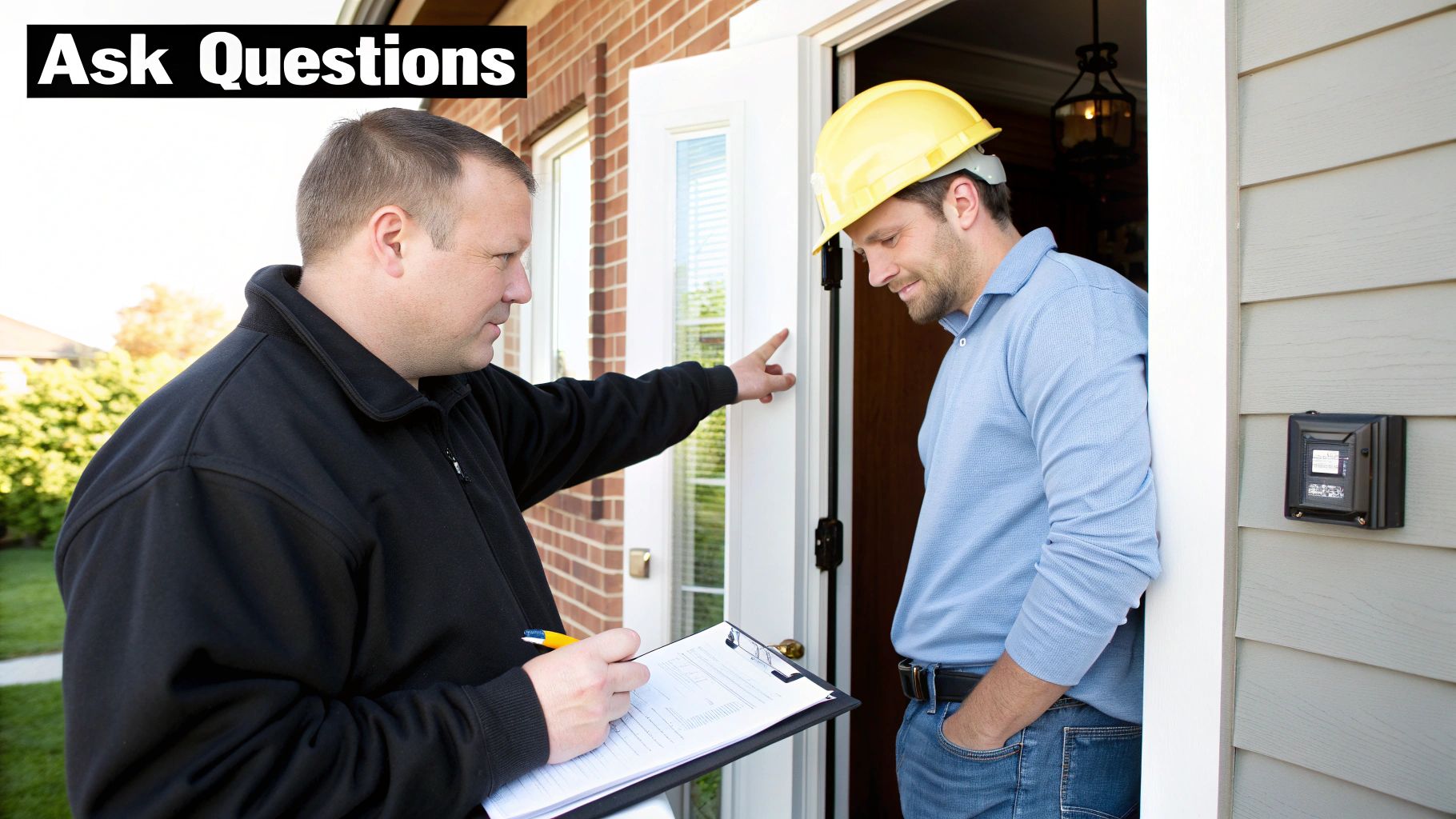
You’ve done your homework, checked licenses, and sorted through the reviews. Now you have a shortlist of electricians who look good on paper. This is where a simple phone call or in-person consultation separates the true pros from the rest. The key is to ask smart questions that go way beyond just the price.
Their answers—and just as importantly, how they answer—will tell you everything you need to know about their experience and problem-solving skills. You want someone who is confident and clear, not evasive or dismissive, right?
Questions About Their Experience and Team
Let's start with questions about their specific experience with your kind of project. A generalist is fine for swapping an outlet, but you need a specialist for a Tesla Wall Connector installation or a tricky rewiring job in an older Ogden home.
Here are a few questions I always recommend:
- "Have you done projects just like this one recently? Can you give me a couple of examples?" This gets right to the point. A confident electrician will have recent, relevant examples ready to go.
- "Who will be doing the actual work? Will it be you, a journeyman, or an apprentice?" This is about knowing who is showing up at your door. There’s nothing wrong with an apprentice, but you want to know they’ll be properly supervised by a seasoned pro.
- "How familiar are you with the permitting process in [Your City, e.g., Layton, Bountiful]?" Navigating local bureaucracy is a huge part of the job. Their answer shows if they’re established, professional, and do things by the book.
Digging Into Technical and Logistical Details
Next, it’s time to get into the nitty-gritty of how they work. This is where you can gauge their technical knowledge and how they handle the unexpected. Let me explain: their approach to safety and problem-solving is a direct reflection of their expertise.
A bit of self-education can help here. Having a basic grasp of concepts like understanding overcurrent protection devices will make their answers about circuit breakers and panel safety much more meaningful to you.
A true professional will welcome detailed questions. They see it as a chance to show what they know and build trust, not as an annoyance. If they get defensive, rush you, or give vague answers, that’s a massive red flag.
Green Flags vs. Red Flags in Their Answers
| Question Topic | Green Flag Response (Good) | Red Flag Response (Bad) |
|---|---|---|
| Project Experience | "Absolutely. We installed three EV chargers in your area last month. We can handle the dedicated circuit and permitting." | "Yeah, we've done some of those before. It shouldn't be a problem." |
| Unexpected Issues | "If we find unforeseen issues like old knob-and-tube wiring, we stop work, document it with photos, and discuss options and costs with you before proceeding." | "We'll just handle it and add it to the final bill. It happens." |
| Permits & Inspections | "We handle the entire permit application and schedule the final inspection with the city. The cost is included in our detailed quote." | "You don't really need a permit for a job this small. It just slows things down." |
| Warranty | "We offer a two-year warranty on all our workmanship and stand by the quality of the materials we use." | "If something goes wrong, just give us a call and we'll see." |
By asking these targeted questions, you push past the sales pitch and get a real sense of their capabilities. This direct conversation is your final filter, ensuring you choose an expert you can actually trust with the safety of your home or business.
Decoding Quotes and Understanding the Costs
You’ve got a few quotes in hand, and now comes the tricky part—figuring out which one is the right one. The cheapest quote is almost never the best deal. A lowball offer often screams "cut corners," "subpar materials," or "inexperienced tech."
This is where you need to look past the final number and really dig into the details. A professional, transparent quote is your project's roadmap, and a good one leaves no room for expensive surprises down the line.

What a Professional Quote Must Include
A legitimate quote is more than just a price scribbled on a piece of paper; it’s a detailed proposal. Vague, one-line estimates? That’s a massive red flag. You want a document that breaks down every single part of the job.
Here’s what every solid quote should contain:
- A Detailed Scope of Work
- Itemized Material Costs
- Breakdown of Labor Costs
- Permitting Fees
- Payment Terms
- Warranty Information
A quote that lacks this level of detail isn't just unprofessional—it’s a warning sign. It leaves you vulnerable to unexpected costs and disputes once the project has already started.
Flat-Rate vs. Hourly Pricing
You'll run into two main pricing structures in the electrical world: flat-rate and hourly. Neither one is inherently better than the other; the right choice really just depends on the project.
- Flat-Rate Pricing: You get a single, upfront price for the entire job. This is great for well-defined projects like a panel upgrade or an EV charger installation because it gives you cost certainty.
- Hourly Pricing (Time and Materials): This is common for troubleshooting and repair work where the scope isn't crystal clear from the start. Always ask for an estimated number of hours and set a "not to exceed" limit without your approval. This keeps you from getting a runaway bill.
To make comparing your options a bit easier, I've put together a simple checklist. Use this to lay out the details from each quote side-by-side.
Electrician Quote Comparison Checklist
| Checklist Item | Electrician A | Electrician B | Electrician C |
|---|---|---|---|
| Detailed Scope of Work Provided? | ☐ | ☐ | ☐ |
| Itemized Material List? | ☐ | ☐ | ☐ |
| Labor Costs Clearly Explained? | ☐ | ☐ | ☐ |
| Permit Fees Included? | ☐ | ☐ | ☐ |
| Payment Schedule Outlined? | ☐ | ☐ | ☐ |
| Warranty Details Specified? | ☐ | ☐ | ☐ |
| License & Insurance Verified? | ☐ | ☐ | ☐ |
| Total Estimated Cost | $ | $ | $ |
Ultimately, a good quote empowers you to make an informed decision based on value, not just the initial price tag. If you ever feel pressured or see vague descriptions, trust your gut.
Making Your Final Decision and Moving Forward
You’ve done the heavy lifting. You’ve checked licenses, read the reviews, asked the tough questions, and laid out a few detailed quotes side-by-side. Now it’s time to hire with confidence.
This last part is all about formalizing the agreement and setting clear expectations. Think of it as laying the foundation for a smooth project, turning all that research into a concrete plan that protects both you and the electrician you’ve chosen.
Solidify Everything with a Formal Contract
Never, ever move forward with significant electrical work on a handshake. A formal, written contract is your single most important piece of protection. It turns verbal promises into legally binding commitments, wiping out any gray areas that could cause headaches later. Any true professional will insist on one.
Before you sign, make sure it nails down these details:
- Complete Scope of Work
- Total Project Cost
- Payment Schedule
- Project Timeline
- Warranty Information
This document is your proof that the high standards you looked for during your search will be met in the real world.
Final Preparations for a Smooth Project
Once the contract is signed, a few last-minute logistical details can make a world of difference. A quick chat to clarify these points isn’t being picky—it’s being professional.
Establish a clear point of contact and ask for their preferred way to communicate. Also, run through the practical stuff: What are their work hours? Where should they park? Are there any pets or kids they need to be mindful of? This little bit of coordination prevents daily disruptions and shows respect for everyone’s time and property.
By taking these final steps, you’re not just hiring an electrician. You’re kicking off a professional relationship built on transparency and clear communication.
A Few Common Questions We Hear All the Time
When you're looking to hire an electrician, a lot of questions come up. It's only natural, especially when the safety of your home is on the line. Getting straight answers is the first step toward finding an electrician you can actually trust.
What's the Difference Between a Master and a Journeyman Electrician?
You'll hear these two terms a lot, and the distinction is actually pretty important. The easiest way to think about it is like a career path.
- A Journeyman Electrician has completed a rigorous 4-5 year apprenticeship. They're fully licensed by the state to work on their own and are qualified for the vast majority of residential and commercial jobs.
- A Master Electrician is a journeyman with at least two more years of experience who has passed an even more difficult state exam. They have a deeper knowledge of the National Electrical Code and can supervise complex projects.
For most projects around your home, a journeyman is perfectly capable. But for complex installations, knowing a master electrician is overseeing the project adds a serious layer of confidence.
When Do I Actually Need a Permit for Electrical Work?
This is a big one, and the short answer is: for most things that go beyond a simple repair. In counties like Weber, Davis, and Salt Lake, you'll almost always need a permit for any new installation or significant change to your electrical system.
You know what? It’s easy to see permits as just a hassle, but they're really your best friend when it comes to safety. A permit automatically triggers a third-party inspection from your city or county. That inspection is what guarantees the work was done right and meets all the current safety codes.
Projects that will absolutely require a permit include things like panel upgrades, adding new circuits, wiring for an addition or remodel, and installing an EV charger. A true professional will always know when a permit is required and will handle that entire process for you.
How Should I Handle an Issue That Pops Up Mid-Project?
Even with the absolute best electrician, surprises can happen—especially in older homes. The key is communication. If something comes up, bring it up immediately and professionally.
A good electrician will pause what they're doing, clearly explain the problem they've run into, and lay out your options before moving forward. If you have more questions about the process, you can always check out our detailed electrician FAQ page for more answers.
The fact is, a recommendation from a friend or another contractor will always beat a flashy advertisement. An overwhelming 92% of homeowners trust word-of-mouth when it comes to the skilled trades. With the U.S. electrical services market now pulling in over $200 billion each year, your personal network is the best way to find the top pros. And the numbers back it up: electricians hired through referrals have a 28% higher customer satisfaction rate, which means far less chance of needing expensive rework down the road. You can discover more insights about market planning in the electrical industry to see the data for yourself.
At Black Rhino Electric, we believe that trust is built on clear, honest communication and expert-level work. If you're ready to partner with a team that puts your safety and satisfaction at the top of the list, give us a call at 385-396-7048 or request a free quote online today.