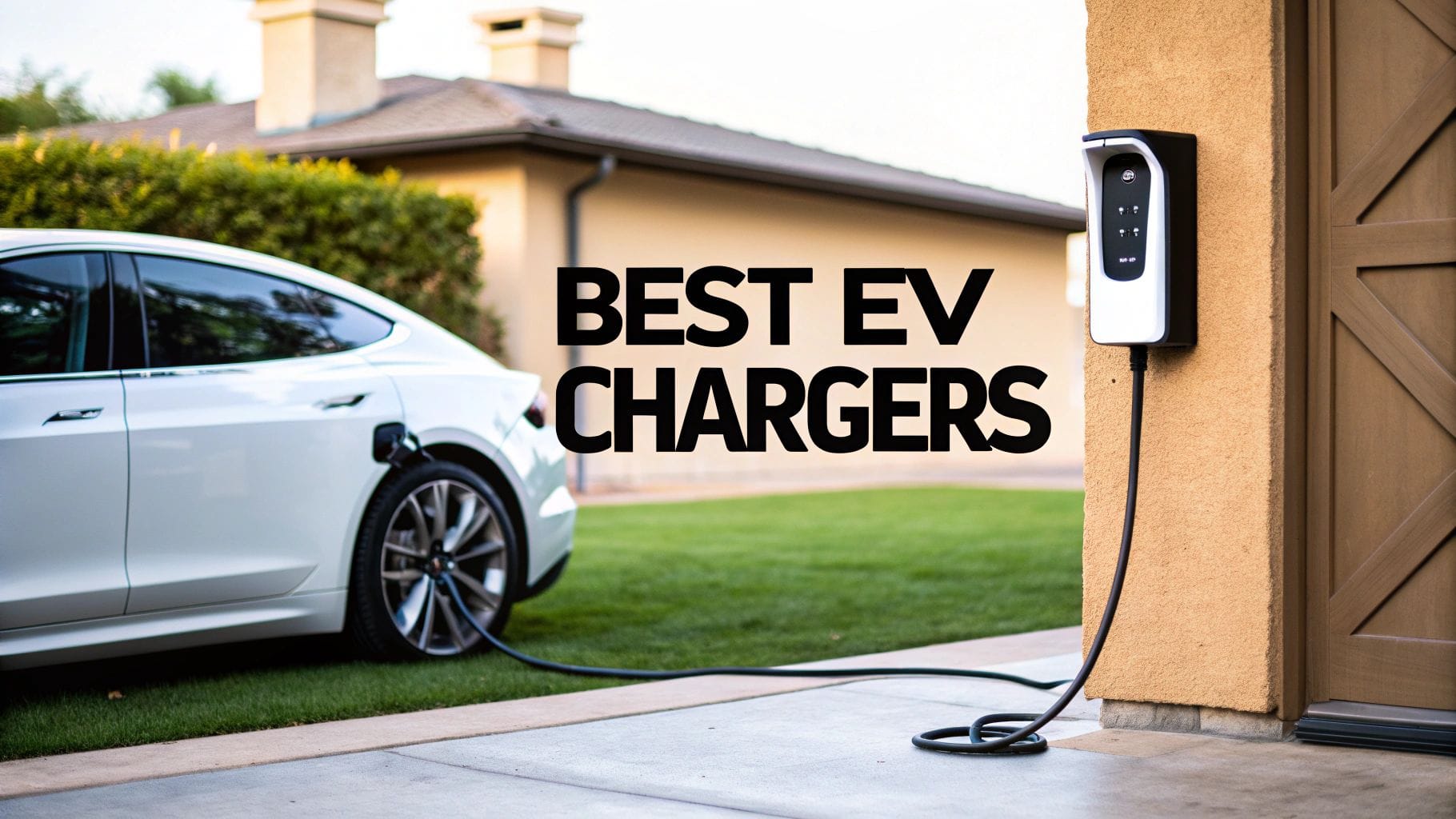
Choosing the right charger for your new Tesla can feel complicated, but finding the best EV chargers for Tesla really boils down to your daily driving habits and future plans. For most Utah homeowners, the decision is between Tesla's own Wall Connector for maximum speed or a universal charger for ultimate flexibility. Let me explain how to make the right choice for your garage.
Choosing the Best EV chargers for Tesla
Let me explain the core difference in plain English: the Tesla Wall Connector is built to give your car the fastest possible charge with seamless integration. On the other hand, universal chargers are all about flexibility, letting you charge any EV brand that might pull into your driveway.
Honestly, both are excellent choices, but they’re built for slightly different situations. To decide, you really just need to weigh raw speed against future-proof versatility.
Here’s a quick breakdown to get you started:
| Feature | Tesla Wall Connector | Universal L2 Charger (e.g., ChargePoint) |
|---|---|---|
| Compatibility | Tesla vehicles only | All EVs (your Tesla will need its J1772 adapter) |
| Max Speed | Up to 44 miles of range per hour | Up to 37 miles of range per hour |
| Best For | Dedicated Tesla households | Homes with multiple EV brands (or guests with them) |
Why Home Charging Is Essential for Tesla Owners
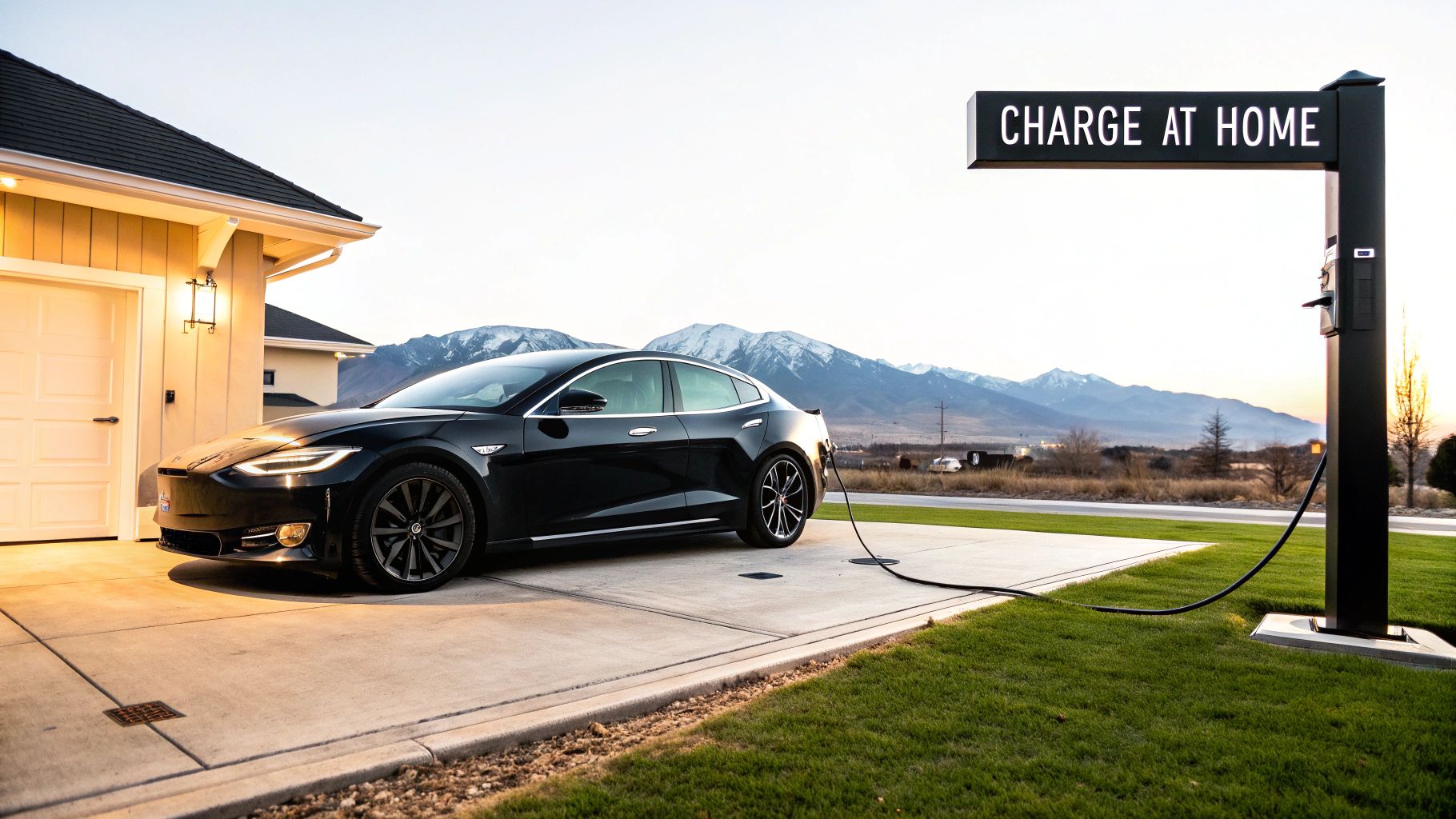
Honestly, is there anything better than the convenience of waking up to a fully charged car every morning? Investing in one of the best EV chargers for Tesla isn't just about adding a cool gadget to your garage; it's a fundamental upgrade to your daily life. It transforms your ownership experience from planning trips around public stations to simply starting each day with a full "tank."
This shift from relying on public infrastructure to having a personal refueling station is the single most impactful change a new Tesla owner can make. Here’s the thing: this move is less of a luxury and more of a practical necessity.
The Massive Leap in Speed and Convenience
Have you ever tried charging your Tesla with a standard 120-volt wall outlet? It’s painfully slow, adding only about 3-5 miles of range per hour. That might be fine for an occasional top-up, but for daily driving in Weber or Davis County, it’s simply not sustainable. A Level 1 charge could take several days to replenish a depleted battery.
This is where a professionally installed Level 2 charger makes all the difference.
By upgrading to a 240-volt Level 2 unit, you unlock charging speeds that are 4 to 10 times faster. This means you can reliably add 25 to 44 miles of range every hour your car is plugged in overnight, ensuring it's ready for any commute or errand by morning.
This upgrade turns charging from an active, time-consuming task into a passive, effortless routine. You arrive home, plug in, and forget about it. The next morning, your Tesla has all the range you need.
The Unbeatable Financial Advantage
Beyond convenience, the financial argument for home charging is overwhelmingly strong. Relying on public chargers, especially DC fast chargers like Tesla Superchargers, comes at a premium. While essential for road trips, using them for daily charging is like exclusively buying gas from the most expensive station in town.
You know what? Home electricity is significantly cheaper. At typical Utah electricity rates of around $0.11–$0.13 per kWh, you can fully charge a 75 kWh Tesla battery for under $10. Compare that to the cost of gasoline for an equivalent trip, which can easily run 3–4 times higher.
The savings are clear and consistent, month after month.
Home Charging by the Numbers
Let's look at the data. Around 80–90% of all EV charging sessions in the U.S. happen at home or at work, precisely because it’s the most efficient and economical method. This preference isn't just a trend; it's a reflection of how seamlessly Level 2 charging fits into a driver’s daily life, making public fast chargers a tool for long-distance travel, not daily necessity. Learn more about EV charging infrastructure trends and their impact on the market.
Ultimately, installing a dedicated home charger provides:
- Effortless Mornings: No more range anxiety or early-morning detours to a public station.
- Significant Savings: Drastically lower your "fuel" costs compared to both gasoline and public fast chargers.
- Battery Health: Slower, consistent overnight charging with a Level 2 unit is generally better for your battery's long-term health than frequent DC fast charging.
- Property Value: A professionally installed EV charger is an attractive feature for future homebuyers.
Comparing Top Tesla Home Charging Solutions
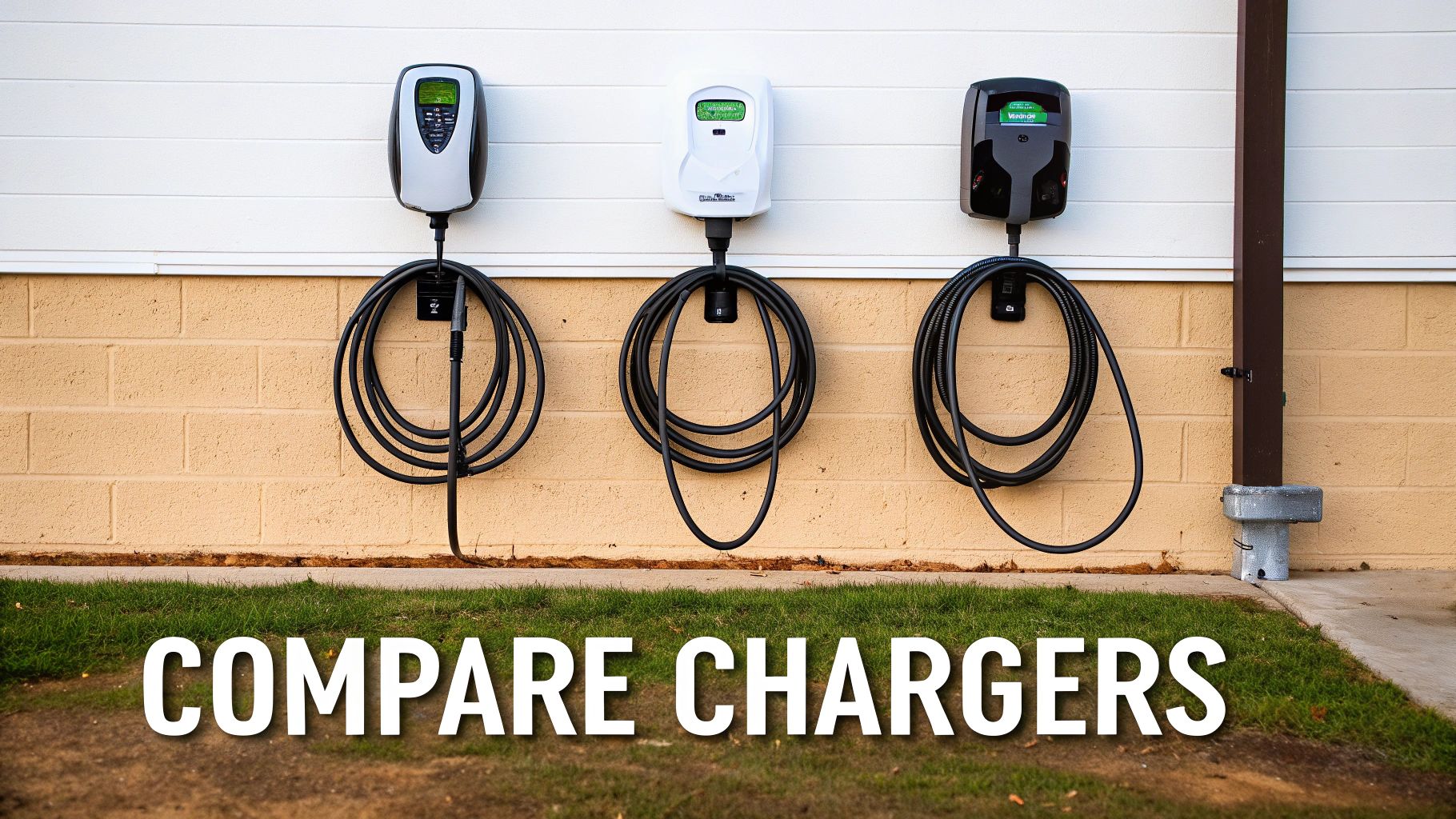
Finding the best EV chargers for Tesla isn't just about picking the one with the Tesla logo. Here’s the thing—not all chargers are created equal, and what works perfectly for your neighbor might be the wrong fit for you. The right decision comes down to a balance of raw charging speed, smart features, future flexibility, and, of course, your budget.
Let’s break down the top contenders for Utah homeowners: the official Tesla Wall Connector, leading universal chargers, and the straightforward NEMA 14-50 outlet. We'll look at each through the lens of what actually matters for daily use.
The Tesla Wall Connector Gen 3
For many Tesla owners, the Wall Connector is the default choice, and for good reason. It’s designed by Tesla, for Tesla. That means you get the fastest possible Level 2 charging speeds your vehicle can handle, delivering up to 44 miles of range per hour when it's installed on a dedicated 60-amp circuit.
Its biggest advantage is just how seamless it is. The charger talks directly to your car, and you can monitor and control everything through the Tesla app you already use every day. Honestly, it just works.
The only real catch is its exclusivity. It uses the proprietary NACS (Tesla) plug, so it can't directly charge non-Tesla EVs without an adapter. That might be a dealbreaker if you have a multi-EV household or plan to in the future.
Universal J1772 Chargers
What if you want to be ready for any electric vehicle that might park in your garage? This is where universal Level 2 chargers, like the ChargePoint Home Flex or Grizzl-E Classic, really shine. They use the standard J1772 plug, which is compatible with every other EV on the market.
To charge your Tesla, you simply use the small J1772 adapter that came with your vehicle. It’s one tiny extra step, but it opens up a world of flexibility for guests, future cars, or a spouse's non-Tesla EV.
A key differentiator for many universal chargers is their independent smart features. They often come with their own dedicated apps that provide detailed energy usage reports, allow you to schedule charging to take advantage of off-peak electricity rates, and integrate with smart home systems like Alexa.
These chargers typically add up to 37 miles of range per hour on a 50-amp circuit, which is more than enough to give you a full charge overnight.
The Simple NEMA 14-50 Outlet
Sometimes, the simplest solution is the best one. A professionally installed NEMA 14-50 outlet is a heavy-duty, 240-volt socket—the same kind you’d find powering an electric range or an RV. It’s not a "charger" itself, but a powerful outlet you plug a portable charger into.
Using Tesla's own Mobile Connector with a 14-50 adapter, you can get charging speeds of around 25-30 miles of range per hour. While it’s not as fast as a dedicated hardwired station, it’s a massive leap from a standard wall outlet.
This option is often the most budget-friendly upfront and offers unbeatable flexibility. If you move, you just unplug your Mobile Connector and take it with you. For a deeper look at what goes into these setups, check out our guide on professional Tesla EV charger installation.
At-a-Glance Comparison of Leading Tesla Home Chargers
To make it easier, this table breaks down the key features, performance, and ideal use cases for the most popular Tesla-compatible home charging options for Utah homeowners.
| Charger Solution | Max Charging Speed | Connection Type | Key Smart Features | Ideal User |
|---|---|---|---|---|
| Tesla Wall Connector | Up to 44 miles/hr | Tesla NACS (Proprietary) | Wi-Fi connectivity, power-sharing for multiple units, seamless integration with the Tesla app. | The dedicated Tesla owner who prioritizes maximum charging speed and a clean, integrated experience. |
| Universal Charger (e.g., ChargePoint) | Up to 37 miles/hr | Universal J1772 | Robust app for scheduling & energy tracking, smart home integration (Alexa), utility demand response programs. | The tech-savvy homeowner who wants detailed control, energy data, and flexibility for any EV brand. |
| NEMA 14-50 Outlet | ~25-30 miles/hr (with Mobile Connector) | 240V Outlet (Plug-in) | Relies on the vehicle's app for scheduling; the outlet itself has no smart features. | The budget-conscious driver, renter, or anyone seeking a simple, flexible, and effective charging solution. |
Ultimately, the choice comes down to your personal priorities. Do you value the absolute fastest charge and ecosystem integration, or is future-proofing for other EV brands more important? Each of these options provides a reliable, powerful home charging experience far beyond what a standard outlet can offer.
Understanding Installation Costs and Requirements
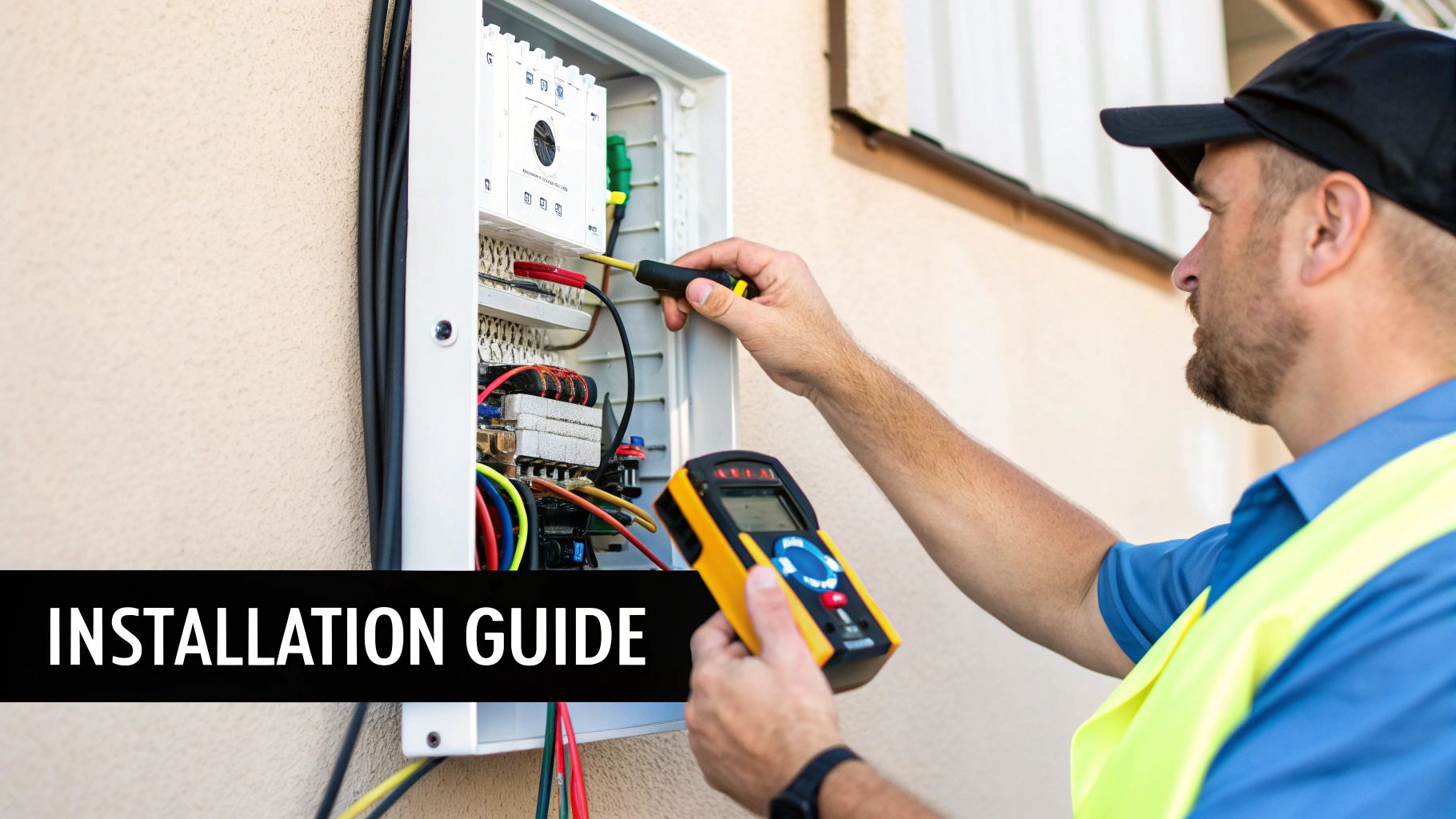
You know what? The charger itself is only half the story. Finding the best EV charger for your Tesla means figuring out what it takes to get it installed safely and correctly. Honestly, the installation work and its cost are just as important as the hardware you hang on the wall.
This is where the real work begins, turning that box on your doorstep into a fully functional, high-speed charging station in your garage. Let me break down the key factors that will shape your project's complexity and final budget.
Your Home's Electrical Panel: The Heart of the System
Think of your home's electrical panel as its heart, pumping power to every room. Adding a Level 2 EV charger is like asking that heart to support a major new organ. To do that, the panel needs enough spare capacity.
Most high-speed chargers, including the Tesla Wall Connector, need a dedicated 240-volt circuit, usually rated for 50 or 60 amps. If your current electrical panel is older, smaller, or already maxed out with other big loads like an electric furnace or hot tub, it might not have the room to handle this new demand safely.
This is why a professional assessment is so critical. A licensed electrician will perform a load calculation to see if your panel can support the new circuit. If it can't, a panel upgrade will be necessary. It’s a bigger job, for sure, but it's the only way to ensure your entire home's electrical system stays safe and reliable.
Hardwired vs. Plug-In Installation: What's the Difference?
Once we know your panel can handle the load, the next decision is how to connect the charger. You’ve got two main options, each with its own pros and cons.
- Hardwired Installation: This means the charger is connected directly to the circuit, creating a permanent, seamless connection. It's often required to unlock the highest possible charging speeds (like the 48-amp output on a 60-amp circuit for a Tesla Wall Connector) and is generally seen as the cleanest, most robust setup.
- NEMA 14-50 Plug-In: This involves installing a heavy-duty 240-volt outlet, the kind you’d see for an electric stove. You then just plug your charger into the wall. It offers more flexibility if you think you might move, but it usually caps charging speed at 40 amps (from a 50-amp circuit).
For most homeowners who want the fastest, most integrated solution, a hardwired installation is the way to go. It eliminates a potential point of failure—the plug and outlet connection—and provides more stable power delivery for years.
Understanding these choices is a key part of the process. For a more detailed look, you can explore what's involved when you hire a professional EV charger installation electrician.
Budgeting for Installation in Northern Utah
So, what should you expect to pay? Installation costs can vary quite a bit based on a few key factors. The distance from your electrical panel to where you want the charger is a big one, as it determines how much heavy-gauge wire we need. The complexity of the wire run—whether it goes through finished walls, attics, or an unfinished garage—also plays a huge role.
Here in Northern Utah, a straightforward installation in a garage with an easy-to-access panel might cost a few hundred dollars. But a more complex job that needs a panel upgrade, a long wiring run, and maybe some trenching could be significantly more.
Here’s the thing: this is not a DIY project. Working with 240-volt circuits is dangerous and demands strict adherence to local electrical codes in Weber, Davis, and Salt Lake counties. Hiring a licensed, insured electrician is non-negotiable. It ensures your installation is safe, code-compliant, and won't void your car's or charger’s warranty. It’s a crucial investment in the safety of your home and your expensive new vehicle.
Get Paid to Upgrade: Maximizing Utah Rebates and Incentives
Installing a great EV charger for your Tesla is a smart move. You know what’s even smarter? Letting someone else help pay for it.
Seriously, there are a bunch of rebates and incentives out there for Utah residents, and they’re designed to knock a serious chunk off your upfront cost. Navigating these programs can feel like a chore, but it’s worth it. We’re talking hundreds, sometimes thousands, of dollars back in your pocket.
Federal Tax Credits for Home Charging
The biggest one for most homeowners is the federal tax credit. The Residential Clean Energy Credit was updated to include EV charging equipment, and it’s a big deal. The program can give you a tax credit for 30% of the total cost of your charger and its installation, up to $1,000.
Just to be clear, it’s a credit, not a deduction. That means it directly reduces the amount of tax you owe, dollar for dollar. The rules can change, so you’ll want to check the latest details when you file. The most important thing? Keep every single receipt from your equipment purchase and the professional installation—you’ll need them to claim the credit.
Local Utility Rebates in Northern Utah
On top of the federal credit, Utah’s local utility providers often have their own programs. Rocky Mountain Power, for example, frequently offers rebates to customers who install a Level 2 charger at home. Their goal is to encourage off-peak charging, which helps keep the electrical grid stable for everyone.
To get in on these local rebates, you usually need to do the following:
- Be a residential customer of the utility provider.
- Buy a new, qualifying Level 2 smart charger.
- Get it installed by a licensed electrician (like us at Black Rhino Electric).
The rebate might come as a check in the mail or a credit on your power bill, giving you an immediate win. We always tell our clients to check their utility’s website for the most current program details in Weber, Davis, and Salt Lake counties, because deadlines and funding can change.
It’s worth noting that the global push for EV adoption is huge. The EV charging infrastructure market is projected to skyrocket from $1.7 billion to over $18.6 billion by 2026, and incentives like these are a key driver. This growth is fueled by homeowners discovering that a Level 2 home charger is the most convenient and cost-effective way to live with an EV. You can discover more insights about the EV charging market on ResearchDive.com.
When you stack a federal tax credit with a local utility rebate, the total cost of getting a high-quality charging station installed becomes way more manageable. The trick is to do your homework before you buy and to work with an installer who knows the ropes. This ensures the charger you pick is eligible and the installation is documented correctly, making it a breeze to claim every dollar you’re entitled to. It turns a smart home upgrade into a brilliant financial decision.
Making the Right Choice for Your Utah Home
Let's pull this all together. Picking from the best EV chargers for a Tesla isn't about finding one "perfect" charger. It's about matching the right solution to your life here in Northern Utah. What a daily commuter in Salt Lake County needs is probably different from what a family with two EVs in Ogden is looking for.
This decision really boils down to three things: your driving habits, your home's setup, and your future plans. Are you after raw charging speed, ultimate flexibility for any EV, or the most straightforward, budget-friendly installation? By walking through a few common scenarios, you can confidently zero in on the charger that will serve you best.
This decision tree gives you a quick visual for finding the right charging path based on what matters most to you as a Tesla owner.
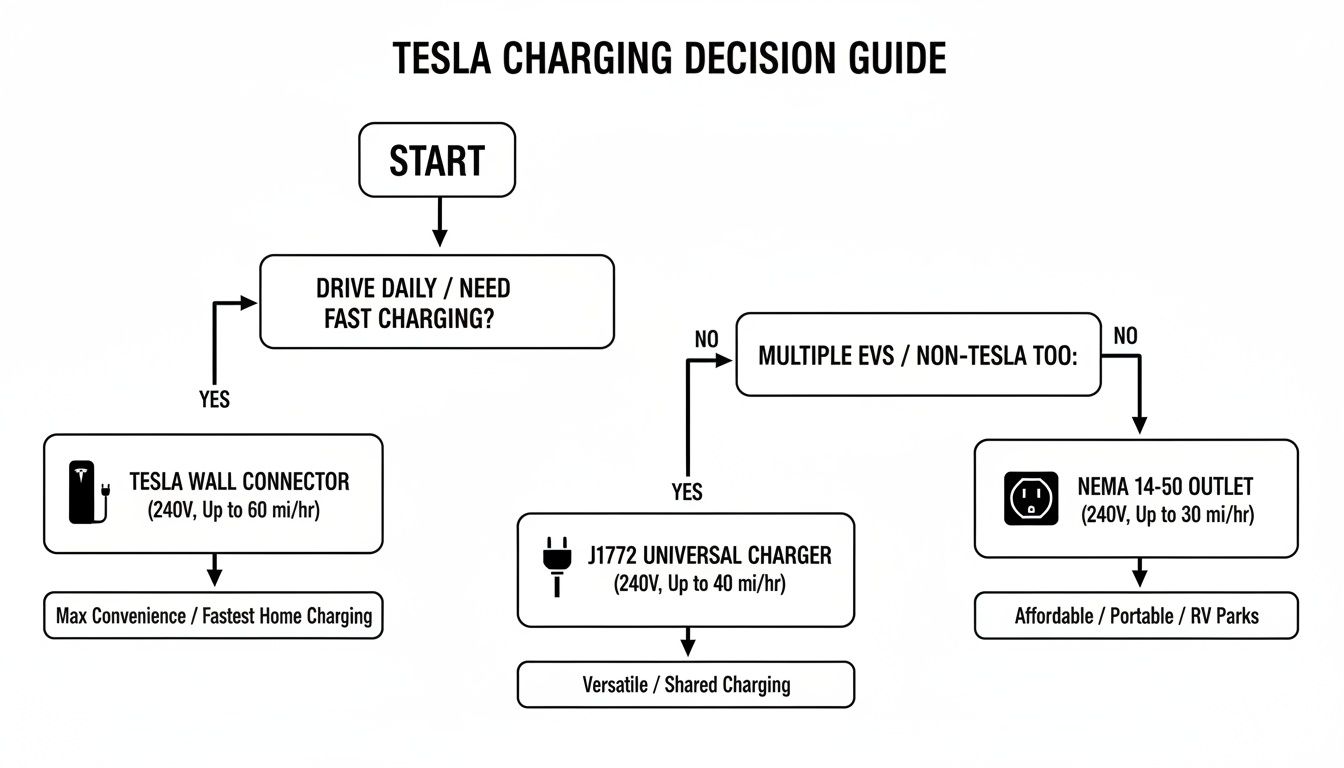
As the guide shows, when you align your choice with your daily mileage and what other cars are in the garage, you’ll end up with a charging setup that just works.
Scenario 1: The Daily Commuter
Are you putting serious miles on your Tesla every day, maybe commuting up and down I-15? You need a setup that guarantees a "full tank" every morning, no excuses, no matter how low the battery was when you pulled in. Your priority is speed and reliability.
For this, the Tesla Wall Connector is almost always the answer. When we install it on a dedicated 60-amp circuit, it delivers up to 44 miles of range per hour—the fastest Level 2 speed your Tesla can get at home. This means even if you get home on fumes, the car will be 100% charged and ready to go in just a few hours.
Honestly, for the dedicated Tesla driver, the Wall Connector's seamless integration with the Tesla app and its ability to power-share with a future second Tesla make it a clean, powerful, and purpose-built choice. It just feels right.
Scenario 2: The Multi-EV Household
You know what? A lot of Utah garages now have more than one electric vehicle. Maybe you have a Model Y, but your partner drives a Rivian, a Ford Mustang Mach-E, or is eyeing one. In this situation, flexibility is king.
A high-quality universal J1772 charger like the ChargePoint Home Flex is your best bet here. It can charge any EV sold in North America. You'll just use the small J1772 adapter that came with your Tesla—a minor step that unlocks major versatility for guests and any other EV that parks in your driveway. Plus, these chargers have their own robust smart features, giving you detailed energy reports and scheduling through their own apps.
Scenario 3: The Renter or Budget-Conscious Owner
Maybe you're renting, or you're just looking for the most practical way to get safe, fast charging without all the extra features. You need a solution that's effective, code-compliant, and doesn't demand a big upfront investment in hardware.
The clear winner here is a professionally installed NEMA 14-50 outlet. This isn't a charger itself; it's a powerful 240-volt socket you plug your Tesla Mobile Connector into. It provides a very respectable 25-30 miles of range per hour, which is more than enough for the vast majority of drivers to recharge overnight. It’s a simple, reliable, and incredibly flexible option that’s a massive upgrade over a standard wall plug.
Ultimately, the best choice is the one that fits how you live and drive. By matching the charger's strengths to your personal scenario, you'll end up with a home charging setup that feels like a perfect fit from day one.
Your Next Steps for a Professional Installation
Once you’ve picked out your charger, the final—and most important—step is getting it installed safely and correctly. This isn’t a weekend DIY project; it's a critical job that protects your home, your new Tesla, and your family. Hiring the right licensed electrician is where expertise and trust become non-negotiable.
Here’s the thing: a proper installation ensures your system isn't just functional, but also fully compliant with local codes here in Weber, Davis, and Salt Lake counties. Let me explain what to look for when you're vetting a pro for the job.
Hiring Checklist for Utah Homeowners
Before you commit to anyone, ask these key questions. Their answers will tell you everything you need to know about their qualifications and real-world experience.
- Are you licensed and insured in Utah? This is the absolute first question. Never, ever work with an electrician who can't provide immediate proof of both.
- Do you have specific experience installing EV chargers? General electrical work is different. You want someone who understands the specific load calculations, hardware, and best practices for EV charging systems. It's a specialty.
- Will you handle the necessary permits? A true professional installer will manage the entire permitting process with your local city or county. This is how you guarantee everything is 100% code-compliant and inspected properly.
- Can you provide a detailed, itemized quote? A good quote should clearly break down the costs for labor, materials (like the specific gauge of wire and conduit needed), and the permit fee itself. No vague numbers.
Choosing an experienced, local expert is the best way to guarantee a seamless and safe installation from start to finish.
A Few Common Questions About Tesla Home Charging
When you're sorting out the best way to charge your Tesla at home, a few questions always come up. That’s perfectly normal. Getting the details right on a home upgrade this important is smart, and we hear the same thoughtful questions from homeowners all over Northern Utah. Here are a few clear, straightforward answers.
Do I Need an Electrical Panel Upgrade for a Tesla Charger?
Not always, but it’s a common part of the job, especially in older homes. A powerful Level 2 charger needs its own dedicated 240-volt circuit, usually between 40 and 60 amps. If your home’s electrical panel is already maxed out running the rest of your house, it’s going to need an upgrade to handle that extra load safely.
The only way to know for sure is with a load calculation. A licensed electrician performs this professional assessment to map out your home's total electrical demand and give you a definitive answer. It’s the right way to make sure your system stays safe and reliable.
Can I Install a Tesla Wall Connector Outdoors?
Yes, absolutely. The Tesla Wall Connector is built for it. It's designed and rated for both indoor and outdoor installation, so it can handle Utah’s rain, snow, and summer sun without a problem.
Here's the thing: proper installation is critical for outdoor units. To keep it safe and ensure it lasts, all the electrical wiring has to be run inside an outdoor-rated conduit. This protects it from the elements and any physical damage. It's a non-negotiable step for any outdoor setup that meets code.
Is a Hardwired Charger Better Than a Plug-In Charger?
This one often comes down to what you value more—top-end speed or a bit more flexibility.
A hardwired charger connects directly to your electrical panel, which lets it pull more power. For instance, to get the maximum 48-amp charging rate from a Tesla Wall Connector, it has to be hardwired to a 60-amp circuit. It’s a permanent, robust, and slightly faster solution.
On the other hand, a plug-in charger that uses a NEMA 14-50 outlet gives you the flexibility to unplug it and take it with you if you move. The trade-off is that it’s limited to a 50-amp circuit, which safely delivers 40 amps to the car. It still provides a fantastic charge speed, but it’s a small step down from what a hardwired unit can do.
Ready to get a clear, professional assessment of your home’s charging potential? The expert team at Black Rhino Electric is here to help you find the perfect solution. To get started, you can call us at 385-396-7048 or request a free quote online today.