That random, annoying flicker isn't just an inconvenience; it's your home's way of telling you something needs a closer look. Honestly, figuring out how to fix flickering lights can feel like chasing ghosts, but it usually starts with some simple detective work. We'll walk through the most common culprits, from a single bad bulb to a stressed-out electrical panel.
Contents
- 1 Why Are My Lights Flickering? A Quick Diagnostic Guide
- 2 Checking the Simple Fixes: Bulb and Fixture Issues
- 3 Solving the Dimmer Switch and LED Dilemma
- 4 Investigating Widespread Flickering and Circuit Overloads
- 5 When to Call a Professional: Recognizing the Danger Signs
- 6 Answering Your Flickering Lights Questions
Why Are My Lights Flickering? A Quick Diagnostic Guide
You know what? The first step in solving any electrical puzzle is figuring out its scope. Is one rogue light fixture acting up, or are you seeing signs of a bigger issue brewing behind the walls?
Let me explain. The location and frequency of the flicker are your biggest clues. A single, misbehaving light often points to a simple, localized problem—like a bulb that’s worked itself loose or a bad connection right at the fixture. But what if all the lights in your kitchen dim every time you run the microwave? That tells a completely different story, one that involves the entire circuit.
Pinpointing the Problem Source
To get started, think like a detective. Pay close attention to when and where the flickering happens. Is it totally random, or does it happen right when a big appliance like your HVAC unit or refrigerator kicks on? Answering that one question narrows down the possibilities in a big way.
This decision tree breaks down the diagnostic process, guiding you from the symptom to its most likely cause.
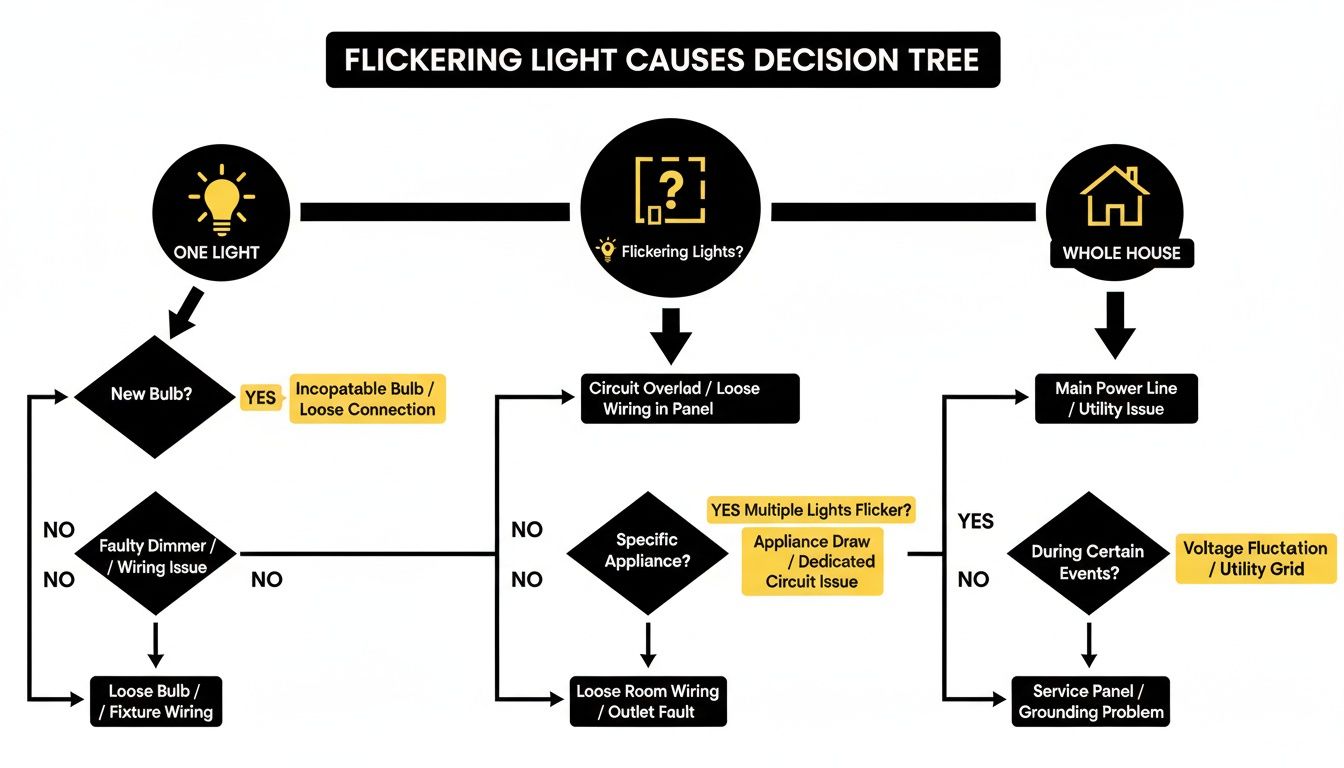
As you can see, figuring out if the problem affects one light, one room, or the whole house is the most important clue you have.
Key Takeaway: Don't jump to conclusions. A systematic approach that starts with just observing the flicker's behavior is the fastest way to an accurate diagnosis and a fix that actually lasts.
Common Scenarios and Their Meanings
Let's break these scenarios down with a bit more detail. It’s crucial to match the symptom to the likely cause before you start taking things apart.
I've put together a simple reference table to help you connect the dots between what you're seeing and what it probably means for your electrical system.
Flicker Symptom and Likely Cause
| Symptom | Most Likely Cause | First Action Step |
|---|---|---|
| A single light flickers constantly. | A loose or failing lightbulb. | Turn off the power and tighten the bulb. |
| A light flickers when you touch the switch. | A faulty or worn-out light switch. | Stop using the switch and plan for replacement. |
| Lights in one room dim when an appliance starts. | A circuit overload or shared neutral wire. | Map the circuit to identify connected devices. |
| The entire house's lights flicker intermittently. | A problem with the main electrical panel or utility line. | Check your breaker panel for tripped circuits. |
Think of this table as your starting point. It helps you rule out the easy stuff first, saving you time and frustration before you decide whether you need to dig deeper or call for backup.
Checking the Simple Fixes: Bulb and Fixture Issues
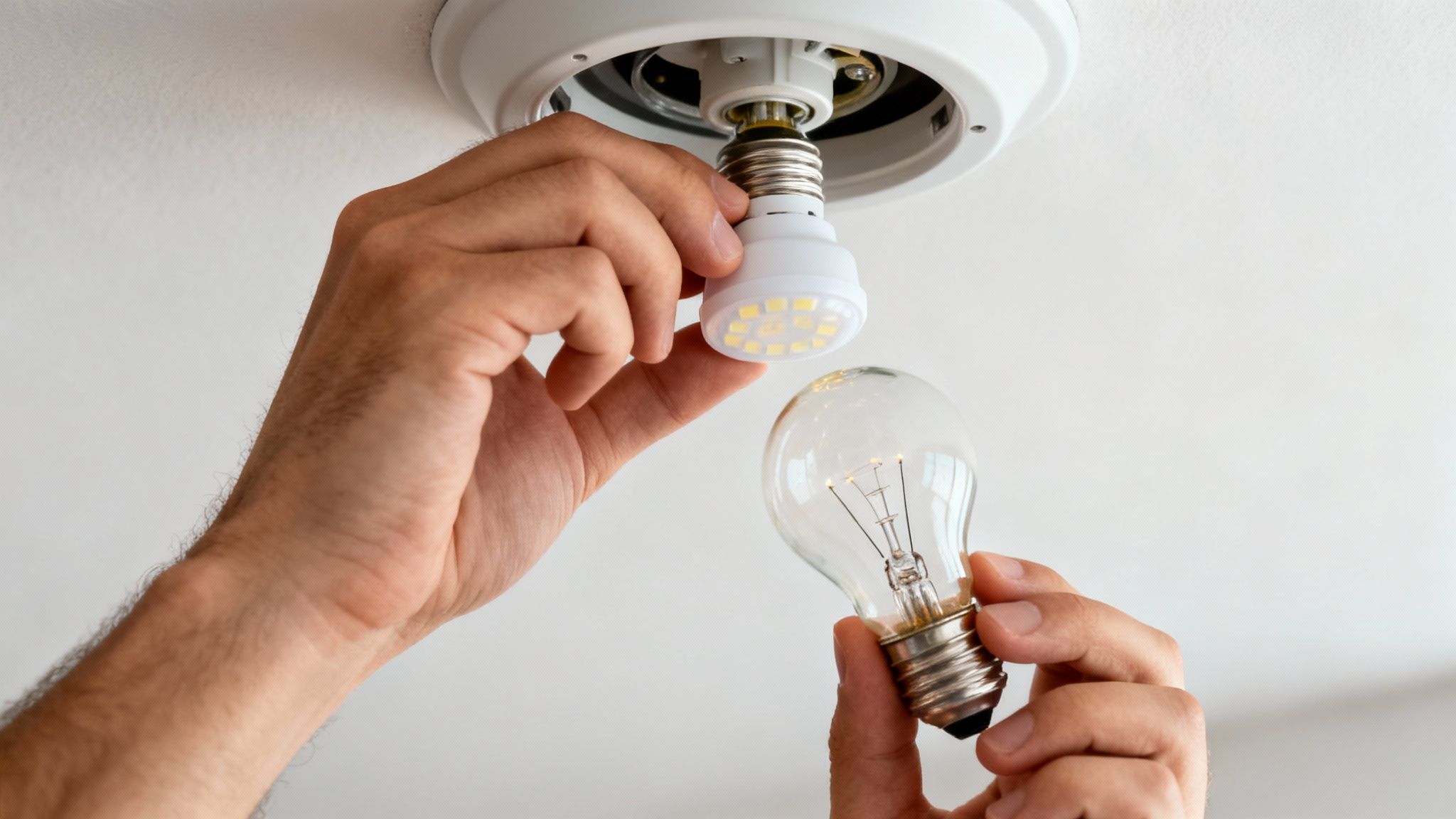
Before you start worrying about complex wiring or calling in the cavalry, let’s tackle the easy stuff first. You know what? A surprising number of issues related to how to fix flickering lights are solved right at the source—the bulb and the fixture. Honestly, these simple, low-risk checks can often save you a lot of time and stress.
Here’s the thing: we often assume the worst, but electrical systems, like anything else, are prone to simple physical problems. A bulb that’s slightly unscrewed from vibrations or a fixture connection that’s worked itself loose over the years are incredibly common culprits.
Start with the Lightbulb Itself
Your first suspect should always be the bulb. It’s the easiest component to check and replace, and ruling it out takes just a few moments.
- Check the Tightness: A loose bulb is a classic cause of flickering. Power off the light switch, wait for the bulb to cool, and then gently twist it clockwise to ensure it's snug in the socket. It doesn’t need to be cranked down, just firmly seated.
- Test a Different Bulb: Sometimes a bulb is simply on its last legs. The internal filament can become damaged, causing it to flicker before it burns out completely. Swap the flickering bulb with a new one or one from a working lamp to see if the problem disappears.
I once spent an hour troubleshooting a flickering kitchen light, only to discover that the brand-new, "bargain" LED bulb I’d just installed was defective right out of the box. It’s a simple reminder to never overlook the obvious!
Inspecting the Fixture Connections
If a new, properly tightened bulb doesn't solve the flicker, the next logical step is the light fixture. Connections inside the fixture can become loose over time due to heat cycles and vibrations, leading to an inconsistent flow of power.
Safety First: Before you touch any wiring, you must turn off the power to that light fixture at your home's circuit breaker panel. Flicking the wall switch off is not enough; you need to kill the power at the source to prevent serious injury.
Once the power is confirmed off (use a voltage tester if you have one), you can safely inspect the fixture’s wiring. Carefully remove the fixture's cover or canopy to expose the connection points where the fixture wires meet the wires from your ceiling. Look for any wire nuts that seem loose or wires that have pulled away.
Loose electrical connections are a major cause of flickering lights, responsible for an estimated 25-35% of residential cases. Simply turning off the breaker and carefully tightening terminal screws on fixtures can resolve a huge number of these issues instantly.
If you find a loose wire nut, unscrew it, ensure the wires are twisted together securely, and then screw the nut back on tightly. For more extensive fixture issues or if you feel uneasy handling the wiring, it might be time to get some professional assistance with your lighting installation.
When the Fixture Itself Is the Problem
Finally, consider the fixture’s age and condition. Older fixtures, especially those with complex internal components like ballasts (in fluorescent lights) or built-in transformers, can fail and cause flickering.
Here’s a quick rundown of common fixture types and their potential failure points:
| Fixture Type | Common Flicker Cause | Recommended Action |
|---|---|---|
| Incandescent/Halogen | Loose bulb or bad socket connection. | Tighten bulb; inspect socket for corrosion. |
| Fluorescent (Tube) | Failing ballast or old bulb. | Replace bulb first; if flicker persists, replace ballast. |
| LED Fixture (Integrated) | Failing internal driver. | The entire fixture usually needs to be replaced. |
This methodical approach—bulb, connection, fixture—is the most efficient way to diagnose the problem. By ruling out these simple causes, you can confidently determine whether you’ve solved the flicker or if it’s time to investigate deeper issues like the switch or circuit wiring.
Solving the Dimmer Switch and LED Dilemma
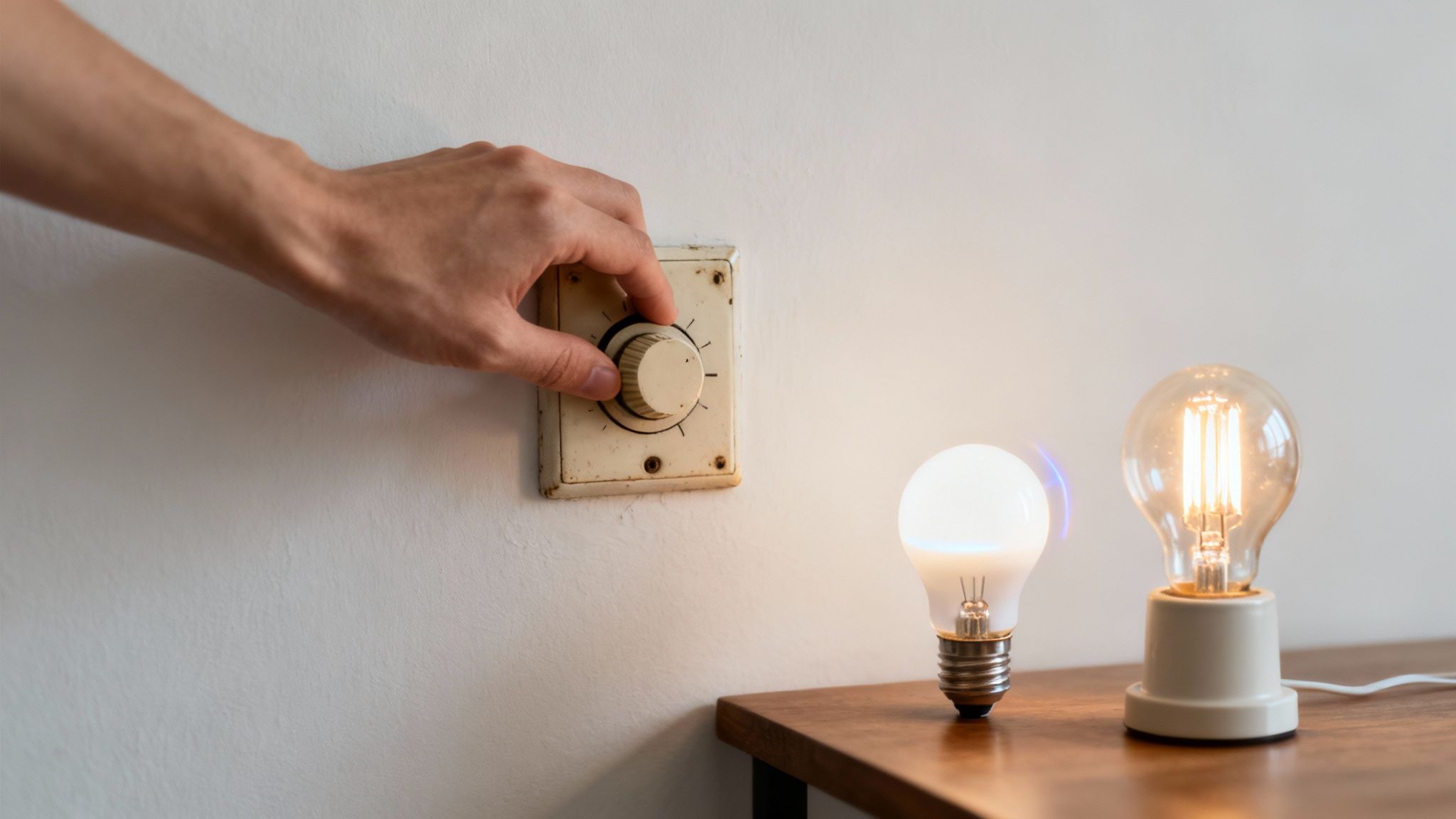
So, you've upgraded to energy-efficient LEDs, but now your lights have a constant, irritating flicker whenever you dim them. Sound familiar? Here’s the thing: this is an incredibly common challenge when learning how to fix flickering lights, and it's almost never the new bulb's fault.
The real issue is a hidden technology mismatch between modern bulbs and older hardware. It's a problem countless homeowners in Northern Utah run into after making what seems like a simple, smart upgrade.
Why Your Old Dimmer Hates Your New LEDs
Let me break it down in plain English. Your old-school dimmer was likely a "triac" dimmer, built for power-hungry incandescent bulbs. It works by crudely chopping up the electrical wave to starve the bulb of power, which makes its glowing filament dim down.
An old 100-watt incandescent is simple—it doesn't care how rough the power delivery is. But a 10-watt LED is a different beast entirely. It’s a sophisticated piece of electronics with an internal "driver" that expects a smooth, steady diet of electricity. When that old triac dimmer starts chopping the power, the LED's driver gets confused and strobes, causing that annoying flicker because it can't draw the tiny amount of power it needs to operate smoothly.
This exact dimmer-switch conflict is a leading cause of flickering lights as homeowners adopt energy-efficient LEDs. While over 75% of industrial facilities have transitioned smoothly, residential retrofits often lag, causing flicker in up to 20-30% of homes. Fortunately, about 80% of these issues are solved with a simple switch replacement that costs less than $50.
Identifying an Incompatible Dimmer
How can you be sure the dimmer is the culprit? Here are the tell-tale signs:
- Flickering only when dimmed: The lights are rock-solid at 100% brightness but start to pulse, strobe, or buzz the moment you slide the dimmer down.
- Limited dimming range: Instead of dimming smoothly to a faint glow, the lights might just shut off abruptly once you dim them below 50%.
- Audible buzzing: A humming or buzzing sound coming directly from the switch is a dead giveaway that it's struggling to handle the LED's low power load.
Pro Tip: A quick way to test this theory is to temporarily swap the dimmable LED bulb with an old incandescent one. If the incandescent bulb dims perfectly without flickering, you’ve confirmed the dimmer-LED incompatibility.
Choosing the Right LED-Compatible Dimmer
The solution is to replace your old switch with a modern dimmer specifically designed for LEDs. When you're at the hardware store, look for packaging that clearly says "LED Compatible," "LED+," or has a "CL" rating. These dimmers are engineered to work with the low-power, sensitive electronics inside LED bulbs.
Here’s a quick comparison to help you understand the difference.
Legacy vs Modern Dimmer Switches
This table shows exactly why swapping out that old dimmer is so important. The technology inside is just fundamentally different.
| Feature | Legacy Dimmer (Triac) | Modern Dimmer (CL/LED+) |
|---|---|---|
| Designed For | High-wattage incandescent & halogen bulbs. | Low-wattage LED and CFL bulbs. |
| Dimming Method | Chops the AC power wave ("leading edge"). | Smoothly adjusts voltage ("trailing edge"). |
| Minimum Load | Requires a high minimum wattage to operate. | Works with very low power loads. |
| Performance | Causes buzzing, flickering, and poor range with LEDs. | Provides smooth, full-range, flicker-free dimming. |
| Adjustability | Typically offers no fine-tuning. | Often includes a small dial to set the low-end dim range. |
Upgrading to a CL-rated dimmer is a game-changer. It ensures your energy-efficient bulbs perform exactly as they should—providing smooth, silent, and flicker-free light at every brightness level. This one change can permanently solve one of the most frustrating lighting problems in modern homes.
Investigating Widespread Flickering and Circuit Overloads
If the flicker is happening in a whole room—or even the entire house—especially when a big appliance like the A/C kicks on, we’re looking at something bigger than a single bulb. Honestly, this is where the issue gets more serious. It means we need to stop looking at switches and start looking at the circuits themselves.
When you see widespread flickering, it’s almost always a sign of two things: a circuit overload or a significant voltage drop. Think of your home’s electrical system like a highway. When a power-hungry appliance starts up, it’s like a massive convoy trying to merge at full speed. It creates a temporary traffic jam, slowing everything down. That slowdown is the voltage drop, and it’s what makes your lights dim or flicker.
Understanding Circuit Overloads
Ever notice the kitchen lights dip for a second when you start the microwave? That’s a small, classic example of what’s happening. It becomes a real problem when too many heavy-draw appliances are sharing the same circuit, constantly pushing it to its limits.
A circuit is only designed to handle a certain amount of electricity, measured in amps. When the demand is too high, the breaker is supposed to trip to prevent overheating and a potential fire. But a circuit that’s constantly running close to its maximum capacity will cause persistent flickering and put a strain on your entire system.
Key Insight: A brief, minor dimming can be normal. However, if the flickering is severe, lasts more than a second, or happens with multiple appliances, it's a clear signal that your circuits are overloaded and need attention.
Voltage fluctuations from overloaded circuits are a huge issue, causing an estimated 20-40% of flickering light problems globally. When high-draw appliances like AC units, which can pull 5-10 amps just on startup, kick on, they can create grid strains responsible for flickering in 25% of new builds. These overload issues still persist in about 15% of North American homes, a problem that’s often solved by redistributing loads or upgrading the service panel.
Mapping Your Home's Circuits
The single most important diagnostic step you can take is to figure out what’s on each circuit. This is called circuit mapping, and it’s how you find out which outlets and fixtures are sharing that "highway" with your major appliances.
Here’s a practical way to get it done:
- Get a Panel Chart Ready: Head to your breaker panel. If it’s not clearly labeled (and let’s be honest, most aren’t), grab a notepad or open a spreadsheet.
- Go Breaker by Breaker: You’ll need a partner for this. Turn off one breaker at a time (but leave the main breaker on!).
- Test and Label: Your partner walks through the house with a small lamp or a phone charger, testing every single outlet, switch, and light to see what’s off. You record every dead outlet and fixture next to that breaker number on your chart.
- Rinse and Repeat: Flip the breaker back on and move to the next one. Keep going until you have a complete map of your home’s electrical layout.
Once you have this map, problems often jump right out at you. Is your fridge, microwave, and toaster all on the same circuit? That’s a recipe for an overload. Identifying these crowded circuits is the first real step toward a solution. If that sounds like too much to tackle, professional electrical troubleshooting services can map your system quickly and accurately.
Fixing a circuit overload might mean moving a high-draw appliance to a less crowded circuit. In some cases, the best long-term solution is to have an electrician install a new, dedicated circuit for that power-hungry appliance. This gives it a clean, open lane on the highway, preventing those electrical traffic jams and finally stopping that frustrating, house-wide flicker.
When to Call a Professional: Recognizing the Danger Signs
We’ve covered a few DIY fixes, and it feels good to solve a problem yourself. But knowing where to draw the line is the most important skill a homeowner can have. Learning how to fix flickering lights is one thing; knowing when to put the tools down and call an electrician is another. This is about your safety, plain and simple.
Honestly, some warning signs are your electrical system’s way of screaming for help. Ignoring them can lead to a house fire. I’m not trying to be dramatic—flickering lights mixed with other symptoms can point to dangerous arcing behind your walls, and that’s a risk you just can’t take.
Red Flags You Must Not Ignore
If you notice any of the following, the game has changed. This isn't about a loose bulb anymore; it's about real, immediate risk. Stop what you’re doing and treat it like an emergency.
- A Distinct Burning Smell: A plastic or electrical burning smell coming from an outlet, switch, or your breaker panel is a five-alarm fire drill. It means something is overheating to the point of melting or igniting.
- Buzzing or Crackling Sounds: Your electrical system should be seen, not heard. If you hear buzzing, humming, or crackling from outlets, switches, or especially the main panel, that's often the sound of electricity arcing across a loose connection.
- Visible Scorch Marks or Discoloration: See brown, sooty, or slightly melted plastic on your outlets or switches? That's physical evidence of dangerous heat. It’s a clear sign of a problem that needs a professional eye, fast.
- Frequently Tripping Circuit Breakers: A breaker that trips once in a blue moon is just doing its job. But a breaker that trips over and over again on the same circuit is waving a big red flag. It’s signaling a persistent overload or a short circuit—both are major fire hazards.
These aren't suggestions; they are hard stops. Trying to fix these issues yourself without the right training and gear is just plain reckless.
Crucial Safety Takeaway: Your senses are your best safety tools. If you see, smell, or hear anything unusual coming from your electrical system, the time for DIY is over. The potential for fire or electrocution is just too high to gamble.
The Dangers of Arcing Wires
So, what’s actually happening to cause these scary symptoms? One of the most common culprits is electrical arcing. This happens when electricity jumps a tiny gap between two loose or corroded wires.
Think of it as a tiny, continuous bolt of lightning happening inside your wall. That arc generates intense heat—we're talking hot enough to melt wire insulation and ignite the surrounding wood framing. Fire administration authorities consistently report that faulty electrical wiring is a leading cause of house fires, responsible for thousands of incidents every year. A flickering light paired with a buzzing sound might be the only warning you get.
Comparing DIY Risk vs. Professional Safety
Knowing when to step back is the smartest thing a homeowner can do. Let’s put the risks into perspective.
| Situation | DIY Approach Risk | Professional Action |
|---|---|---|
| Flickering with Burning Smell | High risk of fire or electrocution. | Safely de-energizes the circuit and replaces the damaged, overheating components. |
| Buzzing from Breaker Panel | Extreme danger; potential for arc flash or panel failure. | Identifies the failing breaker or connection and performs a safe, code-compliant replacement. |
| Frequently Tripping Breaker | Risk of ignoring a dangerous short circuit. | Uses diagnostic tools to trace the fault and fix the underlying cause of the overload. |
At the end of the day, your safety and the safety of your home come first. For homeowners in Weber, Davis, or Salt Lake counties, if you're experiencing any of these danger signs, please don't hesitate. You can contact a licensed electrician to safely figure out what's wrong and fix it right. It's always the right call to make.
Answering Your Flickering Lights Questions
We’ve walked through the common causes and fixes, but let's be honest, questions always come up when you’re dealing with electrical mysteries at home. Getting straight answers about how to fix flickering lights can give you the confidence to tackle the simple stuff or make the right call for a pro.
So, let’s dig into some of the most common questions we hear from homeowners right here in Northern Utah. Electrical work can feel a little intimidating, but just understanding why something is happening is half the battle.
Can a Bad Light Switch Cause Flickering?
You bet it can. A worn-out or faulty switch is one of the most common culprits we find. Just think about how many thousands of times that little switch gets flipped over the years. The internal metal contacts that complete the circuit can get dirty, corrode, or just plain wear out.
This creates a weak, inconsistent connection, causing the light to flicker—especially when you physically wiggle the switch handle. You might even hear a faint buzzing or crackling sound coming from the switch itself. If playing with the switch directly affects the flicker, that's your smoking gun. The switch has hit the end of its road and needs replacing. For anyone comfortable with basic wiring, this is a pretty straightforward DIY fix, but always, always kill the power at the circuit breaker first.
Why Do My Lights Flicker When the AC Turns On?
Ah, the classic summer dim. This is a tell-tale sign of a temporary voltage drop, and it’s one of the most common electrical quirks homeowners notice. Big-ticket appliances like an air conditioner, refrigerator, or furnace need a massive jolt of power just to kick their motors into gear.
Here’s the thing: if your lights share a circuit with that appliance, the sudden, huge power draw momentarily "starves" everything else on that line. The result is a brief dim or flicker. A minor, split-second dim is often perfectly normal. But if the flicker is severe, lasts more than a second, or your breaker trips, it could be a warning sign that the circuit is overloaded. The best long-term solution is often having an electrician put that heavy-hitting appliance on its own dedicated circuit.
Are Flickering Lights a Fire Hazard?
They absolutely can be, and this is a question that deserves a serious answer. While a loose lightbulb is harmless, flickering caused by faulty wiring, a failing circuit breaker, or loose connections inside your walls is a significant fire risk.
Crucial Point: These poor connections can create a dangerous phenomenon called arcing, where electricity literally jumps across a tiny gap. That arc generates intense heat—sometimes thousands of degrees—which can easily ignite the surrounding wood framing, insulation, or dust in your walls.
If your flickering is paired with any of the other danger signs we've talked about—like a burning smell, buzzing from outlets, or scorch marks—you should treat it as an emergency. Don't wait. It's time to shut down that circuit and call a licensed electrician immediately.
Could My Neighbor's Electrical Usage Affect My Lights?
It’s less common, but it’s definitely not impossible. When this happens, it usually points to a problem outside your four walls, somewhere in the utility company's equipment.
This can happen in older neighborhoods where several homes share a single transformer, or where the main utility lines are simply getting old. If you notice that your lights flicker at the exact same time as your immediate neighbors', the problem is likely with the power grid feeding your street. The best move here is to compare notes with a neighbor and then contact your local utility company to report a potential area-wide issue. They have the gear to test the supply lines and the transformer serving your block.
Dealing with persistent electrical issues can be frustrating and, in some cases, downright dangerous. If you've tried the simple fixes and the flicker won't quit—or if you've spotted any of those serious red flags—don't hesitate to get professional help. The experienced electricians at Black Rhino Electric are here to provide safe, reliable troubleshooting and repairs for homeowners across Weber, Davis, and Salt Lake counties. Visit us online to schedule your service today.