Hiring duct sealing contractors is one of the smartest moves a homeowner can make to improve comfort and slash energy bills. These pros find and fix the hidden leaks in your home's HVAC ductwork, ensuring the conditioned air you’re paying for actually gets where it’s supposed to go. It’s a core investment in your home’s efficiency, value, and overall health.
Contents
Why Leaky Ducts Are a Hidden Drain on Your Wallet
Ever tried to fill a leaky bucket? You can pour water in all day, but you’re constantly losing some through the holes. You know what? That’s exactly what’s happening inside your walls and attic when your HVAC ducts have gaps, cracks, and bad connections.

All that conditioned air—the warm air in winter and the cool air in summer that you pay good money for—escapes into unconditioned spaces like attics, crawlspaces, and wall cavities. In fact, studies from the Department of Energy show that a typical home loses a staggering 20% to 30% of its conditioned air through these leaks.
The True Cost of Inefficiency
The most obvious hit from leaky ducts is a much higher energy bill. Your furnace and air conditioner are forced to run longer and work harder just to keep your home at the temperature you set on the thermostat. This constant overwork doesn’t just inflate your monthly utility payments; it puts serious strain on your expensive HVAC equipment.
Here’s the thing: that extra runtime accelerates wear and tear on critical parts like compressors and blower motors. This can easily lead to more frequent breakdowns and a shorter overall lifespan for your entire system, turning a few small air leaks into a massive replacement cost down the road.
Our Experience: Inefficient ductwork forces your HVAC system into a cycle of overcompensation. It’s not just about wasted energy—it’s about the premature aging of one of your home’s most expensive assets.
More Than Just Wasted Money
Beyond the financial drain, duct leakage creates real, noticeable comfort problems. Isn't it frustrating when one bedroom feels stuffy and warm while the living room stays stubbornly chilly, no matter how much you fiddle with the thermostat? That imbalance often causes homeowners to crank their systems up or down, which only compounds the energy waste.
Even worse, leaky return ducts can actively suck dirty, unfiltered air into your home. This air is often pulled from dusty attics, mold-prone crawlspaces, or wall cavities full of insulation fibers and other nasty pollutants. This process directly tanks your home's indoor air quality and can lead to a host of problems, including:
- Excessive dust that seems to settle everywhere, no matter how often you clean.
- Worsened allergy and asthma symptoms for you and your family.
- Persistent musty or stale odors that you can’t quite seem to locate.
At the end of the day, professional duct sealing is far more than a minor fix. It's a foundational upgrade for your home's efficiency, comfort, and health. By making sure the air you pay to heat and cool actually reaches its destination, you stop the hidden drain on your wallet and make your home a better place to live.
Telltale Signs You Need Professional Duct Sealing
Figuring out if your ducts are leaking can feel like trying to solve a mystery with too many suspects. You know something’s off—the house is dusty, one room’s an icebox—but it’s easy to blame the usual culprits like an old furnace or drafty windows.
But what if the real problem is hidden inside your walls, floors, and ceilings? The truth is, leaky ducts leave clues. They start small, but eventually, they become impossible to ignore. If these signs sound familiar, it's a strong hint your ductwork is calling for help from a pro.
Unusually High Energy Bills
Are your heating and cooling bills climbing month after month, even though you haven't changed a thing? That’s the most obvious red flag. Leaky ducts force your HVAC system to run constantly, trying to make up for all the conditioned air escaping into your attic or crawlspace.
Think of it like trying to fill that leaky bucket again. You’re just wasting energy—and money—for nothing. A sudden spike or a steady creep in your utility costs is a dead giveaway that your home's efficiency is being compromised somewhere in the delivery system.
Inconsistent Temperatures and Hot or Cold Spots
Do you have that one room that’s always a sauna in the summer and an ice cave in the winter, no matter where the thermostat is set? That’s a classic sign of leaky ducts. It’s not about how hard your furnace or AC is working; it's about whether the air is actually getting where it needs to go.
When a big chunk of that heated or cooled air escapes through gaps on its way to a bedroom or office, that room will never feel comfortable. You’re left with a house full of frustratingly uneven temperatures and an HVAC system working overtime for mediocre results.
Expert Insight: Don't mistake uneven temperatures for a failing HVAC unit. Often, the problem lies in the delivery system—the ducts—not the source of the heating or cooling itself.
Excessive Dust and Poor Indoor Air Quality
If you feel like you're in a constant battle with dust—wiping down surfaces only to see a new layer appear hours later—it’s probably not your housekeeping. It’s a direct result of leaks in your return ducts. These leaks create negative pressure, literally sucking unfiltered, dirty air from your attic, basement, or wall cavities.
This air is full of dust, insulation fibers, pollen, and even mold spores. It completely bypasses your HVAC filter and gets blown right back into your living spaces. This doesn't just make your house dirtier; it can make allergies and asthma a whole lot worse.
Symptoms of Leaky Ducts and Their Hidden Costs
To connect the dots, it helps to see how these symptoms translate into real-world consequences for your home and your wallet.
| Symptom | What It Really Means | Potential Impact |
|---|---|---|
| High Utility Bills | Your HVAC system is overworking to compensate for lost air. | Wasted money, accelerated wear on your HVAC equipment. |
| Uneven Temperatures | Conditioned air isn't reaching every room effectively. | Constant discomfort and a struggle to maintain a consistent climate. |
| Excessive Dust | Your ductwork is pulling in dirty air from unconditioned spaces. | Poor indoor air quality, increased allergy symptoms, and a dirtier home. |
| Musty Odors | Air from damp crawlspaces or attics is entering your airstream. | Unpleasant smells and potential for mold or mildew circulation. |
Recognizing these signs is the first step. If this list hits a little too close to home, remember that leaky ducts don't fix themselves. It's time to bring in an expert who can find the problem at its source and seal it for good.
What to Expect from a Professional Duct Sealing Service
Hiring a contractor to seal your ducts shouldn’t feel like a mystery. A real professional service isn't about a guy showing up with a roll of tape and a shrug. It’s a systematic, measurable process from start to finish. Let me explain what a high-quality duct sealing job actually looks like, so you know exactly what to expect.
Frankly, if someone arrives with just a roll of duct tape, that’s your signal to show them the door. Proper duct sealing is a science, and the team at Black Rhino Electric treats it that way.
The Diagnostic Phase: Finding Every Last Leak
First things first: a pro can't fix what they can't find. The initial step is always a thorough diagnostic assessment. This isn’t a guessing game; it’s a data-driven hunt for every single leak, big or small.
This process usually involves a few key steps:
- A Visual Inspection: The technician will crawl into your attic, basement, or crawlspace to look for the obvious stuff—ducts that are disconnected, torn, or crushed flat.
- A Blower Door Test: This test temporarily depressurizes your whole house. It makes it much easier to feel where air is getting in or out, including from the duct system itself.
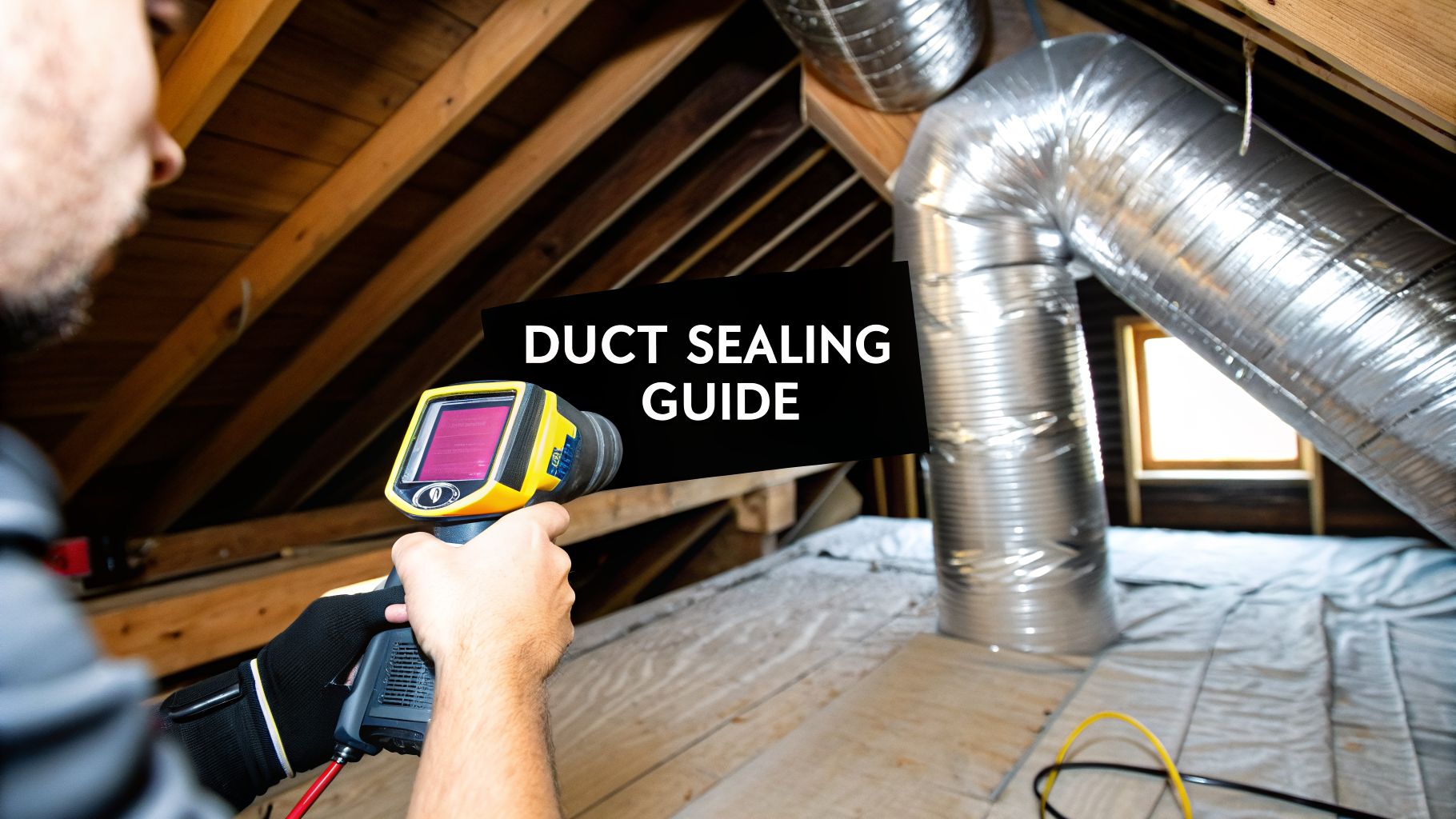
- Duct Leakage Testing: This is the heart of the diagnosis. A specialized fan is connected to your ductwork to pressurize it, while a computer measures precisely how much air is escaping. This gives a hard number—a baseline CFM (cubic feet per minute) of leakage—that tells you exactly how bad the problem is.
This initial test gives us a benchmark. It's the "before" picture that lets a contractor prove their work actually made a difference when they test it again at the end.
Advanced Sealing That Goes Beyond Tape
Once all the leaks have been mapped out, the real work starts. Professionals use specialized materials engineered to create a tough, long-lasting seal that can handle the temperature swings and constant pressure inside your ducts.
Expert Insight: Simply patching the holes you can see isn't enough. The worst leaks are almost always the ones you can't get to—hidden in walls, between floors, or in other tight spots. This is where modern tech really makes a difference.
For those hard-to-reach leaks, top-tier contractors use aerosol-based sealing. This process involves injecting a non-toxic, aerosolized sealant into the pressurized duct system. The tiny sealant particles are automatically drawn toward the leaks, where they stick together and build up until the hole is sealed completely from the inside out.
The infographic below shows how common issues like cold rooms, dust, and high bills all point back to leaky ducts—the very problem a professional service is designed to solve.

This method is incredibly effective. Aerosol duct sealing can eliminate 70% to 90% of all leaks, whereas traditional manual methods might only catch 40% to 50%. That’s a huge difference, especially when you consider that unsealed ducts can waste 20% to 40% of your heated and cooled air, often through those hidden leaks. If you want to see what this looks like in practice, it can be helpful to explore examples of professional duct sealing services to get a better sense of the process. The right technology just gets results that old-school methods can't touch.
Verification and the Post-Sealing Report
The job isn't over just because the sealant is in. The final, and arguably most important, step is verification. The contractor will run the exact same duct leakage test they performed at the beginning.
This "after" test provides concrete proof of the improvement. They should be able to hand you a report that clearly compares the pre-sealing and post-sealing leakage rates. This kind of transparent, data-backed result is the hallmark of a trustworthy contractor and your confirmation that you got the efficient, comfortable home you paid for.
How to Choose the Right Duct Sealing Contractor
Okay, so you know your ducts are leaking and wasting money. Now for the tricky part: finding the right pro to fix them. With so many duct sealing contractors out there, how do you choose a team you can trust? A little prep work makes all the difference.
Honestly, not all contractors are created equal. You need a team that uses modern tools, provides real data to prove their work, and doesn't just slap some tape on a joint and call it a day.

You’re not just hiring labor; you’re bringing in an expert to make your home healthier and more efficient. Here’s how to separate the pros from the amateurs.
Your Contractor Vetting Checklist
Before you even start talking about price, there are a few non-negotiables. Think of this as a background check for your home's performance. It’s the fastest way to weed out the people you don’t want anywhere near your HVAC system.
| Qualification | Why It Matters | What to Ask For |
|---|---|---|
| Valid State License & Full Insurance | This is your safety net. It protects you from liability for accidents or property damage. An unlicensed contractor puts all the risk on you. | Proof of a current state contractor license and a certificate showing both liability and workers' compensation insurance. |
| Positive Local Reviews & References | This shows a real track record of keeping local customers happy. It’s proof they actually deliver on what they promise. | Links to their Google profile or other review sites. Ask for the names of 2-3 recent customers you can call. |
| Experience with Modern Technologies | Old-school methods just don't cut it. Techniques like aerosol sealing and diagnostic pressure testing are far more effective. | Confirmation that they use tools like a blower door and advanced sealing methods to find and fix leaks, even hidden ones. |
| Transparent and Itemized Quotes | A vague, one-line quote is a huge red flag. A professional will break down the costs for labor, materials, and testing. | A detailed, written estimate that outlines every step, from the first test to the final verification report. |
A solid contractor will have all this ready without hesitation. If they balk, move on.
Digging Deeper with Sharp Interview Questions
Once a contractor passes that first test, it’s time to see if they really know their stuff. Their answers to these questions will tell you everything you need to know about their process and commitment to quality.
Don’t be shy about asking. A real pro will be happy to explain how they work.
- "What diagnostic tools do you use to find the leaks before you start?" The right answer involves a blower door test and a duct pressurization fan. This shows they use data to pinpoint problems instead of just guessing.
- "How do you prove the job is done right?" There's only one correct answer: a post-sealing duct leakage test. They should give you a report showing the "before" and "after" leakage numbers (measured in CFM) to prove how much they improved your system.
- "What kind of sealant do you use, especially for the hard-to-reach spots?" Look for them to mention aerosol-based sealants for the ducts you can't see, plus professional-grade mastic for manually sealing joints. If they just say "duct tape," hang up the phone.
Our Experience: Hiring a contractor is an interview. You are the hiring manager for your home's efficiency. Asking detailed questions empowers you to make a choice based on competence, not just a low bid.
Frequently Asked Questions About Duct Sealing
Finding good duct sealing contractors can feel like a chore, but asking the right questions makes all the difference. Let's tackle some of the most common ones we hear from homeowners. These are the straightforward answers you need to figure out the value and logistics of getting this done in your own home.
How Much Does Professional Duct Sealing Cost?
Let me break this one down carefully. There's no flat rate for professional duct sealing because the price depends on your home’s size, how tough it is to get to your ducts, and frankly, just how bad the leaks are. It's better to think of it as an investment in your home's performance, not just another repair bill.
While there’s an upfront cost, a lot of homeowners see a serious return. It’s common to cut monthly energy bills by 20% or more, which means the service can pay for itself over time. The only way to get a real number for your house is to have a professional come out, assess the situation, and give you a detailed quote.
How Long Does the Duct Sealing Process Take?
You might be surprised by how fast this actually happens. For an average-sized home, the whole duct sealing process is usually done in a single day. That includes the initial diagnostic tests, the sealing itself using modern methods like aerosol injection, and the final tests to verify the job was done right.
Most of our duct sealing jobs are wrapped up in about 4 to 6 hours. That means you get a major upgrade in your home's comfort and efficiency with very little disruption to your day.
Expert Insight: Duct sealing isn't a week-long construction project. It's a targeted, high-impact service designed to deliver measurable results in just a few hours.
Are There Benefits Besides Energy Savings?
Absolutely. This is a point that people often overlook. One of the biggest side benefits is a huge improvement in your home's indoor air quality. When we seal up those leaks, we stop your HVAC system from sucking dust, allergens, and other junk out of your attic or crawlspace and blowing it right into your living room.
This makes for a cleaner, healthier house, which is a game-changer for anyone in your family with allergies or asthma. You’ll also finally get rid of those frustrating hot and cold spots, so you have consistent, comfortable temperatures in every single room. For answers to more general questions, you can find extra info on our main FAQ page. It all adds up to a much more enjoyable home.
Ready to put an end to energy waste and inconsistent temperatures? The expert team at Black Rhino Electric has the diagnostic tools and experience to seal your ductwork right. To learn how we can improve your home's efficiency and comfort, give us a call at 385-396-7048 or request a free quote online today.