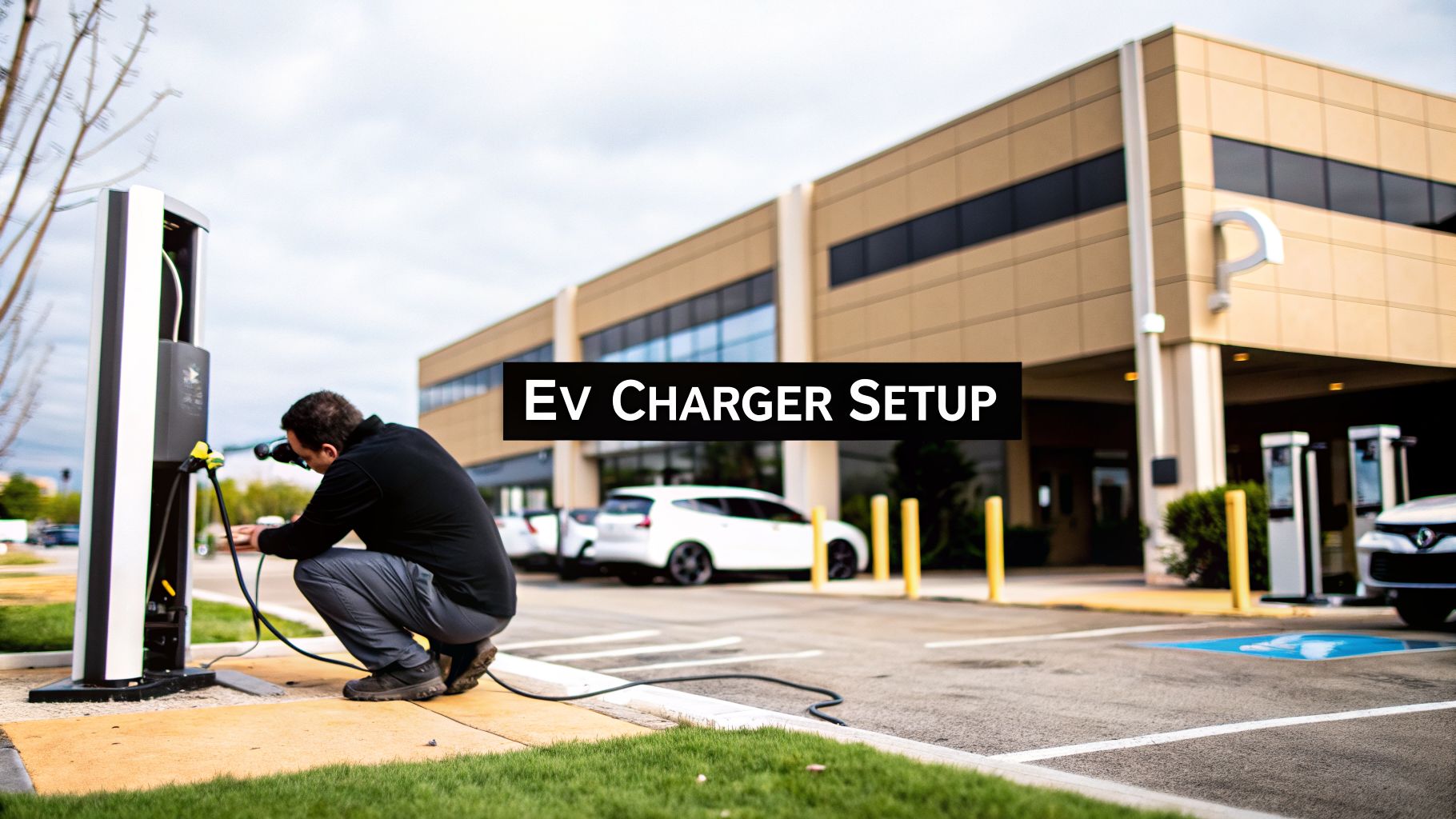
Adding EV chargers is a powerful business move, not just an eco-friendly gesture. For businesses here in Northern Utah and beyond, a commercial EV charger installation is quickly shifting from a nice perk to a flat-out necessity. This decision directly impacts employee retention, tenant satisfaction, and customer loyalty—and it absolutely boosts your bottom line.
Contents
- 1 Why Investing in Commercial EV Chargers Is a Smart Move
- 2 Starting With A Professional Site And Load Assessment
- 3 Choosing The Right Commercial EV Charger For Your Business
- 4 Navigating Installation Costs And Financial Incentives
- 5 Common Installation Pitfalls And How To Avoid Them
- 6 Why A Licensed Local Electrician Is Non-Negotiable
- 7 Frequently Asked Questions
Why Investing in Commercial EV Chargers Is a Smart Move
Are you wondering if now is the right time to add EV charging to your property? Let me give you the short answer: a resounding yes. There's a massive gap between the explosion in electric vehicle sales and the public charging infrastructure that's struggling to keep up. For forward-thinking property owners, that gap is an opportunity.
You know what? Offering charging is the new offering Wi-Fi; it's becoming an expected convenience.
The data paints a clear picture. In 2025, while global EV sales surged by 20%, the charging infrastructure just couldn't keep pace. Data from over 100 million charging sessions revealed a 34% jump in charging volume, which blew past both vehicle population growth and the addition of new charging ports. Utilization—how often chargers are actually being used—grew nearly 20% faster than new chargers were even installed.
This imbalance is especially critical for businesses right here in Northern Utah. We see small and mid-sized offices, retail spots, and multi-family properties all across Weber, Davis, and Salt Lake counties racing to add Level 2 chargers just to meet the demands of their employees and tenants.
The Competitive Edge of Early Adoption
Putting in EV chargers now gives you a real, distinct advantage over the competition. Here’s how it breaks down for different types of properties:
- Workplaces: Companies that offer workplace charging find it way easier to attract and keep top talent. For the growing number of EV drivers, it’s a highly sought-after perk.
- Multi-Family Properties: Apartment buildings and condo complexes with on-site charging can command higher rent and see lower vacancy rates. It’s a key differentiator in a crowded rental market.
- Retail and Hospitality: Stores, restaurants, and hotels that provide charging encourage customers to stick around longer and spend more money. A 30-minute charge can easily turn into a shopping trip or a meal.
For a comprehensive understanding of the entire process from a professional perspective, consider consulting an Electric Car Charger Installation: An Engineer's Guide.
This kind of strategic investment future-proofs your property, getting it ready for the needs of a market that's expanding fast. By getting ahead of the curve, you're not just catering to today's tenants and customers—you're preparing for tomorrow's. To see how this applies to different business settings, check out our guide on commercial electrical services.
Thinking about a commercial EV charger installation? Don't just pick a parking spot and start digging. That’s like building a house without checking the foundation first. The very first step—a professional site and load assessment—is the most important part of the entire project. It's the blueprint that makes sure everything else goes smoothly, safely, and without breaking the bank.
Starting With A Professional Site And Load Assessment
So, where do you start? Honestly, it begins with a deep dive into your property's existing electrical system and its physical layout. This isn't a step you can afford to gloss over. A licensed electrician, like the pros at Black Rhino Electric, performs a detailed evaluation to head off future headaches like tripped breakers, expensive rework, or serious safety issues.
This initial review looks at everything from your electrical panel's current capacity to the best physical spots for the chargers themselves. Here’s the thing: adding multiple EV chargers puts a significant new strain on your electrical system. We have to be absolutely certain it can handle the extra work without disrupting your daily business.
Understanding Your Electrical Capacity
At the heart of the assessment is a load calculation. Think of your building’s main electrical panel as a power budget. Every light, computer, and piece of equipment "spends" a little bit of that budget. An EV charger is a major new line item, and we have to make sure you have enough power in the bank to cover it.
A professional load calculation figures out:
- Your current peak electricity usage.
- The total capacity of your main service panel.
- The "available" power that can be safely dedicated to new EV chargers.
If the math shows your panel is already running near its limit, it doesn't kill the project. It just means an upgrade is needed first. You can learn more about how we handle these situations in our guide on commercial electrical panels and meters. Trying to skip this step can lead to an overloaded system, which is both dangerous and a clear violation of electrical codes.
The infographic below nails the business case created by the boom in EV sales and the infrastructure that’s struggling to keep up.

This flow is simple: as more people drive EVs, the shortage of public chargers creates a perfect opening for businesses to step in and meet that growing demand.
Identifying Ideal Charger Locations
Beyond the panel, the physical placement of the chargers is just as critical. Convenience and safety are the top priorities here. During a site walk, an electrician will scout potential locations based on several key factors.
A recent study found that public charging networks have an average uptime of just over 73%. Proper site planning and a professional installation are the bedrock of ensuring your chargers are reliable and always available for drivers, making your business stand out.
The best spots are typically easy to see and get to, well-lit for safety, and placed to accommodate different vehicle sizes and charging port locations. We also have to consider the distance from the electrical panel—longer cable runs can drive up installation costs. By planning these locations strategically from day one, you create a user-friendly experience that encourages people to come back and protects your investment.
So, you're ready to move forward with a commercial EV charger installation. That's a great call. But hold on a minute—before you jump in, it’s critical to understand that not all chargers are built the same. Picking the right hardware is one of those make-or-break decisions that will determine whether your project is a genuine success or a costly headache.
Choosing The Right Commercial EV Charger For Your Business

Choosing the right commercial EV charger isn’t just a technical detail; it's a strategic business move. The best fit for your property hinges entirely on your goals, who you’re serving, and how long people typically stay. Let me break down the two main options you'll be looking at.
Level 2 AC Chargers: The Workplace And Destination Standard
Level 2 chargers are the workhorses you see in most commercial settings, and for good reason. They run on 240-volt AC power—the same kind an electric dryer uses—and deliver about 12 to 80 miles of range for every hour of charging. This makes them the perfect tool for places where cars are going to be parked for a while.
Think about it. If you run an office park in Salt Lake County where employees park for eight hours straight, a Level 2 charger is a no-brainer. They can head home with a full battery. The same logic applies to:
- Multi-family housing: Tenants can easily charge their cars overnight.
- Hotels: Guests can power up their EVs while they sleep.
- Destination retail: Shoppers spending a few hours at the mall can get a meaningful top-up.
Cost is the other big win here. Level 2 chargers are significantly more affordable to buy and install than their high-powered cousins, making them a practical and smart entry point for most businesses.
DC Fast Chargers: The Quick-Stop Solution
DC Fast Chargers, sometimes called Level 3, are the heavyweights of the EV charging world. These units are different because they convert AC power to DC right inside the station, bypassing the car's smaller onboard charger to pump power directly into the battery. The result? A stunningly fast charge, often adding 80% battery capacity in just 20-30 minutes.
So, when does a DC Fast Charger make sense? They’re built for locations serving people on the move—drivers who need a quick fill-up and want to get right back on the highway.
This includes businesses like gas stations, convenience stores, and retail centers right off the interstate. For these properties, a DC Fast Charger is a powerful magnet for attracting EV drivers who are just passing through.
The trade-off is significant cost and power demand. These systems are a major investment and require much more robust electrical infrastructure, often needing a direct, high-voltage connection from the utility.
Commercial EV Charger Comparison Level 2 vs DC Fast Charging
To help you see the difference clearly, let's put these two technologies side-by-side. The right choice really comes down to what you want the chargers to do for your business.
| Feature | Level 2 AC Charger | DC Fast Charger (Level 3) |
|---|---|---|
| Ideal Use Case | Workplaces, apartments, hotels, destination retail (long-dwell time) | Highway corridors, gas stations, quick-stop retail (short-dwell time) |
| Charging Speed | Adds 12-80 miles of range per hour | Adds 80% charge in 20-30 minutes |
| Cost | Lower upfront hardware and installation costs | High upfront hardware and installation costs |
| Power Needs | 240V AC circuit, manageable for most commercial properties | 480V+ 3-phase power, often requiring significant electrical upgrades |
| Primary Goal | Provides a convenient amenity for employees, tenants, or long-stay guests | Attracts transient customers needing a rapid refuel and generates direct revenue |
Looking at this, you can see how each charger serves a totally different purpose. One is an amenity for people staying put; the other is a pit stop for people on the move.
The market for these stations is exploding. The US EV charging station market hit 73,000 active units in 2024, with yearly installations expected to climb from 10,000 in 2023 to 25,000 by 2033. This growth is happening everywhere—retail, fleet depots, and offices—which shows just how essential both charger types are becoming. You can learn more about US EV charger market findings on marksparksolutions.com.
Ultimately, choosing between Level 2 and DC Fast Charging is about matching the technology to your business model. For most properties here in Weber and Davis counties, a strategic Level 2 commercial EV charger installation delivers the best balance of cost, convenience, and return on investment.
Alright, let's talk about the bottom line. What does a commercial ev charger installation actually cost, and what financial help is out there to make it more affordable? Knowing the full financial picture upfront—both the expenses and the savings—is the best way to plan a project without any surprises down the road.
The initial investment for a commercial EV charger can feel like a big number, but it’s crucial to understand what that number covers and, more importantly, how to bring it down. The total cost is a mix of hardware, labor, and a few other key services.
Here’s the thing: thinking about these costs as one big lump sum is a mistake. It’s far more helpful to see them as individual components you can manage and optimize.
The price tag is made up of several key parts. Let's break down what you should expect to budget for.
Breaking Down The Costs
When you get a quote from a professional electrician, it will cover a lot more than just the charger itself. A complete, safe, and compliant installation involves a few distinct cost categories.
Here are the main expenses to plan for:
- Charger Hardware: This is the cost of the physical charging units. As we've covered, a tough, commercial-grade Level 2 charger can run anywhere from $3,000 to $10,000 per unit, depending on its features.
- Labor and Installation: This pays for the electrician's time and expertise to install the chargers, run conduit, and make all the critical electrical connections. Labor is a significant part of any project budget.
- Permitting and Inspections: Your local municipality—whether in Weber, Davis, or Salt Lake county—requires permits for this kind of electrical work. After we’re done, an inspector has to sign off on the project to make sure it meets every safety code.
- Electrical Upgrades: This is the biggest variable. If your current electrical panel doesn't have the muscle for new chargers, you'll need an upgrade. This can be a substantial, but necessary, additional cost.
- Site Work: Depending on where the chargers go, you might have costs for trenching to bury electrical lines, pouring concrete pads for the units, or installing protective bollards to prevent vehicle damage.
The global EV charging infrastructure market is absolutely booming. It's expected to grow from $41.05 billion in 2025 to over $322.41 billion by 2035, with commercial projects leading the charge. This explosive growth proves these installations are financially smart, especially when you factor in the available incentives. You can discover more insights about the EV charging market on cervicornconsulting.com.
Unlocking Financial Incentives And Rebates
Now for the good news. You don’t have to shoulder the full cost alone. A handful of powerful financial incentives exist specifically to encourage businesses like yours to invest in EV charging.
These programs are designed to speed up EV adoption by making the business case for installing chargers undeniable. It’s smart to work with an installer who knows the local and federal incentive landscape inside and out.
Here’s a look at the most common types of financial help available:
| Incentive Type | Description | Potential Impact |
|---|---|---|
| Federal Tax Credits | The Alternative Fuel Vehicle Refueling Property Credit can cover a significant chunk of your installation cost, up to a certain dollar limit per charger. | Can seriously reduce your project's net cost and improve your ROI. |
| Utility Rebates | Many local utility companies offer direct cash rebates for buying and installing qualified Level 2 chargers. These programs are often first-come, first-served. | Provides immediate cash back, lowering the initial cash you need. |
| State & Local Grants | Some state or city governments offer grant programs for businesses installing public or workplace charging. They can be competitive but offer huge funding. | Can cover a large percentage of project costs for qualifying businesses. |
Let me explain why this is so important. These incentives aren't just small discounts; they can fundamentally change the entire financial picture of a commercial ev charger installation.
By stacking a federal tax credit with a local utility rebate, you could potentially slash your project cost by 50% or more. That turns a long-term investment into one with a much, much faster payback period.
Common Installation Pitfalls And How To Avoid Them
It’s tempting to jump right into a commercial EV charger installation. The benefits are clear, but the work is serious electrical business. And frankly, we've seen well-intentioned projects get sidelined by a few common—and costly—mistakes. These errors can turn a smart upgrade into a headache of delays, blown budgets, and even safety risks.
Here’s the thing: these mistakes are almost always avoidable. With a bit of foresight and professional guidance, you can get it right the first time and protect your investment from day one.
Underestimating Your Electrical Load
This is the big one. The single most common pitfall we see is underestimating the new electrical load. You can't just tack multiple chargers onto your existing panel and cross your fingers. A commercial EV charger is a power-hungry piece of equipment, and running several at once can easily knock out a system that wasn't built for that kind of demand.
Scenario: An office park installs six Level 2 chargers without a proper load calculation. The first day, a few employees plug in, and the main breaker for the whole building trips. Suddenly, servers are down, workstations are dark, and business grinds to a halt. The project now needs an emergency panel upgrade, adding thousands of dollars in unplanned costs and causing a major disruption.
Poor Charger Location And Site Design
Where you put the chargers is just as important as how they’re wired. Tucking them away in a dark, inconvenient corner of the parking lot is a surefire way to create a bad user experience. You need to think about accessibility, visibility, and safety—these aren't negotiable.
Think about it from the driver's perspective:
- Accessibility: Are the spaces ADA-compliant? Is there enough room for cars to get in and out easily without a 10-point turn?
- Safety: Is the area well-lit for someone charging after dark? For many drivers, feeling safe at a public charger is a huge factor.
- Cable Management: Are the charging cables long enough to reach the ports on different EV models without becoming a tripping hazard?
Choosing a poor location doesn't just frustrate drivers; it creates liability. To effectively avoid these issues, a solid approach to managing risk in project management is crucial.
Forgetting Future Scalability
What your business needs today is almost certainly not what it will need in three to five years. Installing just enough chargers for current demand without planning for the future is shortsighted. The number of EVs on the road is only going one way—up. And so will the demand for charging at your property.
Scenario: A retail center installs two chargers, and they’re an immediate hit. A year later, they decide to add four more. But they discover the first installation didn't include large enough conduit or leave space in the electrical panel. Now, a "simple" expansion requires digging up the parking lot all over again, practically doubling the cost of the new chargers.
A smart installation plans for growth from the start. This means running larger conduit than you need right now and making sure the electrical panel can handle more circuits down the road. This "make-ready" approach adds a small cost upfront but saves you a fortune on future expansion. It’s one of the smartest moves you can make.
Why A Licensed Local Electrician Is Non-Negotiable

When you’re planning a big project like a commercial ev charger installation, it’s tempting to look for ways to trim the budget. But let’s be blunt: you wouldn’t hire a plumber to wire your company’s server room, right? This is a complex electrical project that demands real, certified expertise—not just a handyman with a toolbelt.
Hiring a licensed, insured, and experienced local electrician isn't just a good idea; it's the foundation of a safe, reliable, and legal installation. An unlicensed installer can expose your business to massive liability, void your insurance, and create serious fire or electrocution hazards. This is one area where trying to save a few dollars upfront can cost you everything in the long run.
Deep Knowledge Of Local Codes And Permitting
What really sets a professional electrician apart is their deep, firsthand knowledge of local rules. The electrical codes and permitting processes in Weber County can be different from those in Davis County or Salt Lake County. A seasoned local contractor like Black Rhino Electric lives and breathes these regulations.
This expertise is critical for a smooth project. We know exactly what inspectors look for, which means your installation passes the first time without costly delays or rework.
This local know-how includes:
- Specific permitting requirements for each city and county.
- Code-mandated setbacks and placement rules for chargers.
- Local standards for trenching, conduit runs, and panel connections.
- Established relationships with local utility companies and inspection departments.
This familiarity with the local landscape is something an out-of-town contractor or a general handyman simply cannot offer. It’s a key part of our commitment to our clients.
Expertise In Complex Electrical Work
A commercial EV charger project often goes way beyond just wiring a new outlet. It frequently involves significant upgrades to your building's core electrical system. A licensed professional is equipped to handle these complexities safely and efficiently.
A recent study found that public charging networks suffer from poor reliability, with an average uptime of just over 73%. A professional installation focused on quality workmanship and proper maintenance is the best defense against becoming another frustrating statistic.
Here’s the thing: a qualified electrician assesses your entire electrical infrastructure, not just the charger connection. This includes performing accurate load calculations to see if your panel can handle the new demand and, if needed, designing and executing a full panel upgrade. This is not a job for amateurs.
Ensuring Long-Term Reliability And Safety
Ultimately, hiring a licensed local electrician is about protecting your investment and ensuring the long-term safety of your property, employees, and customers. A professional stands behind their work, providing a guarantee of quality and a commitment to safety-first workmanship. They carry the proper insurance and licensing, which protects you from any liability in the unlikely event of an accident.
This professional oversight ensures that every connection is secure, every component is correctly sized, and the entire system operates safely for years to come. Don't leave your commercial ev charger installation to chance.
Frequently Asked Questions
When businesses start looking into commercial EV charger installation, the same questions tend to pop up. From hardware choices to project timelines, getting clear answers is the first step toward making a smart investment for your property. Let’s tackle a few of the most common questions we hear from business owners.
How Many EV Chargers Does My Business Need?
Honestly, there’s no single right answer. It depends entirely on your property and who you're serving.
For a typical workplace, a good starting point is one charger for every 10-15 employees who drive an EV. That ratio usually ensures good availability without having you overinvest right out of the gate.
For places like retail centers or apartment complexes, starting with 2-4 strategically placed ports is a smart move. The trick is to put them in a prime, high-visibility spot and, more importantly, to plan the underground infrastructure so you can easily add more later. Demand is only going one way. A professional site assessment is the only way to get a precise recommendation based on your actual traffic.
What Is The Difference Between A Smart Charger And A Regular One?
The difference really comes down to connectivity and control. A "smart" or networked charger connects to the internet, and that simple connection unlocks a ton of powerful features. You can remotely monitor them, control who has access (like employees only), take payments from the public, and track incredibly detailed usage data.
A "non-networked" or regular charger just does one thing: it delivers power. You plug in, and the car charges. For almost any commercial setup, smart chargers give you far more control, better data for decision-making, and a much stronger return on your investment. If you want to dig a little deeper, you can find more details in our comprehensive FAQ section.
How Long Does A Commercial Installation Take?
This is another one where "it depends" is the honest answer. A straightforward installation, where your building already has plenty of electrical capacity to spare, might only take a few days from start to finish.
However, a larger, more complex project is a different animal. If the job involves extensive trenching to run new conduit, a major electrical panel upgrade, and coordinating with the local utility company, it could easily take several weeks. That timeline covers everything from the initial planning and permitting all the way to the final city inspection. Your electrical contractor will give you a detailed and realistic schedule after they’ve done a full site assessment.
Ready to get your own commercial EV charger project off the ground? The team at Black Rhino Electric has the local expertise to get it done right. To talk through your property's needs, call us at 385-396-7048 or request a free quote online today.