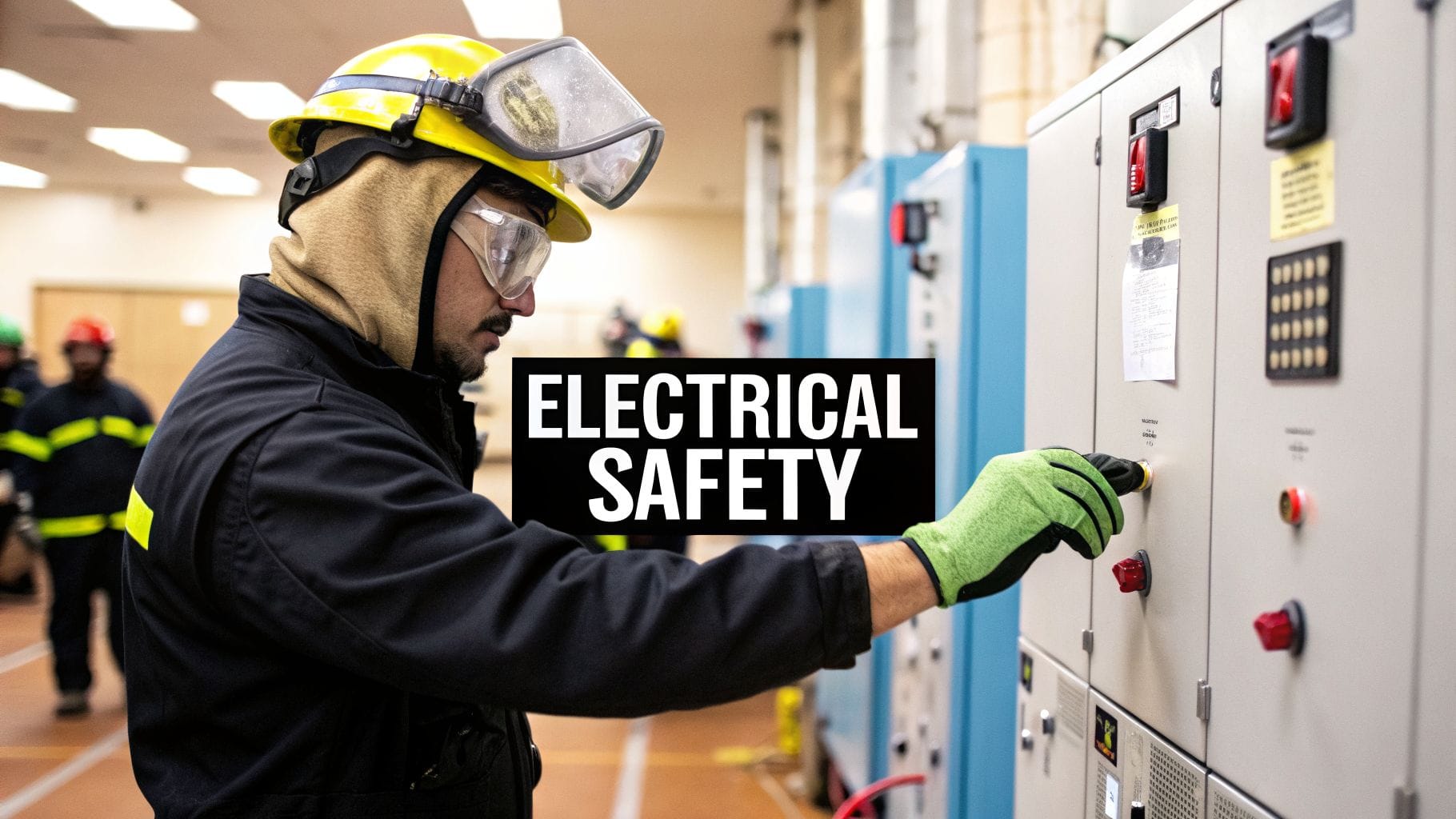
When it comes to workplace safety, neglecting electricity is a risk no business can afford to take. A well-designed electrical safety training for employees program isn't just a regulatory requirement; it’s a critical investment in your people, your productivity, and your company's future. Honestly, overlooking this essential step is one of the most expensive mistakes a business owner can make.
Why Comprehensive Electrical Safety Training Is a Must
It’s easy to look at safety training as just another line item on the budget. I get it. But shifting that view from an "expense" to an "essential pillar" of your company's success is the first real step toward building a business that’s not just productive, but resilient.
This is about more than just compliance. It’s about protecting your most valuable asset: your people.

The reality is, there's a huge gap between the safety protocols on paper and what employees actually experience. A staggering 29% of workers—that’s it—believe most companies provide adequate electrical safety training. That eye-opening stat comes from a 2023 global survey by Fluke Corporation, which also found that over 30% of workers consistently feel their training isn't good enough.
This isn't just a perception problem. It points to a systemic issue with real, painful consequences.
The Human Cost of Inadequate Training
Forget the numbers for a second and think about the human element. Every single electrical incident has the potential to alter a life forever. It doesn't just affect the employee; it hits their family and their community.
In fact, more than one-fifth of non-fatal electrical injuries at work are severe enough to cause 31 or more days of missed work. That tells you everything you need to know about how serious these events are.
The tough part is that most of them are preventable. Proper training gives people the skills to spot hazards, use safe work practices, and react correctly in an emergency. It turns them from passive observers into active guardians of their own safety and their colleagues'.
"The first thing I think of, as a former business owner, with electrical safety is the moral obligation to my employees to give them everything I can, training-wise, protective equipment–wise, the things they need to be able to do their jobs safely and go home to their families.” – Corey Hannahs, NFPA
The Financial Fallout Beyond the Fines
Sure, OSHA penalties for non-compliance can be steep. But honestly, they’re often just the tip of the iceberg. The financial ripple effect of a single electrical incident can snake through an organization in ways most business owners never see coming.
Think about the dominoes that fall:
- Operational Downtime: An unexpected equipment failure can bring production to a screeching halt. For some businesses, that's tens of thousands—or even millions—of dollars lost every hour.
- Skyrocketing Insurance Premiums: A poor safety record flags your business as a high risk. That means workers' comp and liability insurance costs can climb dramatically.
- Legal and Investigation Costs: The expenses tied to investigating an incident and dealing with potential litigation can be massive and drag on for years.
- Reputation Damage: A serious incident can tarnish your company's name, making it harder to attract good talent and keep the trust of your customers.
At the end of the day, a strong safety program isn't just "good practice"—it's good business. Investing in a solid program is a proactive move that pays you back in productivity, morale, and financial stability. To see how this fits into the bigger picture, it's worth exploring other essential employee safety training programs that build a foundation of safety. It all starts with a commitment to doing things the right way.
At Black Rhino Electric, we believe that commitment is non-negotiable. Building a true culture of safety begins by giving your team the knowledge and tools they need to work confidently and securely, every single day.
Building a Robust Electrical Safety Curriculum
A great electrical safety curriculum is built on a few non-negotiable pillars. These are the core topics that tackle the most severe and common risks your workers face, and they form the backbone of any training worth its salt. Let’s break down the "big three" that every single program needs to nail.

Mastering Arc Flash Safety Protocols
Have you ever really considered the raw power of an arc flash? It's a violent, explosive release of energy that can cause devastating burns, instant hearing loss, and serious injuries from flying shrapnel. Frankly, it’s one of the most terrifying electrical events possible.
Training on arc flash safety, guided by the NFPA 70E standard, is absolutely critical. This isn't just about theory; it's about practical survival skills. Your team has to learn how to:
- Identify arc flash hazards: This means understanding arc flash boundary zones and knowing how to read equipment labels correctly.
- Perform risk assessments: Before a job ever starts, workers need to assess the potential for an arc flash and take the right precautions.
- Understand energized work permits: Knowing when energized work is even allowed and following the strict protocols is a huge part of the process.
The data here is sobering. Arc flash incidents account for a staggering 77% of all electrical injuries in the United States, leading to thousands of injuries every year.
Implementing Proper Lockout/Tagout Procedures
When a machine is down for service, the absolute last thing you want is for it to be accidentally turned back on. That’s where Lockout/Tagout (LOTO) comes in. It's a life-saving practice designed to control hazardous energy.
LOTO procedures ensure equipment is properly shut off and can't be restarted until all maintenance or repair work is completely finished. The training needs to be hands-on, teaching employees the specific steps for their machinery. Watching a video isn't enough; they need to physically apply the locks and tags themselves.
There's a reason this area is getting so much attention from regulators. Recent reports show a 29% spike in OSHA citations for LOTO violations in a single year, jumping from 1,968 to 2,532.
A critical mistake is treating LOTO as a suggestion rather than a rigid, mandatory procedure. Every step, from notifying affected employees to verifying isolation, must be followed every single time. There are no shortcuts when a life is on the line.
Selecting and Using Personal Protective Equipment
Personal Protective Equipment (PPE) is the last line of defense against electrical hazards. But here’s the thing: it only works if employees use the right gear for the job and use it correctly.
Your training has to go beyond just handing out gloves and a hard hat. It needs to cover:
- Selection: How to choose the appropriate arc-rated (AR) clothing and other PPE based on the specific hazard level.
- Inspection: Teaching workers to inspect their gear for wear and tear before every single use. A tiny hole in a rubber glove can be a fatal flaw.
- Proper Use: Demonstrating how to correctly put on and take off PPE to avoid accidental contact with energized parts.
As you build out your curriculum, how you structure and deliver the content is just as important as what's in it. For a deep dive on structuring your materials, you can learn how to create comprehensive training manuals.
Core Modules for Your Electrical Safety Training
| Training Module | Primary Goal | Key Learning Objectives |
|---|---|---|
| Arc Flash Safety (NFPA 70E) | To prevent severe injury from electrical explosions by understanding and respecting arc flash boundaries. | Identify hazards, perform risk assessments, and understand energized work permit requirements. |
| Lockout/Tagout (LOTO) | To prevent accidental equipment startup during service by isolating all energy sources. | Apply locks/tags, verify de-energization, and follow specific machine shutdown procedures. |
| Personal Protective Equipment (PPE) | To provide a final barrier of protection against shock and arc flash hazards. | Select, inspect, and correctly use the appropriate arc-rated and voltage-rated gear. |
Beyond the Big Three: Other Essential Topics
While arc flash, LOTO, and PPE are the headliners, a truly complete curriculum doesn't stop there. You also need to cover safe work practices for both energized and de-energized equipment, plus the proper use of safety devices like Ground Fault Circuit Interrupters (GFCIs).
Finally, basic emergency response—including how to react to an electrical incident without becoming a second victim—can be the difference between a close call and a tragedy. When you weave these elements together with real-world scenarios, the training stops being a checklist item and becomes a skill set that protects your team day in and day out.
Trying to untangle the web of regulatory bodies gets confusing fast, so let’s make it simple. Think of it this way: The Occupational Safety and Health Administration (OSHA) tells you what you have to do, and the National Fire Protection Association (NFPA) shows you how to do it.
OSHA is the law. They're a federal agency that sets and enforces the rules, mandating that employers provide a workplace "free from recognized hazards." That's a legal requirement, plain and simple.
NFPA 70E, on the other hand, is a consensus standard. It's the practical, detailed playbook on how to build that safe workplace, outlining best practices for everything from risk assessments to choosing the right PPE. While OSHA doesn't enforce NFPA 70E directly, they lean on it heavily as the benchmark for what a safe electrical work environment looks like. Following NFPA 70E is widely considered the best way to meet your legal obligations under OSHA.
Understanding Key Concepts and Responsibilities
A huge part of compliance is just speaking the language. One of the most critical distinctions you'll find is between a "qualified" and an "unqualified" person.
Let me explain. An employee isn't qualified just because of their job title. According to OSHA, a qualified person is someone who has received specific, documented training on the equipment and hazards they’ll actually face. They can spot live parts, know the safe approach distances, and have the skills to avoid getting hurt. Everyone else is considered an unqualified person.
This distinction is crucial because it dictates the type and depth of training each person needs.
The buck stops with the employer. It's your duty to determine, document, and certify which of your employees are qualified to perform specific electrical tasks. This isn't just paperwork; it’s a cornerstone of your safety program.
To get a clearer picture of where you stand, a quick self-check can be revealing.
A Mini-Checklist for Compliance Readiness
Are you really meeting your obligations? Ask yourself these questions to spot potential gaps in your safety protocols:
- Written Safety Program: Do you have a documented Electrical Safety Program (ESP) as required by NFPA 70E?
- Employee Qualification: Is there a clear, written record identifying which employees are qualified for which specific tasks?
- Training Records: Are your training records current, detailing who was trained, on what topics, and when?
- Equipment Labeling: Is your gear—panelboards, switchgear—properly labeled with arc flash warnings?
- Regular Audits: Are you performing and documenting annual audits of your LOTO procedures and field audits of your ESP at least every three years?
This isn't an exhaustive list, but it hits the big-ticket items regulators look at first. If you answered "no" to any of these, it's a clear signal you have some work to do. Ignoring these requirements can lead to big fines and a much higher risk of someone getting hurt. It's always better to tackle these issues proactively than to face forced electrical code violation repairs after an incident or inspection.
| Regulatory Body | Role & Function | Key Requirement for Employers |
|---|---|---|
| OSHA | The Law. A U.S. federal agency that creates and enforces workplace safety regulations. | Provide a workplace free from recognized electrical hazards and document all employee training. |
| NFPA 70E | The "How-To" Guide. A consensus standard outlining safe work practices to protect workers. | Implement a comprehensive Electrical Safety Program (ESP) that includes risk assessments and job planning. |
At the end of the day, OSHA sets the destination (a safe workplace), and NFPA 70E provides the roadmap to get there. Trying to skip one or the other leaves your team and your business exposed. By embracing both, you build a safety culture that’s rooted in both legal compliance and proven best practices—the foundation of any responsible operation.
Finding the Right Training Format for Your Team
Choosing the right way to deliver your training is just as critical as picking the right topics. Let's be honest, a one-size-fits-all PowerPoint presentation rarely works. Every team learns differently, and every job site has its own unique quirks.
To make safety habits actually stick, you have to match the training format to how your crew works in the real world. The best programs don't just rely on one method. They blend different approaches to cover everything from the "why" behind the rules to the hands-on "how."
The Classic Classroom Approach
Old-school classroom training is fantastic for building a solid foundation. It’s an efficient way to get everyone on the same page with essential theory, go over regulatory standards like OSHA and NFPA 70E, and talk through your company's specific policies in a controlled setting.
This is where you explain the physics of an arc flash or the legal reasons behind lockout/tagout (LOTO) procedures. It's a great place for Q&A, making sure everyone starts with the same level of knowledge before they even think about touching a piece of equipment.
Hands-On Practical Simulations
But you can't learn to wire a panel by reading a book about it. The same goes for electrical safety. Hands-on training is where theory turns into muscle memory.
This is where your team takes what they learned in the classroom and puts it into practice. Imagine a crew is learning to install new EV chargers. After a classroom session, they'd move to a workshop to practice the installation on a de-energized setup, with an expert looking over their shoulder. This is where they get the feel for the tools and learn the flow of the process without any live risk.
Hands-on practice is the bridge between knowing what to do and knowing how to do it safely when the pressure is on. It’s a non-negotiable step for building real competence.
This type of learning lets employees make mistakes in a safe place—which is a whole lot better than learning from them out in the field.
On-The-Job Training (OJT)
On-the-job training is the final, most important piece of the puzzle. This is where employees, under the watchful eye of a seasoned supervisor, perform tasks in the actual work environment.
Here, everything comes together. OJT is incredibly powerful because it’s tailored to the exact equipment and situations your team faces every single day. For instance, a new maintenance tech might shadow a senior electrician during a live panel upgrade, helping with specific steps until they can do it themselves, safely and confidently. This mentorship is crucial for passing down not just technical skills, but the unwritten wisdom that only comes with years of experience.
Why a Blended Approach Wins
Here's the thing: the real magic happens when you combine all three methods. A blended approach uses the strengths of each format to create a layered, powerful learning experience. It ensures your employees don't just memorize rules but truly understand and can apply them when it counts.
A Comparison of Training Delivery Methods
| Training Format | Best For | Pros | Cons |
|---|---|---|---|
| Classroom Learning | Foundational knowledge, regulations, and safety theory. | Consistent delivery to large groups; controlled environment for Q&A. | Can lack engagement; doesn't build practical skills on its own. |
| Hands-On Simulation | Building practical skills and procedural muscle memory. | Safe practice without real-world risk; high knowledge retention. | Needs specialized equipment and space; can be costly to set up. |
| On-the-Job Training | Applying skills in a real-world context with mentorship. | Highly relevant and job-specific; builds confidence with real equipment. | Can slow down production; effectiveness depends on the mentor's quality. |
Ultimately, the goal isn't just to check a box. It's to make sure the training actually sticks. This means going beyond a written quiz and using practical evaluations where employees have to show you they can perform the task safely. That's how you confirm your team isn't just trained, but truly qualified for the job.
Putting Your Training Program into Action
Launching your training isn't a one-time event; it's the start of a continuous cycle. The real work starts when you roll it out. A well-designed plan is useless if it just sits there.
The goal is to shift from a "training event" mindset to a "safety culture" reality. This means setting up a realistic schedule, committing to regular refreshers, and keeping meticulous records that prove your dedication to keeping your people safe.
It helps to think about the process in stages—from learning the theory to proving you can do the work safely in the field.

True competence is built in layers. You can't just watch a video and be ready to work on live gear. It takes both classroom learning and real-world practice before those skills can be reliably assessed.
Establishing a Sustainable Training Schedule
A common mistake is cramming all the training into a single week and then forgetting about it for three years. A much better approach is to spread it out. You know what? This makes the information a lot easier to digest and actually remember.
Consider a schedule that includes:
- Initial Onboarding: All new hires get foundational electrical safety awareness training right away. No exceptions.
- Quarterly Safety Huddles: Short, focused meetings to review a specific topic, like a recent near-miss or how to inspect a new piece of PPE.
- Annual Core Training: A comprehensive review of key topics like Lockout/Tagout (LOTO) and arc flash safety for all relevant employees.
- Task-Specific Training: Scheduled just before a high-risk job, like working on a new type of switchgear for the first time.
This approach keeps safety top-of-mind all year round, not just during "training season."
The Critical Role of Refresher Courses
Why are refreshers so important? Because standards change, equipment gets updated, and skills get rusty. An employee who was trained on a specific panel three years ago might not be prepared for the upgraded model that was just installed last month.
Documentation isn't just about avoiding fines; it’s about creating a living record of your company's commitment to safety. It's your proof that you are actively protecting your people.
Regular refreshers are also required by standards like NFPA 70E, which generally mandates retraining at least every three years, or even more frequently if an employee's job duties change or new hazards are introduced.
Maintaining Meticulous Records for Compliance
If it isn't documented, it didn't happen. That’s the reality when an OSHA inspector shows up. Maintaining clear, organized training records is non-negotiable for compliance and liability protection. Your records should be simple but thorough.
Here is a sample template you can adapt to track your team's training progress.
| Employee Name | Training Date | Topics Covered | Instructor Name/Signature | Assessment Score |
|---|---|---|---|---|
| John Smith | 2024-10-26 | Arc Flash Safety (NFPA 70E), LOTO | Jane Doe | 95% |
| Maria Garcia | 2024-10-26 | Arc Flash Safety (NFPA 70E), LOTO | Jane Doe | 98% |
| David Chen | 2024-10-28 | PPE Selection & Inspection | Jane Doe | Pass (Practical) |
This ongoing process of training and documentation has a real-world impact. Targeted safety training is driving real reductions—31% fewer electrocution and electric shock reports in 2024 compared to 2023, according to the IPAF Global Safety Report 2025. This progress shows that a well-executed program is about a continuous process, not a one-and-done event.
Ultimately, a proactive approach to scheduling, refreshing, and documenting your program transforms safety from a requirement into a core business value. It shows your team you're invested in their well-being, which is the strongest foundation for a resilient safety culture.
Partnering with Experts for Onsite Training and Support
Crafting and managing an effective electrical safety program is a massive responsibility. You don't have to carry it alone. Bringing in a professional electrical contractor can bridge critical knowledge gaps and provide some serious peace of mind.
Onsite training is a game-changer. It brings expertise directly to your facility, tailored to your specific equipment, your unique risks, and your team's day-to-day reality.

Why Onsite Support Matters
Working with experienced electricians transforms training from a theoretical classroom exercise into a practical, real-world lesson. Whether you're managing a commercial facility in Salt Lake County or a new residential build in Weber County, customized training hits on the exact challenges your team faces.
The information is immediately relevant and applicable. It sticks.
A partnership with a dedicated electrical expert isn't just about outsourcing training; it’s about investing in a safety culture. It positions safety as a core operational value, showing your team their well-being is the top priority.
This commitment demonstrates that you see them not just as workers, but as your company’s most valuable asset. The team at Black Rhino Electric is passionate about this mission—you can see it in how we operate. Check out our commitment on the Black Rhino Electric about us page.
Common Questions About Electrical Safety Training
Navigating the rules for workplace safety can bring up a lot of questions. And when it comes to something as serious as electricity, you need clear, straightforward answers to build a program that actually works. Here are a few of the most common questions managers have when they start putting together their training.
How Often Do Employees Need Electrical Safety Training?
The honest answer: it really depends on an employee's role and how often they're near electrical hazards. According to both OSHA and NFPA 70E, there are two main groups to think about:
- Qualified Persons: These are your folks who work directly on or near exposed, energized equipment. They need comprehensive training when they're first assigned that role, and then retraining at least every three years. You'll also need to provide refresher training sooner if their job duties change, you bring in new technology, or if safety audits show they aren't following the rules.
- Unqualified Persons: This group includes employees who work near electrical hazards but not directly on them—think machine operators or even office staff. They need training to recognize and avoid those dangers, with refreshers provided as needed to keep their awareness sharp.
This tiered approach just makes sense. It ensures everyone has the right level of knowledge to stay safe doing their specific job.
What Is the Difference Between a Qualified and Unqualified Employee?
This distinction is absolutely critical, and it's a determination the employer has to make and document. OSHA defines a qualified person as someone who has received specific, documented training on the construction and operation of electrical equipment and the hazards involved. They have to demonstrate the skills to identify live parts and know the safe approach distances.
An unqualified person, on the other hand, simply hasn't received that specialized training. It's the employer's legal duty to assess, determine, and document who is qualified for which specific electrical tasks.
Do My Office Workers Need Electrical Safety Training?
Yes, absolutely—but the scope is completely different. They don't need the same in-depth technical training a field electrician gets, but they still need to understand the basic electrical hazards in their own environment.
This general awareness training for all staff is a key part of creating a real workplace safety culture. It makes sure that everyone, no matter their role, helps contribute to a safer environment.
This training should cover practical, everyday stuff. Things like identifying frayed cords, not overloading power strips, understanding how GFCIs in breakrooms work, and knowing the proper response to an electrical fire. You can find more helpful information by exploring our frequently asked questions.
At Black Rhino Electric, we believe that expert training is the foundation of a safe and productive workplace. To discuss your team's specific needs and build a culture of safety that truly works, give us a call at 385-396-7048 or request a free quote online.